
A LEED Accredited Professional (LEED AP) is someone who has passed an advanced LEED exam in a chosen specialty, proving they can apply the LEED rating system on real projects. It is the tier above LEED Green Associate, it requires an active Green Associate credential to sit, and it comes in five specialties — the most widely held being Building Design + Construction (BD+C).
USGBC
The United States Green Building Council is the world’s leading institution for administering and granting professional certificates in the field of green building. In its own words, USGBC “accelerates and scales the transformation of the built environment to minimize climate impacts and enhance the well-being of people, the environment, and communities worldwide.” The credentials themselves are administered by GBCI, USGBC’s certification body.
LEED provides a practicable system that ensures efficient, healthy, cost-saving, and reduced carbon emission buildings for people. LEED certification is globally accepted as it is widely recognized as a symbol of excellence, sustainability achievement, and leadership. Also, the world’s most popular green building rating system. If you are new to LEED entirely, start with what is LEED.
There are two different levels to upgrade your career in green building:
1. LEED Green Associate (LEED GA)
LEED Green Associate credential signifies that the holder has knowledge of green buildings and expertise in the LEED rating system and does not require any prerequisites to attend training or apply for the examination. Our full guide is in what is LEED Green Associate.
2. LEED Accredited Professional (LEED AP)
LEED Accredited Professional credential signifies that the holder has advanced knowledge of green buildings and expertise in the LEED rating system.The LEED AP places more emphasis on high-level knowledge of sustainable building concepts and even more on the practical. Attaining the USGBC LEED Accredited Professional credential demonstrates your dedication to gaining practical knowledge of green building, improving your career, and contributing to the green building awareness and movement.
What the LEED AP BD+C exam covers
The LEED AP BD+C exam is built around eight knowledge domains, each mapped to a LEED v5 credit category. The candidate handbook publishes the number of questions in each, which tells you exactly where the weight sits:
| Knowledge domain | Questions |
| Energy and Atmosphere | 18 |
| Materials and Resources | 13 |
| Indoor Environmental Quality | 13 |
| Sustainable Sites | 9 |
| Water Efficiency | 9 |
| Integrative Process, Planning and Assessments | 8 |
| Location and Transportation | 8 |
| LEED Process | 7 |
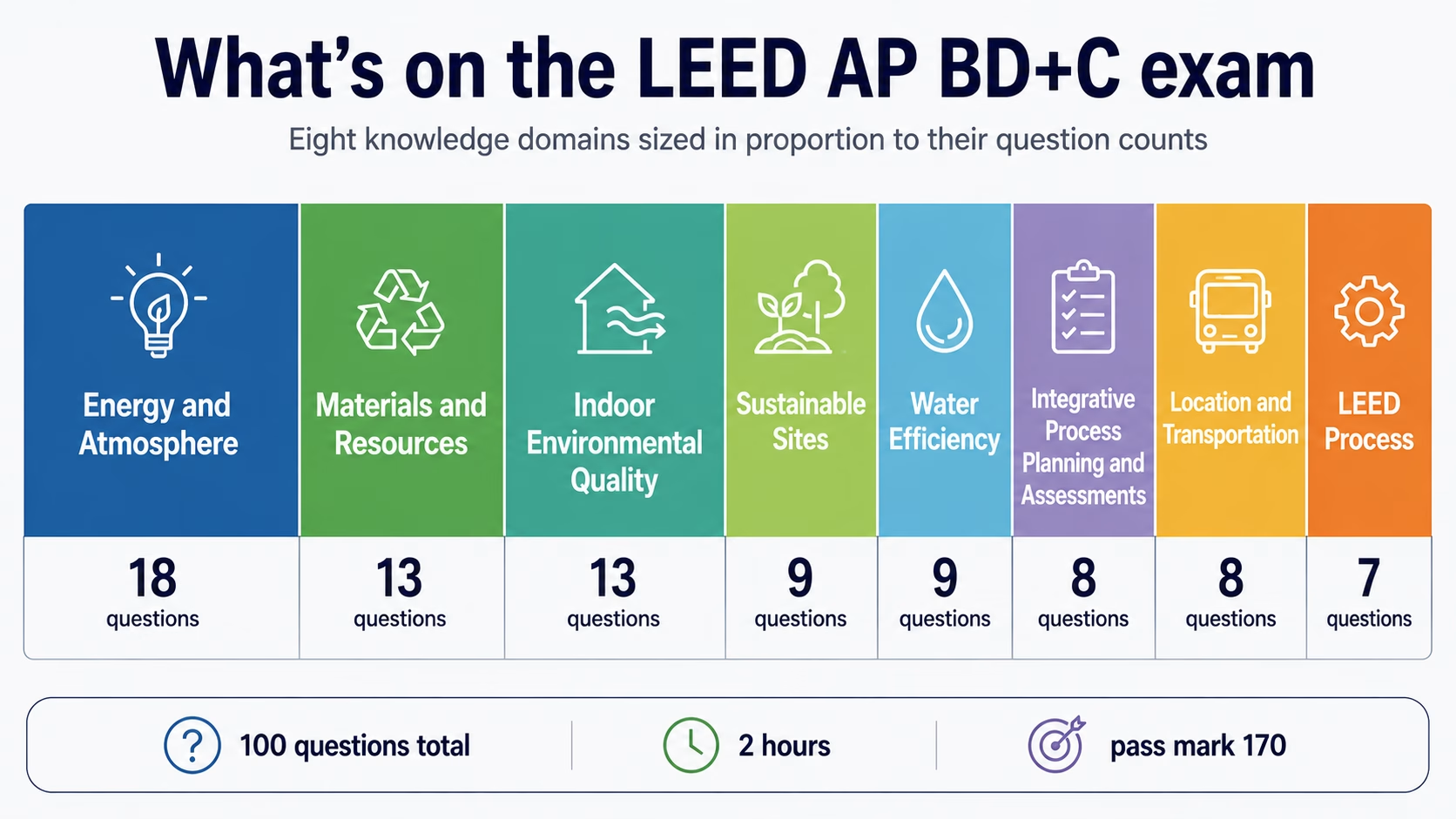
The exam is 100 multiple-choice questions in a 2-hour appointment, and you need a scaled score of 170 or higher to pass. It mixes scored and unscored questions distributed at random, so treat every question as if it counts. Each specialty has its own domain breakdown — the authoritative specification for all of them is the LEED AP with Specialty Candidate Handbook.
Prerequisites for the LEED AP
To become a LEED Accredited Professional, you must have achieved the LEED GA credentials. It is mandatory to have passed the LEED GA exam and the certification must be valid before you can proceed to write the LEED AP exam.
In full, the requirements are: be 18 years of age or older, hold an active LEED Green Associate credential at the point of registration (or an active LEED AP with specialty credential), and agree to GBCI’s disciplinary, exam appeals and credential maintenance policies. Prior LEED project experience is strongly recommended but is not an eligibility requirement — the exam does test practical project competency, so experience genuinely helps.
If you have not written the LEED GA examination you have the opportunity to write it alongside the LEED AP exam. This is the combined exam route, and registering for it waives the Green Associate prerequisite because you sit both parts in a single appointment. If you pass only one part you can retake just that part, and passing the Green Associate section earns you that credential.
Availability of the combined format depends on the specialty and on which rating-system version that exam is currently based, and it changes during a version transition. Always confirm what is available, and the appointment length, in the USGBC LEED Candidate Handbooks before you register.
It is recommended and important to have exposure to LEED and green building concepts through educational courses, or work experience before writing the exam.
LEED AP Specialty
There are five different specialty credentials in the LEED Accredited Professional, they are as follows:
- LEED AP BD+C (Building Design + Construction): Professionals with experience in the design and construction phases of green buildings for the commercial, residential, educational, and healthcare sectors should pursue this certificate.
- LEED AP ID+C (Interior Design + Construction): Professionals in the design, development, and improvement of commercial interiors and tenant spaces that provide a healthy, sustainable, and productive work environment will benefit from this certificate.
- LEED AP O+M (Operations + Maintenance): Professionals who apply sustainable practices, improve performance, increase efficiency, and reduce environmental impact in existing buildings through improved operations and maintenance earn this certificate.
- LEED AP ND (Neighborhood Development): Professionals involved in the planning, design, and development of sustainable, pedestrian-friendly neighborhoods can earn this certificate.
- LEED AP Homes: The LEED AP Homes accreditation is for professionals who work on designing and building healthy, long-lasting homes that use fewer resources and generate less waste. In the LEED for Homes rating system, the specialization represents practical knowledge.
Which specialties are based on LEED v5?
LEED v5 launched on 28 April 2025 and is the current rating system. It matters when choosing a specialty: LEED AP BD+C, LEED AP O+M and LEED AP ID+C are transitioning to LEED v5, while LEED AP Homes and LEED AP ND continue to be based on LEED v4. Because exam availability and format can shift during a transition, confirm the current position in the USGBC LEED Candidate Handbooks before registering, and read our LEED v5 guide for GA and AP candidates for what the change means for study.
What does the LEED AP exam cost?
Exam fees are set by USGBC and paid directly to them, separately from any training. There is a standard rate and a reduced rate for USGBC members, and the combined LEED GA and LEED AP exam is priced separately again. Because these are reviewed from time to time, always check the current fee on the USGBC website before you register rather than relying on a figure quoted elsewhere.
Retakes and keeping the credential
There is no cap on attempts, but after three unsuccessful attempts within a twelve-month period you must wait 90 calendar days before registering again, and the registration fee applies to each attempt.
Once earned, a LEED AP credential runs on a two-year cycle. You report 30 continuing education hours per cycle, of which 6 must be LEED-specific in your specialty. Hours can come from education, authorship, volunteering or project participation. Renewal fees apply and vary depending on whether you renew early, on time or late, and holding more than one AP specialty is charged once rather than per credential. There is a grace period after your renewal date, but once a credential expires it must be re-earned by re-taking the exam.
LEED AP or LEED Green Associate — which should you take?
Green Associate first, in almost every case: it has no prerequisites and it is required before you can sit a specialty exam. Go on to LEED AP if you work on LEED-registered projects, advise clients on credit strategy, or need the credential named on tender or role requirements. We compare the two side by side in the difference between LEED GA and LEED AP, and set out the full route in how to become a LEED Professional.
3FOLD TRAINING is a professional certification preparation institute operating since 2008, with more than 30,000 professionals trained across over 100 countries. We deliver LEED AP BD+C training — the Building Design and Construction specialty, which is the most widely held of the five. If you do not yet hold the Green Associate, the LEED GA and AP BD+C combo course covers both credentials in one programme, and LEED Green Associate training is available on its own. All course materials are written to LEED v5.
Talk to us through the course enquiry form, email, or WhatsApp.



Leave a Reply
Your email is safe with us.