
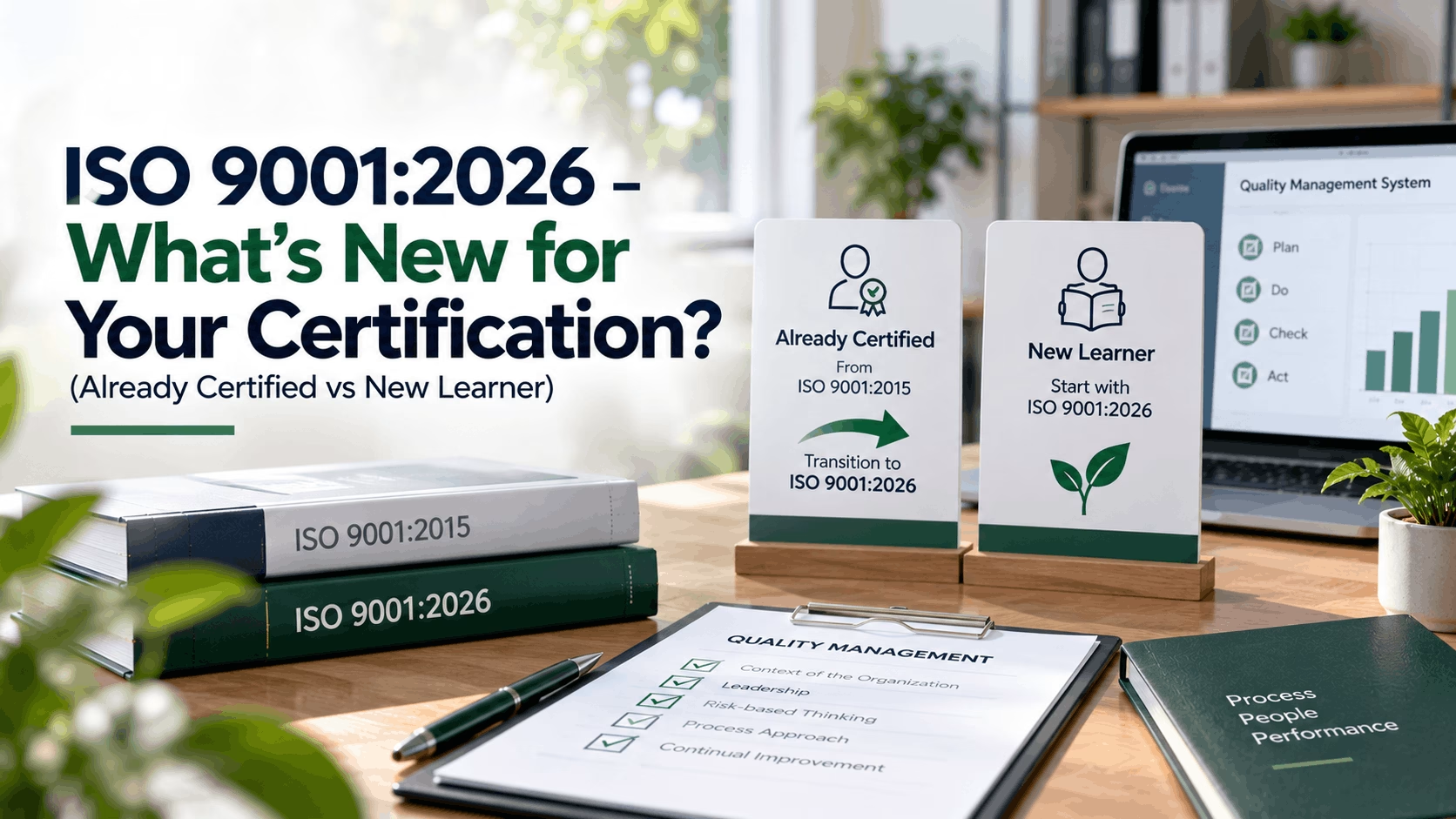
ISO 9001:2026 – What’s New for Your Certification?
ISO 9001:2026 was published on 16 September 2026. Whether you already hold an ISO 9001 auditor certificate or you're starting from scratch, here is what has changed and what it means for your personal certification path.
ISO 9001:2026 is here. Published on 16 September 2026, the new edition replaces ISO 9001:2015 as the quality management standard that individual auditors and QMS professionals are certified against.
Whether you already hold an ISO 9001:2015 auditor certificate or you're considering certification for the first time, this guide breaks down exactly what's changed and, more importantly, which certification path is right for you.
This practical guide from 3FOLD Training is written for two people: the already-certified professional who needs to update their credential, and the new learner who wants to get certified for the first time.
What is ISO 9001:2026?
ISO 9001:2026 is the latest edition of the ISO 9001 Quality Management Systems standard—the standard you are examined and certified against as an ISO 9001 Auditor or Lead Auditor. If your certificate currently references the 2015 edition, your certified knowledge needs to reflect the 2026 requirements going forward.
If you already studied ISO 9001:2015, the good news is that the core framework you learned remains familiar. ISO describes the revision as an evolution of the existing standard rather than a complete redesign—so your existing knowledge is not wasted, it just needs updating.
In simple terms: You do not need to relearn quality management from scratch. If you already hold an ISO 9001:2015 auditor certificate, the practical task is to understand the revised requirements and formally update your certification. If you're new, you can train directly on the 2026 edition from day one.
Why does it matter for your certification?
Certification bodies and employers expect auditors and QMS professionals to hold credentials that reflect the current edition of the standard. An ISO 9001:2015-based certificate does not automatically demonstrate competence against ISO 9001:2026.
The revision strengthens the relationship between quality management, leadership, culture, strategy, risks and opportunities—areas that a certified auditor is expected to be able to assess and explain with confidence.
What are the main ISO 9001:2026 changes?
1. Stronger focus on leadership and quality culture
Leadership remains essential, but ISO 9001:2026 gives greater attention to quality culture and ethical behaviour. As a certified auditor, you'll need to know how to evaluate these less tangible elements, not just check documented procedures.
Ask yourself: Could you confidently audit whether quality is genuinely part of how decisions are made, or would you only know how to check paperwork?
2. Stronger connection between quality and strategic direction
The revised standard makes the connection between the QMS and strategic direction clearer. A certified auditor now needs to be able to trace how strategic decisions relate to quality outcomes—a skill covered in updated Lead Auditor training.
3. Clearer treatment of risks and opportunities
Risk-based thinking was already part of ISO 9001:2015. ISO 9001:2026 provides clearer differentiation between managing risks and pursuing opportunities, and you'll be expected to distinguish between the two during an audit.
In practice, this means your audit questioning needs to go beyond “What could go wrong?” to also ask “What beneficial opportunity has been identified and acted on?”
4. More emphasis on people and awareness
The revised standard places greater emphasis on awareness, quality culture and ethical behaviour. A certified auditor needs updated interview techniques to assess whether employees genuinely understand how their work affects quality—not just whether training records exist.
5. New Annex A for clearer understanding
ISO 9001:2026 introduces a new Annex A to help users understand important concepts, terminology and the intent behind requirements. This is particularly useful for auditors, since consistent interpretation is exactly what certification exams and real audits test for.
6. Better alignment with other ISO management systems
The new edition uses the latest Harmonized Structure. For auditors who hold or are pursuing multiple ISO certifications (e.g. ISO 9001 and ISO 14001), this makes it easier to build integrated auditing skills across standards.
What has NOT changed?
It is just as important to understand what remains familiar, so you know what you don't need to relearn.
- Customer focus remains central.
- Process approach remains a foundation of the QMS.
- Risk-based thinking remains important.
- Continual improvement remains a core objective.
- Leadership involvement remains essential.
So, if you already hold an ISO 9001:2015 auditor certificate, updating to ISO 9001:2026 is not about starting from zero—it's a targeted update, not a full retrain.
Already certified? Here's what to do
If you already hold an ISO 9001:2015 Auditor or Lead Auditor certificate, you don't need to sit a full course again. What you need is a focused transition course that covers only what has changed—leadership and culture, strategic alignment, risks and opportunities, people and awareness, and the new Annex A—so your certification reflects the 2026 edition.
- Confirm which edition your current certificate references.
- Take a short, focused ISO 9001:2026 transition course rather than a full Lead Auditor course.
- Focus your study time on the six areas that changed, not the whole standard.
- Update your knowledge of the revised standard with an additional ISO 9001:2026 Revision & Awareness Certification.
3FOLD Training's ISO 9001:2026 Transition Training is built specifically for already-certified professionals—it's shorter than a first-time course and focuses only on what's new.
New to ISO 9001? Here's your path to certification
If you have never held an ISO 9001 auditor certificate, you don't need to learn the 2015 edition first. You can train directly on ISO 9001:2026 through a full Lead Auditor course, which builds your knowledge of the standard and your practical auditing skills from the current edition.
- Learn the ISO 9001:2026 requirements from the current edition—no need to unlearn anything later.
- Build practical audit skills: planning, evidence gathering, interviewing and reporting.
- Work toward a recognised Lead Auditor certification.
- Open the door to work as an internal auditor, external auditor or QMS consultant.
Explore 3FOLD Training's ISO 9001 Lead Auditor course to start your certification journey.
ISO 9001:2015 vs ISO 9001:2026 – At a Glance
| Area | ISO 9001:2015 | ISO 9001:2026 |
|---|---|---|
| Overall approach | Established QMS framework | Familiar framework with targeted updates |
| Leadership | Leadership responsibility | Greater focus on leadership, culture and accountability |
| Strategy | Context and policy support direction | Clearer strategic connection |
| Risks & opportunities | Risk-based thinking | Clearer treatment of risks and opportunities |
| People | Competence and awareness | Greater focus on awareness, culture and ethics |
| Guidance | Existing supporting guidance | New Annex A for clearer interpretation |
| Certification route | Full Lead Auditor course | Transition course (already certified) or full Lead Auditor course (new learners) |
Frequently Asked Questions About ISO 9001:2026 Certification
What is the new ISO 9001 version?
ISO 9001:2026 is the current edition, published on 16 September 2026. It replaces ISO 9001:2015 as the edition individuals are certified against.
I already hold an ISO 9001:2015 certificate. Do I need to start over?
No. You don't need a full course again. A focused ISO 9001:2026 Transition Training course covers only what's changed, so you can update your existing certification without retraining on the whole standard.
I've never been certified. Where do I start?
Start directly with a full ISO 9001:2026 Lead Auditor course. There's no need to learn the 2015 edition first—you can train on the current edition from the beginning and work toward your first certification.
What are the main ISO 9001:2026 changes I need to know for certification?
The key changes to study are: stronger emphasis on leadership and quality culture, clearer strategic alignment, clearer treatment of risks and opportunities, greater emphasis on people and awareness, the new Annex A, and closer alignment with other ISO management system standards.
How long does the transition training take compared to a full course?
Transition training is significantly shorter than a full Lead Auditor course because it only covers the areas that changed in the 2026 edition, rather than the entire standard and full auditing skillset.
ISO 9001:2026: What Should You Do Next?
The biggest mistake is treating ISO 9001:2026 as something to think about later. Certification bodies and employers increasingly expect current-edition knowledge, so the sooner your certificate reflects ISO 9001:2026, the better.
If you already hold an ISO 9001:2015 auditor certificate, your next step is ISO 9001:2026 Transition Training. If you are new to quality auditing, your next step is a full ISO 9001:2026 Lead Auditor course.
ISO 9001:2026 is an evolution of quality management—not a reason to start from zero.
Ready to update or start your certification? Explore 3FOLD Training's ISO 9001:2026 transition training and other Lead Auditor course.
Transition training
You also might be interested in

As most of you are preparing to take the PMP[...]
Introduction: If you must stay relevant in the market as[...]

The Chartered Quality Institute (CQI) The Chartered Quality Institute (CQI)[...]

Leave a Reply
Your email is safe with us.