
LEED AP BD+C Salary: What Is the Credential Actually Worth?
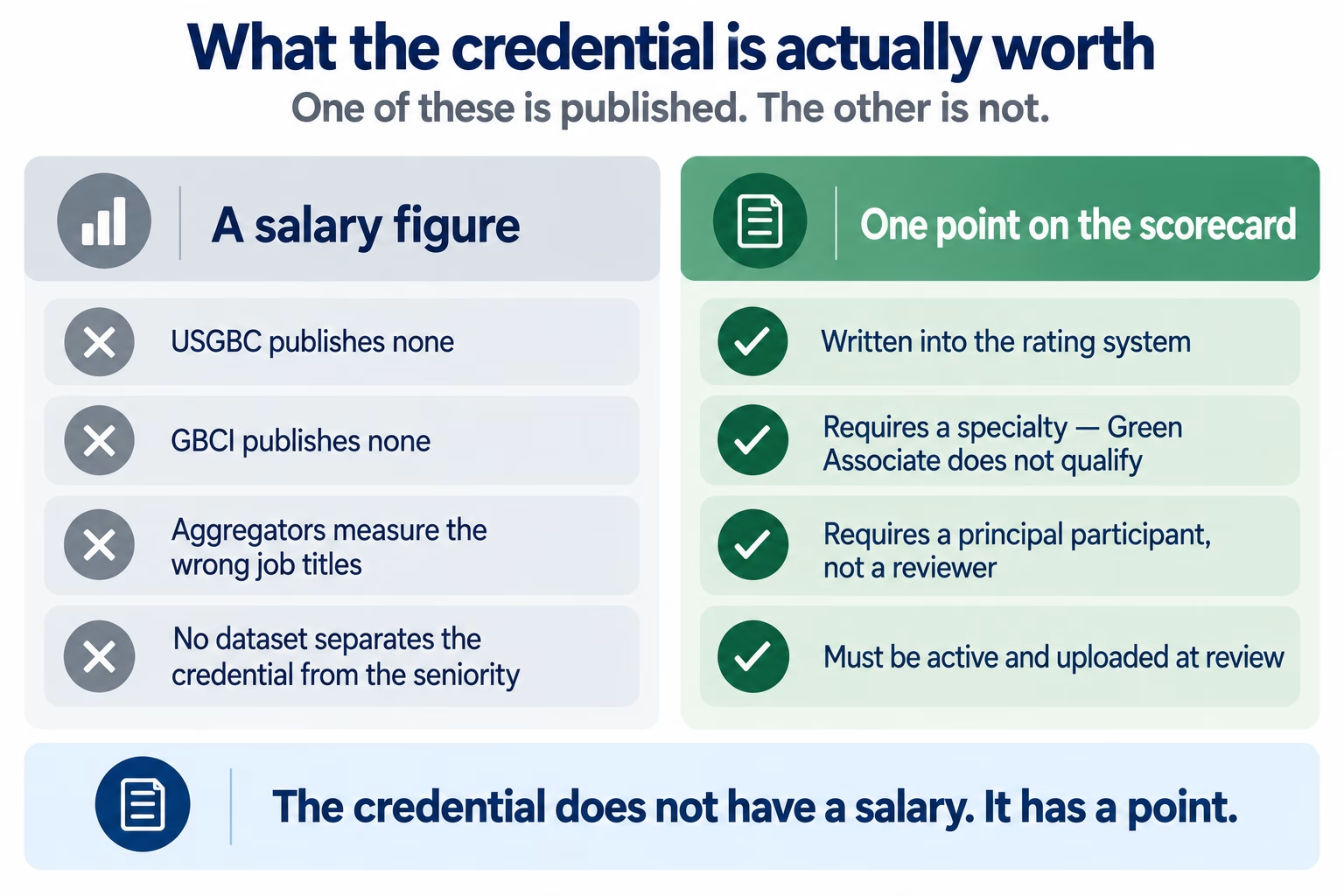
USGBC and GBCI do not publish a salary figure for LEED AP credential holders. Many of the figures that rank for this question are measuring something else. What is published is more useful: LEED v5 BD+C can award a project one point when the applicable LEED AP specialty requirement is met.
USGBC and GBCI publish no compensation data for credential holders, and many figures presented online measure employer salaries or specific job titles instead of the effect of the LEED AP credential itself.
USGBC and GBCI do not publish a salary figure for LEED AP credential holders. USGBC and GBCI publish no compensation data for credential holders, and many of the figures that rank for this question are measuring something else.
What is published — and rarely mentioned on pages about LEED AP pay — is that LEED v5 BD+C awards a project one point when at least one principal participant of the project team is a LEED AP with a specialty appropriate for the project. That is not a wage, but it is the clearest published statement of what the credential is worth to a project, and it explains more about what the credential does for you than any invented average.
Why the numbers you have found disagree
Search this question and the results conflict wildly. They are not disagreeing about the same thing. They are answering three different questions:
| What the page is measuring | Why it does not answer your question |
|---|---|
| Salaries paid by USGBC as an employer | Several high-ranking results are titled along the lines of “how much does the US Green Building Council pay”. That is the wages of people employed by USGBC — not what a credential holder earns anywhere else. |
| Aggregator estimates associated with particular job titles | These figures may be self-reported and may measure specific job titles rather than the LEED AP credential itself. A salary figure for a narrowly defined or uncommon title may not represent the broader market for LEED AP credential holders. |
| Real salaries for real roles that happen to mention LEED | The most useful of the three, and still not a credential figure. It measures what sustainability consultants or project architects earn, which is driven mostly by seniority, sector and country. |
None of the three isolates the credential. To do that you would need two otherwise identical people, one with the credential and one without, in the same role, in the same market.
The article does not identify a published dataset that isolates the effect of the LEED AP credential from other compensation factors. A reported salary difference would not, by itself, establish that the LEED AP credential caused the difference, because factors such as experience, role, sector and location may also affect compensation.
What we will not publish, and why
| Claim | Why not |
|---|---|
| A salary figure for LEED AP BD+C holders | Neither USGBC nor GBCI publishes compensation data. Aggregator numbers are self-reported and often attached to the wrong titles. |
| “LEED APs earn a premium of X” | No dataset separates the credential from the seniority and sector of the people who tend to hold it. |
| A payback period for the exam fee | It would require a salary uplift figure, which does not exist. |
| Named employers that require it | Requirements vary by role and change without notice. What can be said is which kinds of role ask for it — see LEED AP jobs. |
Refusing a number is only worth doing if something better replaces it. Here is the better thing.
The one number that is published
One LEED v5 BD+C point
LEED v5 BD+C awards one point when at least one principal participant of the project team is a LEED AP with a specialty appropriate for the project.
The conditions are exact:
| Condition | What it means for you |
|---|---|
| A principal participant | A key member of the project team, not an occasional reviewer. The point attaches to someone doing the work. |
| With a specialty appropriate to the project | For New Construction and Core and Shell, that is the Building Design and Construction specialty. LEED APs without a specialty do not qualify, and nor does LEED Green Associate — a decisive practical difference between the two credentials. |
| Qualifying LEED AP | At least one principal participant of the project team must hold a LEED AP specialty appropriate for the project. |
| Credential documentation | The LEED AP uploads a copy of the LEED AP certificate to the Credentials section in LEED Online so the system can identify the credential. |
Important: The point value and the credit's requirements are as taught in our LEED AP BD+C v5 course material and reflect LEED v5 BD+C. Confirm against the LEED v5 BD+C Rating System before relying on them for a live project.
Common eligibility or documentation issues include not having a qualifying principal participant, not meeting the appropriate specialty requirement, or not providing the required credential information in LEED Online.
Why that point is the real answer to the money question
One point does not sound like much until you look at what it is. It is a point tied to the qualification of a principal participant rather than to a specific product or design measure. Very few points on the scorecard work that way.
So the practical value of the credential is not a wage premium you can look up. It is this:
- On a project claiming this point, someone has to hold it. Not everyone, but someone, and they have to be a principal participant. That is a defined slot on a team.
- Being able to fill that slot changes which projects you can be staffed on, and which bids your employer can put you on the sheet for.
- It separates the two credentials where a project is counting. Green Associate demonstrates knowledge; the specialty credential is the one that can be claimed on the scorecard.
- For projects pursuing this point, the project team needs at least one principal participant who is a LEED AP with a specialty appropriate for the project.
What actually determines what you are paid
No dataset ranks these against each other for this population, so take them as the factors rather than as an order:
The one that moves the number most obviously, and it is not close between markets.
Developer, contractor, consultancy, design practice and government pay differently for the same nominal role.
Whether you run projects or work on them.
Energy modelling, life cycle assessment and commissioning are different skills from documentation coordination, and they are hired for differently.
It opens a door rather than setting a rate — and no dataset isolates what it does to pay.
It affects whether your CV survives a filter and whether you can be named on a project team. What you are paid once you are through the door is decided by the other factors.
The costs, honestly
There are several costs to consider, and only the first is obvious.
- The exam fee. Payable on every attempt — see LEED AP exam cost.
- Your time. Realistically several weeks — see how long to study for LEED AP for the factors that affect preparation time.
- Credential maintenance. Every two years. A LEED AP with Specialty reports 30 continuing education hours, at least 6 of them LEED-specific, against a Green Associate's 15 and 3.
The continuing education figures are set out in GBCI's Credential Maintenance Program guide rather than in the candidate handbook. The reporting period runs from your exam date to two years minus one day later — not from an anniversary.
Project participation can earn 1 CE hour per credit when the credential holder actively participates in an eligible LEED project and reports the activity appropriately.
One thing that surprises people
When you earn a LEED AP with specialty, the specialty credential supersedes your LEED Green Associate credential, so you no longer maintain the Green Associate separately. If you were expecting to hold both and list both, you were not.
For your CV: LEED AP BD+C is what you write, and Green Associate comes off.
On written confirmation you may use LEED AP BD+C after your name. Never write “LEED Accredited Professional”, and never “LEED Certified” — certification applies to buildings, never to people.
So is it worth the money?
The honest version: if you work on or want to work on LEED projects, yes, and the reason is the point rather than a pay rise.
If you do not, and you are hoping the credential itself moves a number, there is no evidence for that and we are not going to manufacture some. The fuller answer, including who should not sit it, is in is LEED AP BD+C worth it?
Frequently Asked Questions
What is the average LEED AP BD+C salary?
There is no published figure. Neither USGBC nor GBCI publishes compensation data for credential holders, and the aggregator estimates that rank for this question are often measuring either salaries paid by USGBC as an employer or job titles rather than the LEED AP credential itself.
Do LEED APs earn more than people without the credential?
No dataset supports a specific figure. Where a correlation exists it may reflect the seniority, sector and country of the people who tend to hold credentials rather than the credential itself. To isolate it you would need two otherwise identical people in the same role and market, one credentialed and one not.
What is the LEED AP credit worth on a project?
One point. LEED v5 BD+C awards a point where at least one principal participant of the project team is a LEED AP with a specialty appropriate for the project, which for New Construction and Core and Shell is Building Design and Construction. These figures are as taught in our own v5 course material; confirm against the LEED v5 BD+C Rating System before relying on them for a live project.
Does LEED Green Associate earn a project the LEED AP point?
No. The credit requires a LEED AP with a specialty. LEED APs without a specialty do not qualify either. That is a decisive practical difference between the two credentials: Green Associate demonstrates knowledge, and the specialty credential is the one a project can claim a point for.
How do project teams lose the LEED AP point?
Potential issues include not having a qualifying principal participant, not meeting the appropriate specialty requirement, or not providing the required LEED AP credential information in LEED Online.
Do I keep my LEED Green Associate after passing LEED AP?
No. The specialty credential supersedes LEED Green Associate: your Green Associate credential expires and is replaced, and you stop using it. On a CV that means LEED AP BD+C is what you write and Green Associate comes off. Never write LEED Accredited Professional, and never LEED Certified, which applies to buildings rather than people.
What does it cost to keep LEED AP BD+C?
Continuing education every two years: 30 CE hours for a LEED AP with Specialty, at least 6 of them LEED-specific, against 15 and 3 for a Green Associate. The reporting period runs from your exam date to two years minus one day later rather than from an anniversary.
Is LEED AP BD+C worth the money?
If you work on LEED projects or want to, the case is concrete: a project can earn a point when at least one principal participant is a LEED AP with a specialty appropriate for the project. If you are hoping the credential itself moves a salary number, there is no published evidence for that, and we would rather say so than invent a figure.
Deciding, without a number to decide on
3FOLD TRAINING has prepared professionals for certification exams since 2008, across more than 100 countries. If you want a straight answer about whether the credential fits what you actually do, describe your role through the course enquiry form and we will tell you — including when the answer is no.
Our LEED AP BD+C training is one route to the exam and no course is required to sit or pass it, ours included.
Considering LEED AP BD+C?
Explore the LEED AP (BD+C)® training, preparation support and course details from 3FOLD TRAINING.



Leave a reply