
How to Maintain Your LEED AP BD+C Credential
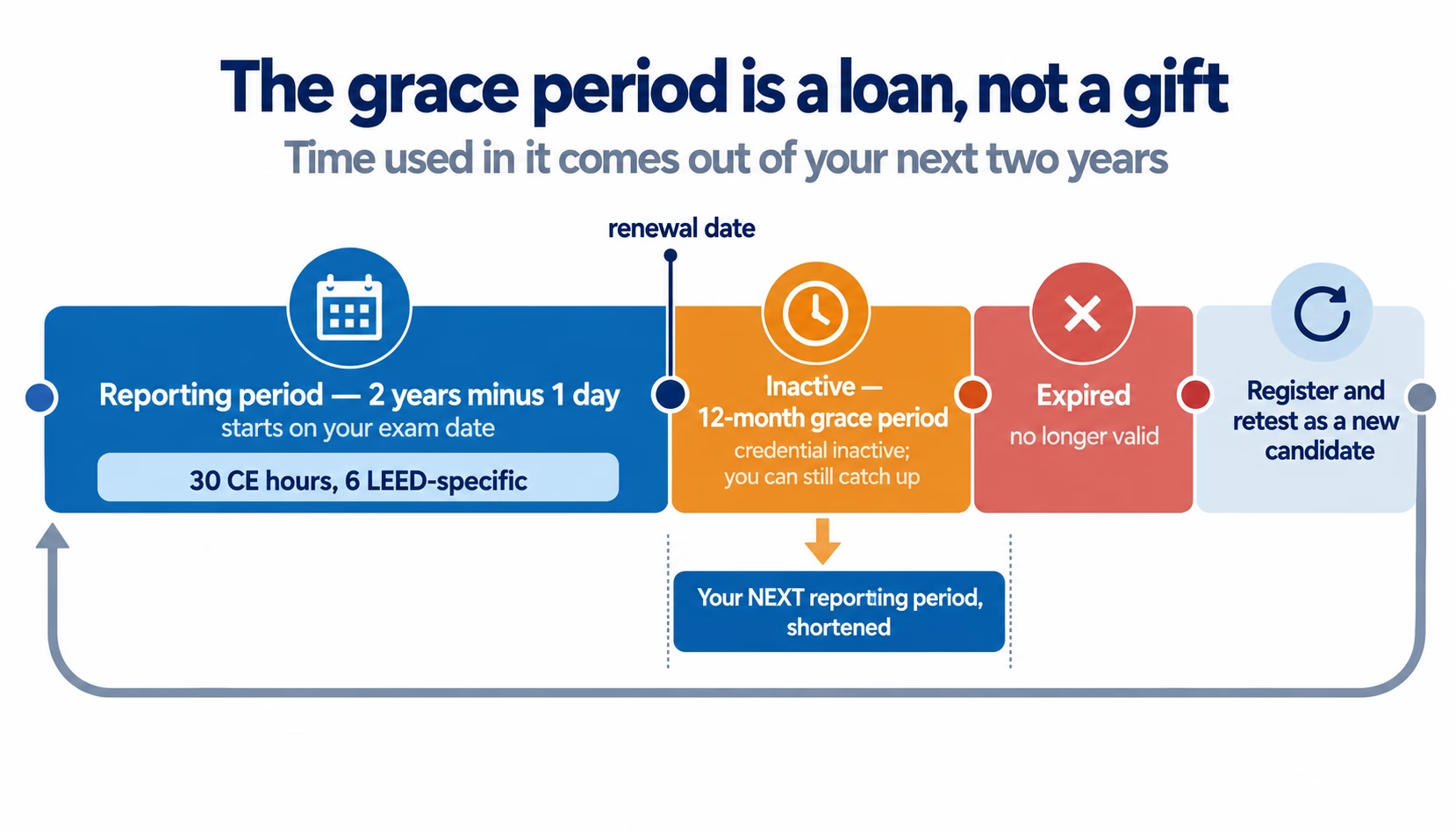
Thirty continuing education hours every two years, six of them LEED-specific — plus a credential renewal fee that varies depending on when you renew. That is the requirement, and it is not the part that catches people out. What catches people out is the clock: your reporting period starts when the credential is earned and runs for two years minus one day, and the twelve-month grace period after it is not free — whatever time you use during that period is taken from your next reporting period.
The requirement
| LEED AP with Specialty | LEED Green Associate | |
|---|---|---|
| CE hours per period | 30 | 15 |
| Of which LEED-specific | 6, in the specialty relevant to your credential | 3 |
| The remainder | 24 general or rating-system-specific hours | 12 (15 minus 3) |
| Period | Two years | Two years |
GBCI publishes the general / rating-system-specific split in its multiple-specialty worked example; the single-credential remainders above are that total minus the LEED-specific requirement.
The AP requirement is exactly double the Green Associate one, on both figures. If you already know the Green Associate rules, you know these — you just do twice as much of it.
The clock, which is where people go wrong
Your reporting period starts when the credential is earned — normally the date you passed the exam — and ends two years minus one day from that start date. For Legacy LEED AP holders who enrolled in a specialty credential without taking an exam, USGBC uses the enrollment date instead.
Two practical consequences:
- Find your start date now and put the end date in a calendar. It takes a minute, and you cannot miss a date you have never worked out.
- The last day is two years minus one day. Pass on 14 March 2026 and your period ends on 13 March 2028 — the day before the second anniversary, not the anniversary itself. That one day is the difference between renewing on time and starting the grace period.
What counts, and at what rate
Four activity types. The rates matter more than the list, because they decide which route is realistic for you.
| Activity | Rate | What it means in practice |
|---|---|---|
| Education courses | 1 CE hour per hour of educational contact time | Straightforward and slow. Thirty hours is thirty hours |
| Project participation | 1 CE hour per credit, on projects registered or certified for LEED | The rate that changes the arithmetic. It is per credit worked on, not per hour spent, so a practitioner accrues hours far faster than a reader does |
| Authorship | 3 CE hours per published article · 10 per published book | Slow to earn and worth knowing exists |
| Volunteering | 1 CE hour per hour of participation, capped at 50% of your total | For a LEED AP with one specialty that cap is 15 of the 30 hours. You cannot volunteer your way to the whole requirement |
Because the rate is per credit rather than per hour, someone working on LEED projects accrues hours without setting time aside for them. If you passed the exam and then did not use it, most of the thirty hours has to come from courses — volunteering can cover at most half, and authorship accrues slowly. That is a real cost to have not planned for.
What happens if you miss the date
This is the part worth reading carefully, because it is where the published rules are more consequential than they first appear.
| Stage | What is true |
|---|---|
| Reporting period ends without the hours | Your credential becomes inactive. It is not gone |
| The 12-month grace period | You can still earn and report the missing hours. But any time you use in the grace period reduces the length of your next reporting period — you do not get a fresh two years |
| Past 12 months | The credential is expired and no longer valid |
| Regaining an expired credential | You register and retest as a new candidate, and you are responsible for all applicable fees |
The grace period is a loan, not a gift. Any time you use in it reduces the length of your next reporting period — you do not get a fresh two years after catching up, so the catch-up that saves the credential makes the following cycle shorter. GBCI does not publish how the reduction is calculated, so do not plan on a particular amount; plan on not needing it.
And past twelve months, whatever you knew when you passed, you sit the exam again as a new candidate. That is a strong argument for the calendar reminder above.
Renewal is also a payment
Reporting your hours is not the whole of renewal. GBCI charges a biennial renewal fee, and the amount depends on when you pay relative to your renewal date — there is an early rate, an on-time rate and a higher late rate once you are into the grace period. Holders of more than one specialty pay a single flat rate rather than one per credential.
We are not printing the amounts here. Fees change, and this page would rather be right in a year than precise today — check the current figures with GBCI when you renew. The structural point stands whatever the numbers are: renewing early costs less than renewing late, and the cheapest moment is before your period ends.
Two things that surprise people
Your Green Associate hours do not come with you. Any CE hours earned as a LEED Green Associate are not transferred to a newly acquired LEED AP with Specialty credential. Separately, the specialty credential supersedes Green Associate: your Green Associate credential expires and is replaced. If you had been accumulating hours as a Green Associate and then passed the AP exam, you start again at zero on the AP requirement.
Reporting is auditable. GBCI reviews a percentage of credential holders' CMP reporting at regular intervals and reserves the right to conduct those reviews at any time. Holders have to provide documentation, and misstated or fraudulent reporting can result in a credential being revoked. Keep the evidence for what you report, as you go.
A maintenance plan that works
- Put your end date in a calendar today, and a reminder three months before it. Your start date is your exam or enrollment date.
- If you work on LEED projects, log credits as you go. One CE hour per credit means the record is worth keeping contemporaneously rather than reconstructing later — which is what you would need if GBCI selected your reporting for review.
- Book the six LEED-specific hours first. They are the only part of the total that must specifically be LEED-specific — the other 24 can be general or LEED-specific.
- Do not plan to volunteer your way there. The 50% cap puts a ceiling of 15 hours on that route if you hold one specialty, and higher only because the total is higher if you hold more.
- Renew before the period ends, not during the grace period. Cheaper, and it protects the full length of your next cycle.
If you hold more than one specialty, the arithmetic changes — see holding more than one LEED AP specialty. If you have not sat the exam yet, the credential itself is covered in what a LEED AP credential is.
Frequently asked questions
How many CE hours does a LEED AP BD+C need?
30 continuing education hours every two years, of which 6 must be LEED-specific in the specialty relevant to your credential. The other 24 may be general or rating-system-specific. That is exactly double the LEED Green Associate requirement of 15 hours with 3 LEED-specific. The figures are set out in GBCI's Credential Maintenance Program Guide rather than in the candidate handbook.
When does my LEED AP reporting period start and end?
It starts when the credential is earned — your exam date, or your enrollment date — and ends two years minus one day from that date. It is not tied to a calendar year. The minus one day is real: pass on 14 March 2026 and the period ends on 13 March 2028, the day before the second anniversary.
What happens if my LEED AP credential lapses?
Your credential becomes inactive and you enter a 12-month grace period in which you can still earn and report the missing hours. Beyond 12 months the credential is expired and no longer valid. To regain an expired LEED AP with Specialty credential, you must start the credential process from the beginning and retest for the LEED Green Associate credential. You are responsible for all applicable fees.
Is the LEED CMP grace period free?
No. Any time you use in the 12-month grace period reduces the length of your next reporting period, so you do not get a fresh two years after catching up. GBCI does not publish how the reduction is calculated. Treat the grace period as a loan against your next period rather than as a safety net.
What counts as a CE hour for LEED credential maintenance?
Four activity types. Education courses earn 1 CE hour per hour of contact time. Project participation on LEED-registered or certified projects earns 1 CE hour per credit worked on, regardless of hours spent. Authorship earns 3 hours per published article and 10 per published book. Volunteering earns 1 hour per hour but is capped at 50% of your total.
Can I meet the whole requirement by volunteering?
No. Volunteering is capped at 50% of your total CE hours, which for a LEED AP with Specialty means a ceiling of 15 of the 30 hours. The remaining 15 have to come from education, project participation or authorship, and 6 of your total must be LEED-specific in your specialty.
Do my LEED Green Associate CE hours transfer to LEED AP?
No. Any hours earned as a LEED Green Associate are not transferred to a newly acquired LEED AP with Specialty credential. The specialty credential also supersedes Green Associate, so the Green Associate credential expires and is replaced. You start at zero against the AP requirement.
Does GBCI check what I report for credential maintenance?
Yes. GBCI reviews a percentage of credential holders' CMP reporting at regular intervals and reserves the right to conduct those reviews at any time. Holders must provide documentation on request, and misstated or fraudulent reporting can result in a credential being revoked. Keep your evidence as you go rather than reconstructing it later.
Where the LEED-specific hours can come from
3FOLD TRAINING has prepared professionals for certification exams since 2008, across more than 100 countries. Our LEED AP BD+C training is written for candidates rather than for renewal, so if what you need is six LEED-specific hours, ask us what we would point you at before assuming it is a course — through the course enquiry form. Project participation earns one CE hour per credit worked on, regardless of hours spent, and no course is required — not to sit or pass the exam, and not to earn CE hours, ours included.
LEED AP BD+C Training
Prepare for the LEED AP BD+C Exam
Build a structured understanding of the LEED AP BD+C exam domains and prepare with training designed around the current exam requirements.
Explore LEED AP BD+C Training

Leave a reply