

Holding More Than One LEED AP Specialty: Rules and Renewal
A second specialty costs six extra hours a period, not another thirty — and it does not come with its own clock. The reporting period for a secondary credential follows your primary one, so everything renews together. That is a good deal lighter than it sounds, and it is still a permanent addition to a recurring obligation, which is the part worth thinking about before you register.
The arithmetic
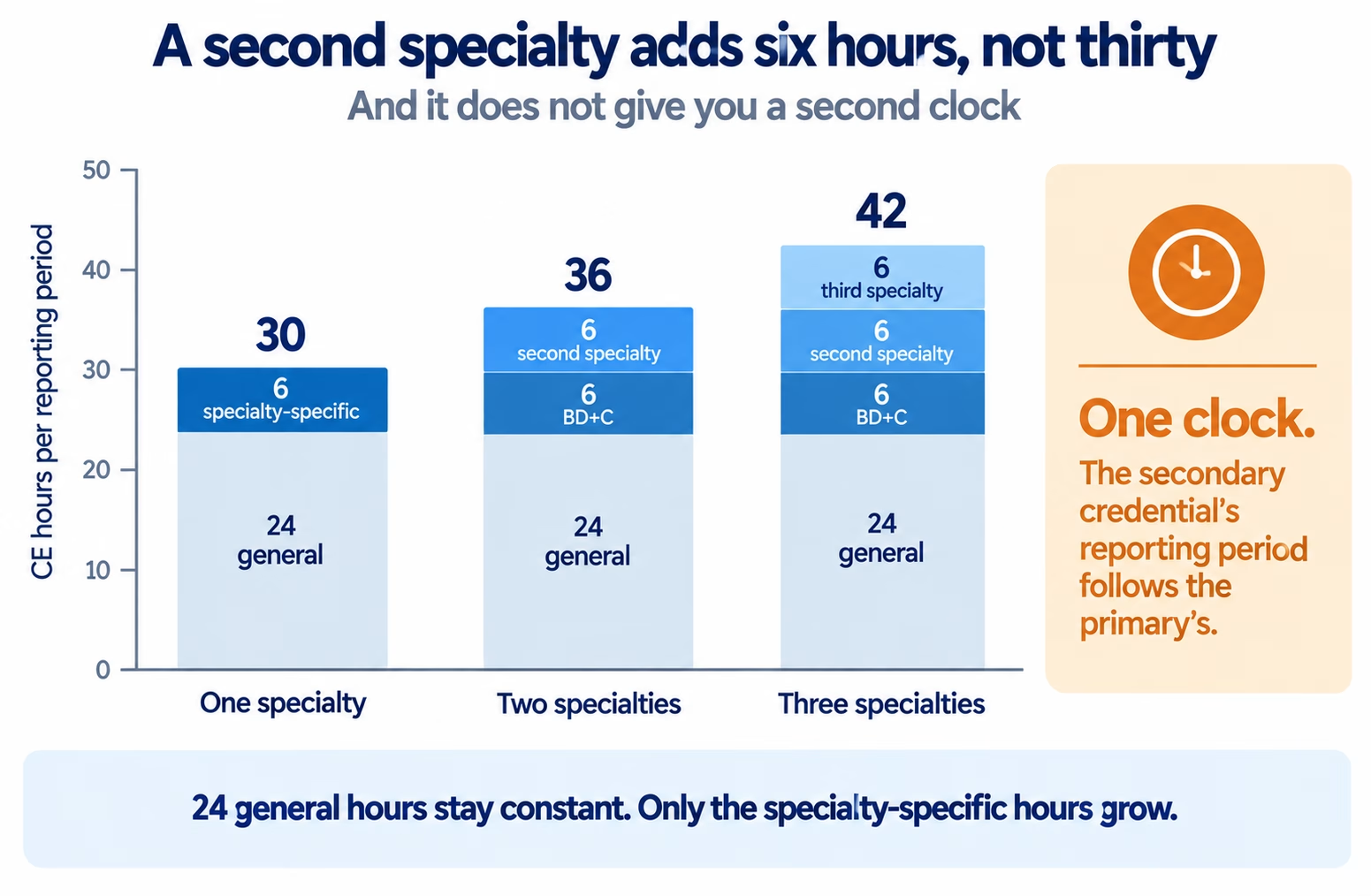
The rule is simple: a LEED AP with multiple specialties completes 6 additional LEED-specific CE hours per reporting period for each additional specialty. The general requirement does not move.
| What you hold | General or rating-system-specific | Specialty-specific | Total per period |
|---|---|---|---|
| One specialty | 24 | 6 | 30 |
| Two specialties | 24 | 6 + 6 | 36 |
| Three specialties | 24 | 6 + 6 + 6 | 42 |
GBCI publishes the two-specialty case as a worked example. The three-specialty row extends the same stated rule and is our arithmetic rather than a published figure.
The 24 general hours are constant. Only the specialty-specific block grows, and it grows by six each time. Someone holding BD+C and O+M owes 36 hours a period: 24 general, 6 BD+C-specific, 6 O+M-specific.
Two things follow that are worth being explicit about, because people assume the opposite:
- Two specialties do not mean 60 hours. They mean 36. The requirement is not doubled.
- Two specialties do not mean two renewals. There is one reporting period and one renewal, covering everything you hold.
One clock, and how it is set
The reporting period for your secondary credential remains the same as your primary credential. One cycle covers everything you hold — GBCI does not publish how it decides which credential is the primary one, so check your own dashboard rather than assuming.
There is a sensible adjustment for the period in which you add one: the requirement for a secondary specialty is prorated for the reporting period in which that specialty was earned. Earn a second specialty most of the way through a cycle and you do not owe a full six hours for the few months remaining.
From the following period onwards you owe all of it, every period, for as long as you hold the credential. That is the honest frame for the decision — not "six hours once", but "six hours every two years, indefinitely".
Renewal when you hold more than one
Renewal is a single payment covering everything you hold, not one payment per credential. GBCI charges a flat rate for holders of multiple specialty credentials — one payment, whatever you hold.
We are not printing amounts here, because fees change and this page would rather be right in a year than precise today. Check the current figures with GBCI when you renew. The structure is what matters for planning: one reporting period, one renewal, one flat rate.
Everything that applies to one specialty applies to all of them
The maintenance rules do not change shape when you add a credential. In particular:
| Rule | How it works with more than one |
|---|---|
| The period | Two years minus one day, running on your primary credential's cycle. One period, whatever you hold |
| The grace period | 12 months if you miss the date, and whatever you use of it shortens your next period. Your credentials share one reporting period and one renewal date |
| Expiry | Past 12 months the credential is no longer valid, and you register and retest as a new candidate to regain it |
| Volunteering cap | Still 50% of your total. At 36 hours the ceiling rises to 18; at 42 it is 21 |
| Project participation | Still 1 CE hour per credit on LEED-registered or certified projects |
| Auditing | GBCI reviews a percentage of reporting at regular intervals and reserves the right to review at any time. More credentials means more reporting to be able to evidence |
The grace-period rule is the one that stings hardest with two credentials, because your credentials share one reporting period and one renewal date, so there is a single date on which all of it turns on. The full mechanics are in how to maintain your LEED AP BD+C credential.
So should you add one?
Our answer on the credential itself has not changed: in our experience most people do not need a second specialty, and those who do can generally name the project that made them need it.
The rating system decides this rather than your job title. In LEED v5 BD+C, a project earns a point where at least one principal participant is a LEED AP with a specialty appropriate for the project — so a second specialty earns its keep when you have work of a second type that you will genuinely be a principal participant on. Check the equivalent provision in the rating system you would actually be working under, because we have verified this one and not the others.
The credit's requirements are as taught in our LEED AP BD+C v5 course material and reflect LEED v5 BD+C. Confirm against the LEED v5 BD+C Rating System before relying on them for a live project.
| Add one when | Do not add one when |
|---|---|
| Your work genuinely crosses two project types — an estates lead who commissions new buildings and then operates them is the clearest case | You are collecting credentials. Six hours a period, permanently, is the price of a line on a CV |
| There is a live project of the second type you will be a principal participant on | The second type is hypothetical. Add it when the project appears, not before |
| Your employer needs a second specialty holder it can name on bids | You are already struggling to make 30 hours a period |
The comparison of what each specialty covers is in LEED AP BD+C vs O+M vs ID+C, and the choice for a first specialty is in which LEED AP specialty should you choose.
One thing that is not additive
Green Associate does not stack with the AP CE requirement. Any CE hours earned as a LEED Green Associate are not transferred to a newly acquired LEED AP with Specialty credential. USGBC treats the Green Associate and LEED AP with Specialty as different credential programs with separate maintenance requirements, so once you earn the AP credential, you must earn new CE hours applicable to the AP requirement.
Frequently asked questions
How many CE hours do I need with two LEED AP specialties?
36 per reporting period: 24 general or rating-system-specific hours, plus 6 LEED-specific hours for each specialty. A LEED AP with multiple specialties completes 6 additional LEED-specific hours per period for each additional specialty, and the general requirement does not change. Two specialties do not mean 60 hours.
Do two LEED AP specialties have separate reporting periods?
No. The reporting period for a secondary credential remains the same as your primary credential, so there is one reporting period and one renewal covering everything you hold rather than a separate cycle for each.
What happens to the CE requirement in the period I earn a second specialty?
It is prorated. The requirement for a secondary specialty is prorated for the reporting period in which that specialty was earned, so earning one late in a cycle does not mean owing a full six hours for the few months remaining. From the following period onwards you owe the full amount for as long as you hold it.
Do I pay twice to renew two LEED AP specialties?
No. Renewal is a single payment covering everything you hold, and GBCI charges a flat rate for holders of multiple specialty credentials rather than one fee per credential. Check the current figure with GBCI when you renew.
Is a second LEED AP specialty worth it?
3FOLD's answer is usually not. In LEED v5 BD+C a project earns a point where a principal participant holds a specialty appropriate for the project, so a second specialty earns its keep when you have work of a second type you will genuinely be a principal participant on. Check the equivalent provision in whichever rating system you would be working under. The clearest case is a career that crosses design and operations. Otherwise it is six hours every two years, permanently, for a line on a CV.
Can I hold LEED Green Associate and LEED AP at the same time?
USGBC's current guidance does not state that earning a LEED AP with Specialty automatically expires or replaces an existing LEED Green Associate credential. What is clear is that the two credentials have separate maintenance requirements, and CE hours earned for the Green Associate are not transferred to the LEED AP requirement.
Does the volunteering cap change with more specialties?
The percentage does not, but the number does. Volunteering is capped at 50% of your total CE hours, so at 30 hours the ceiling is 15, at 36 it is 18 and at 42 it is 21. The specialty-specific hours still have to be specialty-specific, whichever activity type you earn them through.
What happens if I miss the renewal date holding two specialties?
Your credentials share one reporting period and one renewal date, so there is a single date that governs all of them. Missing it starts a 12-month grace period in which you can catch up, and whatever you use of that reduces the length of your next reporting period. Past 12 months a credential is expired, and regaining it means registering and retesting as a new candidate.
Which of these we can help with
3FOLD TRAINING has prepared professionals for certification exams since 2008, across more than 100 countries. We deliver LEED AP BD+C only — not Operations and Maintenance, Interior Design and Construction, Homes or ND — so if you are adding one of those you will need another provider, and we would rather say so than take the booking. If BD+C is the one you are adding, our LEED AP BD+C training is one route and no course is required to sit or pass the exam, ours included. Ask through the course enquiry form.
LEED AP BD+C Training
Prepare for the LEED AP BD+C Exam
Build a structured understanding of the LEED AP BD+C exam domains and prepare with training designed around the current exam requirements.
Explore LEED AP BD+C Training


Leave a reply