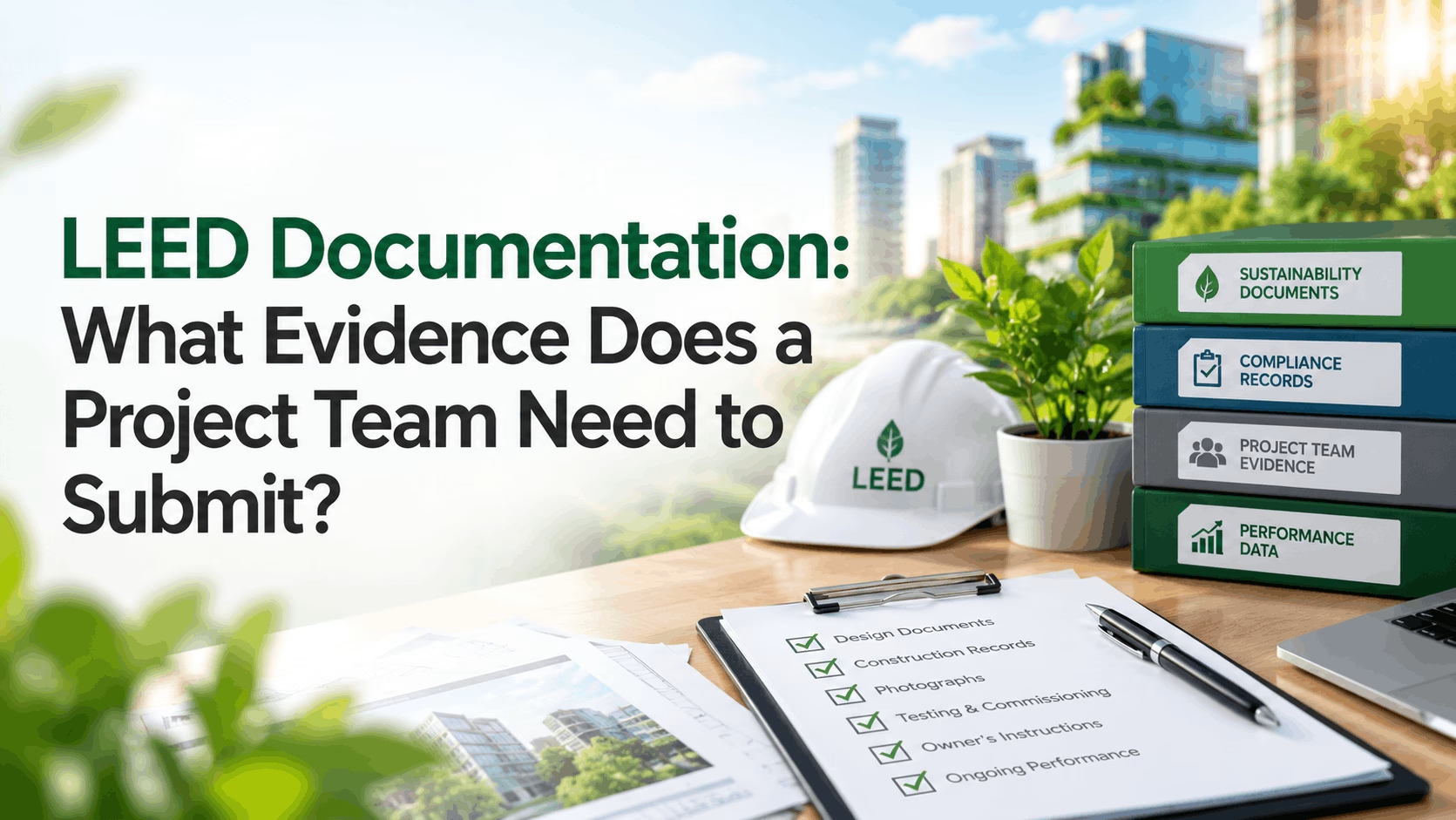
LEED Documentation: What Evidence Does a Project Team Need to Submit?
LEED certification is based on more than selecting credits. A project team must demonstrate compliance with the applicable requirements through the appropriate forms, calculations, narratives, drawings, reports and other supporting evidence. This guide explains what LEED documentation may include and how teams can organize evidence for a clear and consistent submission.
LEED Documentation Is the Evidence Behind the Credit
A LEED project does not earn certification simply because a team intends to achieve a credit. The project team must provide the information and documentation needed to demonstrate that the applicable requirements have been met.
According to USGBC guidance, documentation requirements are identified through the applicable LEED reference materials and credit forms. Depending on the prerequisite or credit, the evidence may involve calculations, drawings, narratives, reports, product information, records or other project-specific documentation.
For project teams, the goal is therefore not to collect as many files as possible. The goal is to provide the right evidence that directly demonstrates compliance.
1. What Is LEED Documentation?
LEED documentation is the information submitted by a project team to demonstrate how the project satisfies the requirements of the prerequisites and credits it is pursuing.
The documentation can include information entered directly into LEED credit forms as well as supporting files uploaded with the submission.
Project Information
Basic project information, areas, occupancy information and other data used across the certification submission.
Calculations
Calculations or spreadsheets used to demonstrate quantitative compliance with a requirement.
Drawings & Plans
Plans, diagrams or drawings that help demonstrate locations, layouts, systems or project conditions where required.
Reports & Records
Technical reports, project records, specifications, product documentation and other supporting evidence where applicable.
2. Why Does LEED Documentation Matter?
Documentation provides the basis for the review of a project's claimed achievement. It allows the review team to understand what the project did and how the submitted evidence demonstrates compliance.
USGBC guidance recommends that project teams collect information, perform the necessary calculations or analysis, and prepare documentation demonstrating achievement before submission.
If a project claims that it has achieved a particular LEED requirement, the submission should contain the appropriate information and evidence needed to support that claim.
Good documentation can also make the review process clearer because the reviewer can more easily identify the information that supports the applicable requirement.
3. What Evidence Might a Project Need?
The exact evidence varies by credit. Depending on the requirement, a project team may need one or more of the following:
| Type of Evidence | What It May Demonstrate |
|---|---|
| Credit forms | Required project information, calculations, declarations and compliance data. |
| Calculations | Quantitative compliance with thresholds, percentages, ratios or other requirements. |
| Plans and drawings | Project layouts, locations, systems, design features or other physical conditions. |
| Product documentation | Relevant product characteristics or attributes where required by the credit. |
| Specifications and records | Project requirements, purchasing information or implementation records. |
| Narratives | Explanations of special circumstances, unique conditions or information that needs clarification. |
| Technical reports | Detailed technical evidence such as energy analysis or other required studies. |
4. LEED Credit Forms: The Starting Point
Credit forms are one of the most important parts of LEED documentation. They help identify the information that the project team needs to provide for a particular prerequisite or credit.
USGBC explains that LEED credit forms outline required data inputs and what information should be provided. They therefore provide an important starting point when planning the project's documentation.
For LEED v5 projects, sample credit forms are available through Arc and can help project teams understand the information and documentation that may be needed during planning.
5. Calculations and Spreadsheets
Many LEED requirements involve measurable quantities. In those cases, calculations or spreadsheets may form an important part of the supporting evidence.
Depending on the credit, calculations may involve areas, quantities, percentages, energy use, water use, material costs or other project-specific data.
Calculations should also be consistent with the information entered elsewhere in the certification submission.
6. Drawings, Plans and Project Records
Drawings and plans may be relevant when the reviewer needs to verify the location, extent or design of a project feature.
Depending on the credit, supporting drawings may include floor plans, site plans, layouts, diagrams, elevations or other project records.
The purpose is not simply to upload drawings. The submitted material should help demonstrate the specific requirement being claimed.
A large drawing package does not automatically create stronger documentation. Provide the relevant information needed to demonstrate compliance and make the evidence easy to understand.
7. Product Data, Specifications and Project Records
Some LEED credits require project teams to demonstrate characteristics or attributes associated with products, materials, equipment or other project components.
Depending on the applicable requirement, evidence may include product information, specifications, purchasing records, invoices or other relevant project documentation.
The project team should make sure that the documentation actually corresponds to the products or materials being claimed and that the information supports the applicable LEED requirement.
8. Narratives and Explanations
A narrative can be useful when a project has special circumstances, unique conditions or information that needs clarification.
USGBC guidance specifically notes that additional materials such as narratives may be provided to explain special circumstances, unique conditions or clarify information.
It should make the submission easier to understand rather than replace documentation that the applicable credit specifically requires.
For example, if project information differs slightly between submissions because of a specific project condition, an explanation can help clarify the discrepancy.
9. Energy Simulation and Technical Reports
Certain LEED compliance paths can require detailed technical analysis. Energy-related requirements are a good example.
The LEED v5 Energy Simulation Report provides an example of the type of detailed technical information that can be relevant to an energy submission. Depending on the applicable requirements, documentation can include narrative information, descriptions of energy-efficiency measures, mandatory provision compliance, calculations, modeled inputs and outputs, renewable energy information and other simulation data.
| Technical Evidence | Possible Information Included |
|---|---|
| Energy model inputs | Building systems, schedules, envelope and equipment assumptions. |
| Energy outputs | Energy consumption, demand and other modeled results. |
| System information | HVAC, lighting, water heating and other relevant systems. |
| Renewable energy | Applicable renewable-energy inputs and outputs where relevant. |
The exact technical documentation depends on the applicable LEED requirements and compliance path.
Building LEED Knowledge Before You Work With Project Documentation
Understanding LEED documentation becomes much easier when you first understand how the LEED rating system is structured, how prerequisites and credits work, and how project teams demonstrate compliance.
For professionals preparing for a LEED credential, 3FOLD Training's LEED Green Associate and LEED AP training can help build a structured understanding of LEED concepts, terminology and the certification process.
The objective is not simply to memorize credit names. A strong understanding of the LEED framework helps professionals understand why documentation is collected and how project evidence relates to LEED requirements.
10. How LEED v5 Documentation Works in Arc
LEED v5 introduces a different project workflow from the LEED v4/v4.1 workflow. Current LEED v5 projects use Arc for project registration, credit forms, documentation and submission for review.
USGBC provides sample v5 credit forms through Arc. These forms help project teams understand the information and documentation that may be required before they finalize their submission.
- Identify the prerequisites and credits being pursued.
- Review the applicable requirements and sample credit forms.
- Collect the required project information and evidence.
- Complete the applicable credit forms.
- Upload the required supporting documentation.
- Review the submission for accuracy and consistency.
- Submit the project for review through Arc.
Because LEED v5 is currently available for BD+C, ID+C and O+M, teams should make sure they are working from the correct rating system and applicable documentation requirements.
11. How LEED v4/v4.1 Documentation Works in LEED Online
LEED v4 and v4.1 projects use LEED Online for their certification documentation and submission workflow.
The Credits page provides access to the applicable credit forms. Supporting documentation can then be uploaded as required by the relevant forms.
Before preparing documentation, confirm whether the project is using LEED v5 in Arc or LEED v4/v4.1 in LEED Online. The platform and workflow are not interchangeable.
For LEED Online submissions, USGBC provides guidance on supported file types and file uploads. Teams should also follow the platform's current requirements when preparing their files.
12. How to Organize Evidence by Credit
One of the easiest ways to create confusion is to collect project documents without organizing them around the actual LEED requirements.
A better approach is to organize the evidence around each prerequisite and credit being pursued.
Step 1: Identify the Requirement
Start with the applicable prerequisite or credit and understand exactly what must be demonstrated.
Step 2: Review the Form
Identify the information, calculations and supporting documentation requested by the applicable form.
Step 3: Collect Evidence
Gather the project records, calculations, plans, reports or other relevant evidence.
Step 4: Check Consistency
Verify that important project data is consistent across forms and supporting documents.
The question should be: "What requirement does this evidence demonstrate?" rather than simply "What documents do we have?"
13. Common LEED Documentation Mistakes
Documentation problems are not always caused by a lack of information. Sometimes the issue is that the evidence is inconsistent, unclear or not directly connected to the requirement.
| Common Problem | Better Practice |
|---|---|
| Submitting documents without checking them | Open and review every file before submission. |
| Using inconsistent project data | Cross-check common information such as floor area, occupancy and other key data. |
| Uploading unnecessary files | Submit relevant evidence that supports the applicable requirement. |
| Missing required documentation | Use the applicable credit form and reference materials as a documentation checklist. |
| Unexplained discrepancies | Provide an appropriate explanation where differences need clarification. |
| Waiting until the end to collect evidence | Plan documentation requirements early in the project process. |
14. LEED Documentation QA/QC Checklist
USGBC recommends a rigorous quality check before submission. A final review can help identify missing information, incorrect files and inconsistent project data.
15. Step-by-Step LEED Documentation Process
- Confirm the LEED rating system and version. Make sure the team is using the correct requirements and platform.
- Identify the targeted prerequisites and credits. Determine which requirements the project intends to pursue.
- Review the applicable credit forms and guidance. Understand what information and documentation will be required.
- Assign documentation responsibilities. Make sure the appropriate team members know what information they need to provide.
- Collect evidence during the project. Do not wait until the final submission to start searching for project records.
- Complete the applicable forms. Enter the required information and calculations carefully.
- Upload supporting evidence. Provide the required documentation through the applicable platform.
- Perform QA/QC. Check files, calculations, consistency and completeness.
- Submit for review. Once the team is satisfied that the documentation accurately demonstrates compliance, submit the project through the applicable certification platform.
16. How 3FOLD Training Can Help You Understand LEED
LEED documentation is easier to understand when professionals first have a clear foundation in the LEED rating system, prerequisites, credits, categories and certification process.
3FOLD Training's LEED Green Associate and LEED AP training is designed to help professionals build their understanding of LEED concepts and the certification framework.
This knowledge can be particularly useful for professionals who work with project teams, sustainability documentation, design coordination, construction activities or green-building requirements and need to understand how LEED requirements translate into project evidence.
Understand LEED Concepts
Build a structured understanding of LEED terminology, categories, prerequisites and credits.
Understand the Certification Process
Learn how LEED requirements connect with project planning, documentation and certification.
Prepare for a LEED Credential
Develop the knowledge foundation needed when preparing for the LEED Green Associate or LEED AP credential.
Apply the Knowledge Professionally
Use your LEED knowledge more effectively when communicating with project teams and sustainability professionals.
Visit 3FOLD Training's LEED Green Associate & LEED AP page to learn more about the available training options.
17. Key Takeaways
Frequently Asked Questions About LEED Documentation
What is LEED documentation?
LEED documentation is the information and supporting evidence a project team provides to demonstrate compliance with the applicable prerequisites and credits. Depending on the requirement, this may include credit forms, calculations, drawings, narratives, reports, product information and project records.
Does every LEED credit require the same documentation?
No. Documentation requirements are specific to the applicable prerequisite or credit. The project team should review the relevant LEED reference materials and credit form to determine what evidence is required.
What types of evidence can a LEED project submit?
Depending on the requirement, evidence may include credit forms, calculations, spreadsheets, drawings, plans, specifications, product information, project records, narratives and technical reports. The exact evidence depends on the credit and compliance path.
Are calculations required for LEED credits?
Some LEED requirements involve quantitative thresholds and therefore require calculations or other quantitative evidence. However, calculations are not automatically required for every credit. The applicable credit requirements determine what must be provided.
Can a narrative be used to explain a project condition?
Yes. USGBC guidance indicates that additional materials such as narratives may be used to explain special circumstances, unique conditions or clarify information. A narrative should support the submission and should not be assumed to replace evidence specifically required by the applicable credit.
Where are LEED v5 credit forms and documentation submitted?
Current LEED v5 projects use Arc for project registration, credit forms, uploading documentation and submission for review. USGBC also provides sample v5 credit forms through Arc.
Where are LEED v4 and v4.1 credit forms submitted?
LEED v4 and v4.1 projects use LEED Online for their credit forms and supporting documentation workflow.
Should project information be consistent across LEED documentation?
Yes. USGBC recommends consistency in reported information such as project areas and other common data points. Where small differences exist, the project team should provide an appropriate explanation for the discrepancy.
What should a project team do before submitting LEED documentation?
The team should perform a thorough QA/QC review. Check the completed forms, open the uploaded files, verify that the correct documents have been attached, confirm calculations and cross-check common project information for consistency.
Can 3FOLD Training help me understand LEED documentation and certification?
3FOLD Training provides LEED Green Associate and LEED AP training designed to help professionals understand LEED concepts, terminology and the certification framework. If you are considering a LEED credential or want to strengthen your understanding of LEED, you can review the 3FOLD LEED training options or contact the team for guidance.
Looking to Build Your LEED Knowledge?
Whether you are preparing for the LEED Green Associate credential, LEED AP, or simply want to understand the LEED certification process better, having a strong foundation in the rating system can make the requirements easier to understand.
Explore 3FOLD Training's LEED Green Associate & LEED AP training →
📞 +971 4 577 6146 | +971 50 481 9989




Leave a Reply
Your email is safe with us.