
• Home
  • About Us
  • AACE
    • CCP Exam Preparation
  • ASQ
    • CMQ/OE Exam Preparation
    • CSSGB Exam Preparation
    • CSSBB Exam Preparation
  • IRCA
    • ISO 9001 QMS Lead Auditor
    • ISO 14001 EMS Lead Auditor
    • ISO 27001 ISMS Lead Auditor
    • ISO 45001 OHSMS Lead Auditor
  • Transition
    • ISO 9001:2026 QMS Transition Training
    • ISO 14001:2026 EMS Transition Training
  • PMI
    • PMP Exam Preparation
  • GBCI
    • LEED GA Exam Preparation
    • LEED AP (BD+C) Exam Preparation
    • LEED Combo (GA + AP) Exam Preparation
  • Course Calendar
  • Articles
  • Webinar
  • Testimonials
  • Contact us
Community Join 3FOLD Training Schedules on WhatsApp — get every course batch update first 3FOLD Training Schedules on WhatsApp Join now

Call or WhatsApp: UAE 971.50.4819989 | India 91.9176257536

online@3foldtraining.com
WhatsApp
3FOLD Training3FOLD Training
  • Home
  • About Us
  • AACE
    • CCP Exam Preparation
  • ASQ
    • CMQ/OE Exam Preparation
    • CSSGB Exam Preparation
    • CSSBB Exam Preparation
  • IRCA
    • ISO 9001 QMS Lead Auditor
    • ISO 14001 EMS Lead Auditor
    • ISO 27001 ISMS Lead Auditor
    • ISO 45001 OHSMS Lead Auditor
  • Transition
    • ISO 9001:2026 QMS Transition Training
    • ISO 14001:2026 EMS Transition Training
  • PMI
    • PMP Exam Preparation
  • GBCI
    • LEED GA Exam Preparation
    • LEED AP (BD+C) Exam Preparation
    • LEED Combo (GA + AP) Exam Preparation
  • Course Calendar
  • Articles
  • Webinar
  • Testimonials
  • Contact us
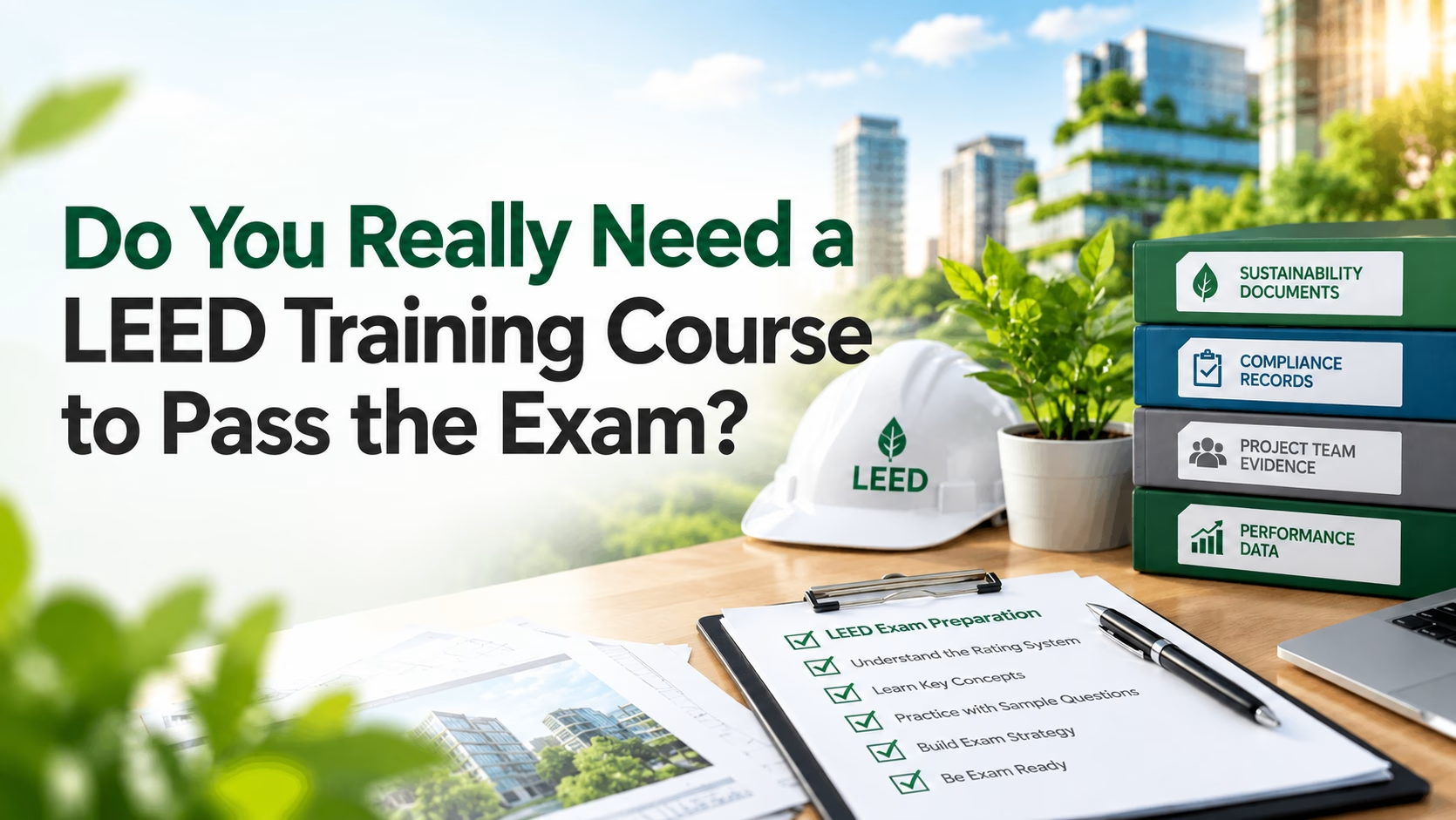
Do You Really Need a LEED Training Course to Pass the Exam?

Do You Really Need a LEED Training Course to Pass the Exam?

September 16, 2026 Posted by Krishnendu Omanakuttan LEED, LEED AP, LEED GA, USGBC No comments
LEED Exam Prep Guide

Do You Really Need a LEED Training Course to Pass the Exam?

Some candidates pass the LEED Green Associate or LEED AP exam after weeks of self-study. Others struggle even after months of reading on their own. The difference usually isn't effort, it's structure. This guide looks honestly at self-study versus a structured LEED training course, so you can decide which approach fits how you actually learn.

A practical look at LEED Green Associate and LEED AP exam preparation
Self-Study Flexible, Unstructured
Structured Training Guided, Sequenced
Practice Exams Applied Understanding
Instructor Access Clarify Difficult Topics

The Real Question Isn't "Can You Pass Without a Course"

Technically, no exam requires a candidate to take a training course first. The LEED Green Associate and LEED AP exams are open to anyone who meets the eligibility requirements and is willing to prepare on their own.

So the honest question isn't whether a course is mandatory. It's whether self-study alone gives you the structure, feedback and practice you need to prepare efficiently, or whether a guided course would get you there with less wasted time and fewer false starts.

Important: This article isn't here to tell you that self-study never works. It works for some people. The goal is to help you evaluate honestly which approach suits your schedule, learning style and current familiarity with LEED.

Table of Contents

  • Self-Study vs Structured Training: What's the Real Difference?
  • Understanding LEED Concepts vs Memorizing Credits
  • What Study Materials Do You Actually Need?
  • Why Practice Questions and Mock Exams Matter
  • The Value of Having an Instructor
  • Studying for LEED While Working Full-Time
  • Signs a Structured Course Would Help You
  • Signs Self-Study Could Work for You
  • How 3FOLD Training's LEED Program Works
  • Key Takeaways
  • Frequently Asked Questions

1. Self-Study vs Structured Training: What's the Real Difference?

Self-study means working through the reference guide, candidate handbook and whatever materials you find on your own, at your own pace, with no fixed schedule and no one checking whether you actually understood a topic before moving on.

Structured training adds a sequence, a pace and a feedback loop. A course typically breaks the syllabus into a logical order, tells you what to focus on and when, and gives you a way to check whether you're actually retaining the material rather than just reading it.

Self-StudyStructured Training Course
You decide the order and pace, which can work well or lead to procrastination.A set sequence and schedule keep you moving through the syllabus.
No one confirms whether you actually understood a concept.An instructor and practice checkpoints surface gaps early.
Lower upfront cost, but a failed attempt costs time and a retake fee.Upfront investment, often offset by a shorter, more efficient prep period.
Works well if you already have construction or design experience.Helpful for candidates newer to green building concepts.
Neither option is automatically "better." The right choice depends on how much unstructured study time you actually have, how disciplined you are about sticking to a plan, and how familiar you already are with the LEED framework.

2. Understanding LEED Concepts vs Memorizing Credits

One of the most common mistakes candidates make is treating LEED exam prep as a memorization exercise. They try to remember credit names, point values and category totals without understanding why the rating system is structured the way it is.

The exam is designed to test whether you understand how LEED works conceptually, not whether you can recite a list. Questions are often scenario-based, asking you to apply a concept to a situation rather than simply recall a fact.

A useful shift in mindset: Instead of asking "what credit is this," ask "why does this category exist, and what problem is it trying to solve." That framing tends to make the individual credits easier to remember, not harder.

This is one area where a structured course often adds real value. An instructor can walk through the logic behind a category or credit, rather than leaving you to infer it from a dense reference guide on your own.

3. What Study Materials Do You Actually Need?

Candidates sometimes assume they need to buy every available book, guide and practice-question bank on the market. In reality, the useful materials fall into a few clear categories.

Candidate Handbook

Defines exam eligibility, structure, scoring and policies. Essential reading before you plan a study schedule.

Reference Guide

The core technical content behind the rating system. Dense, but the foundation for understanding credits and categories.

Structured Study Notes

Condensed, organized material that summarizes key concepts in a more digestible sequence than the full reference guide.

Practice Questions

Scenario-based questions that mirror the style and difficulty of the actual exam, used to test applied understanding.

More materials isn't automatically better. Collecting five different study guides can create confusion if they're not organized around the same structure. It's usually more effective to work through one well-organized set of materials thoroughly than to skim several.

4. Why Practice Questions and Mock Exams Matter

Reading about LEED and being tested on LEED are two different skills. Practice questions and full-length mock exams help bridge that gap by forcing you to apply what you've read under exam-like conditions.

Mock exams are also useful for identifying weak areas. A candidate might feel confident after reading a chapter, only to discover through practice questions that they misunderstood a key concept.

A practical approach: Use practice questions throughout your preparation, not just at the end. Reviewing why an answer is correct, or why a wrong answer is wrong, often teaches you more than the initial reading did.

Timed, full-length mock exams closer to your test date also help with pacing, so the real exam's time pressure isn't something you're experiencing for the first time on exam day.

5. The Value of Having an Instructor

Self-study materials, however well written, can't answer a follow-up question. If a candidate misunderstands a concept while reading alone, that misunderstanding can go uncorrected until it shows up as a wrong answer on the exam.

An instructor changes that dynamic. Difficult topics, such as how categories interact or how a specific compliance path works, can be clarified in real time rather than left as an open question.

Where instructors tend to add the most value:
  • Explaining why a concept works the way it does, not just what it is
  • Answering candidate-specific questions that generic materials can't anticipate
  • Reframing a topic a different way when the first explanation didn't land
  • Sharing practical, real-project context that makes abstract concepts concrete

This is particularly useful for candidates who are newer to green building, construction or design, and don't yet have the industry context to fill in gaps on their own.

6. Studying for LEED While Working Full-Time

Most LEED candidates aren't full-time students. They're working professionals trying to fit exam preparation around a job, and often around family and other commitments as well.

This is where the difference between self-study and structured training becomes especially practical. Open-ended self-study can be easy to postpone indefinitely when work gets busy, since there's no fixed session to attend and no one expecting you to show up.

Structure creates accountability. A scheduled course, even a part-time or evening one, gives your preparation a fixed place in your week. That alone can be the difference between finishing your prep in a few weeks versus dragging it out for months.

For working professionals, a course that offers recorded sessions or flexible access can also help, since it allows you to keep the structure of a course while still fitting study time around a variable work schedule.

Considering Structured Support for Your LEED Exam Prep?

If you've read through the sections above and recognized your own situation, limited time, uncertainty about where to start, or difficulty retaining concepts from reading alone, a structured course may be worth considering.

3FOLD Training's LEED Green Associate and LEED AP training is built around this exact challenge: helping working professionals prepare efficiently, with structure, instructor support and applied practice.

7. Signs a Structured Course Would Help You

✓
You're new to green building or LEED entirely. A course can provide the conceptual foundation that self-study materials often assume you already have.
✓
You've tried self-study before and stalled. If reading alone hasn't produced steady progress, a fixed schedule and instructor support may help.
✓
You have a limited timeframe to prepare. A structured course can compress preparation time by focusing on what actually matters for the exam.
✓
You learn better with explanation than with reading alone. If you tend to retain material better when someone walks you through it, an instructor-led format fits that learning style.
✓
You want feedback on your progress before exam day. Practice exams and instructor check-ins can tell you where you actually stand, rather than guessing.

8. Signs Self-Study Could Work for You

✓
You already work in construction, architecture or engineering. Existing industry context can fill in a lot of the gaps that generic materials leave open.
✓
You're a disciplined, self-directed learner. If you consistently follow through on self-set study plans, structure may matter less to you.
✓
You have a longer runway before your target exam date. A slower, unstructured pace is easier to sustain when there's no looming deadline.
✓
You're comfortable identifying your own knowledge gaps. Some candidates are effective at self-testing and honestly assessing what they don't yet understand.
Be honest with yourself here. Most candidates overestimate how disciplined their unstructured study time will actually be once work and life get busy. If you're unsure which category you fall into, it's worth assuming you'll need more structure, not less.

9. How 3FOLD Training's LEED Program Works

3FOLD Training's LEED Green Associate and LEED AP program is designed for working professionals who want the structure of a course without losing the flexibility that a busy schedule requires.

Live Online Training

Instructor-led sessions delivered live online, so candidates can ask questions in real time and get difficult topics clarified directly rather than left unresolved.

Learning Management System (LMS)

Course content, recordings and materials organized in one place, so candidates can revisit sessions and study on their own schedule around work commitments.

Structured Study Materials

Organized notes and resources that sequence the syllabus logically, rather than leaving candidates to work through the reference guide unassisted.

Practice Questions & Mock Exams

Applied practice designed to mirror the format and difficulty of the real exam, helping candidates identify weak areas before exam day.

Interested in structured LEED exam prep?

Visit 3FOLD Training's LEED Green Associate & LEED AP page to learn more about the training options available.

10. Key Takeaways

✓
A course isn't mandatory, but it changes the odds. Structure, feedback and instructor access tend to make preparation more efficient, especially for less experienced candidates.
✓
Understanding beats memorization. The exam tests applied understanding of LEED concepts, not the ability to recite credit names.
✓
Practice questions are not optional. Reading alone rarely reveals the gaps that practice questions and mock exams expose.
✓
Working professionals benefit most from structure. A fixed schedule creates accountability that open-ended self-study often lacks.
✓
Be honest about your own study habits. The right choice depends less on ability and more on how realistically you'll follow through on your own.

Frequently Asked Questions About LEED Training Courses

Is a LEED training course required to take the exam?

No. A training course is not a requirement to sit for the LEED Green Associate or LEED AP exam. Candidates can prepare through self-study, a structured course, or a combination of both.

Can I pass the LEED exam through self-study alone?

Yes, some candidates do, particularly those with existing construction, design or sustainability experience and strong self-directed study habits. Others find that self-study alone leaves gaps that only become apparent on exam day.

What's the main benefit of a structured LEED training course?

A structured course adds sequencing, pacing and feedback that self-study typically lacks. It also gives candidates access to an instructor who can clarify difficult topics in real time.

How important are practice questions and mock exams?

Practice questions and mock exams help candidates apply what they've read and identify weak areas before the real exam. They test applied understanding in a way that passive reading does not.

Is it harder to study for LEED while working full-time?

It can be, mainly because open-ended self-study is easy to postpone when work gets busy. A structured course with a fixed schedule can create the accountability needed to keep preparation on track.

What study materials do I actually need for the LEED exam?

At minimum, the candidate handbook and reference guide. Many candidates also benefit from structured study notes and practice questions that organize the syllabus in a more digestible sequence.

Does 3FOLD Training offer a live LEED training course?

Yes. 3FOLD Training offers live online LEED Green Associate and LEED AP training, delivered alongside an LMS, structured study materials and practice questions to help candidates prepare while working full-time.

Not Sure Which Approach Is Right for You?

Whether you're leaning toward self-study or want the structure and support of a live course, understanding your own study habits and timeline is the first step. If you'd rather not leave your exam prep to chance, a structured course can help close the gap.

Explore 3FOLD Training's LEED Green Associate & LEED AP training →

📧 online@3foldtraining.com

📞 +971 4 577 6146  |  +971 50 481 9989
💬 WhatsApp 3FOLD Training

📝 Submit a LEED course enquiry

This article is intended for educational purposes. Exam formats and eligibility requirements can change, always confirm current details directly with GBCI/USGBC before planning your exam.
No comments
Share
0

About Krishnendu Omanakuttan

Specialized Product Manager handling ISO 27001 ISMS, LEED GA and AP (BD+C) training programs at 3FOLD Training.

You also might be interested in

How to add CCP to your CV and LinkedIn after you pass?

Oct 10, 2026

How to add your CCP to your CV and LinkedIn after you pass: wording, LinkedIn fields, the digital badge and what to check first.

ISO 45001 Lead Auditor Course Fee in Mumbai

ISO 45001 Lead Auditor Course Fee in Mumbai

Oct 6, 2021

ISO 45001:2018 OHSMS Lead Auditor Course ISO 45001:2018 is one[...]

AACE CCP Study Plan: How to Prepare for the Exam

AACE CCP Study Plan: How to Prepare for the Exam

Sep 14, 2026

Follow an 8–12 week AACE CCP study plan with 3FOLD Training, covering study materials, video lessons, practice tests, memo writing and mock exams.

Leave a reply Cancel reply

COURSE ENQUIRY FORM


    Latest Articles

    • CCP Video Lessons: How to Take Notes for Faster Revision
    • CCP Video Lessons and Study Guide: How to Use Both?
    • ISO 14001 Nonconformity and Corrective Action
    • ISO 14001 MCQ Questions and Answers
    • LEED GA Syllabus
    • LEED Certification For Professionals

    Have a look at our courses

    Certified Cost Professional
    Certified Manager of Quality
    Certified Quality Auditor
    Certified Six Sigma Green Belt
    Certified Six Sigma Black Belt
    FIDIC Contract Management
    ISO 9001:2015 QMS Internal Auditor
    ISO 9001:2015 QMS Lead Auditor
    ISO 45001:2018 OHSMS Lead Auditor
    ISO 14001:2015 EMS Lead Auditor
    LEED Green Associate
    LEED Accredited Professional
    Project Management Professional

    QUICK SUPPORT

    3FOLD WhatsApp

    3FOLD Training

    Your Ultimate Resource for Professional Certification and Qualifications.

    Enquire Today!

    whatsapp button

    United Arab Emirates

    1003, Park Avenue,
    Dubai Silicon Oasis, Dubai,
    United Arab Emirates.

    Telephone: +971.4.5776146
    Mobile: +971.50.4819989

    online[at]3foldtraining[dot]com

    Google Map

    India

    Plot No: 1342, HIG,
    TNHB Main Road,
    Sithalapakkam,
    Chennai – 600126.

    Mobile: +91.9176257536
    online[at]3foldtraining[dot]com

    Google Map

    SUPPORT

    Enquiry
    Contact Us
    Certificate Registry
    Privacy Policy
    Refund and Cancellation Policy
    Terms and Conditions

    © 2026 · 3FOLD Training FZE. PMP, PMBOK® Guide, and PMI Authorized Training Partner logo are registered marks of the Project Management Institute, Inc. All other logos are trademarks of their respective owners.

    Prev Next

    Press Enter to search · Esc to close

    Learn. Certify. Advance.

    Advance your career with globally recognized certifications

    • PMI Authorized Training Partner
    • CQI IRCA Approved Training Partner
    • AACEI Approved Education Provider
    30,000+ learners · 100+ countries · 4.9★ on Google

    Get course details and expert guidance

    Ask about fees, syllabus, eligibility and the certification path


      Chat on WhatsApp

      We respect your privacy. No spam. Your details are safe with us.

      WhatsApp
      Hello, welcome to 3FOLD!
      How can we assist you?
      Open chat