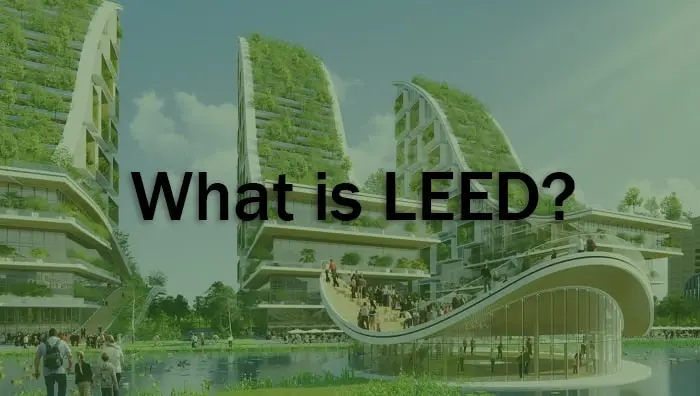
LEED — Leadership in Energy and Environmental Design — is a green building rating system developed by the U.S. Green Building Council (USGBC). It scores buildings on points across categories such as energy, water, materials and indoor environmental quality, and awards one of four certification levels: Certified, Silver, Gold or Platinum.
It is the most widely used green building programme in the world, applied to more than 100,000 commercial projects across over 180 countries and territories. Current global figures are published on the USGBC website.
What is LEED?
LEED does two distinct things, and mixing them up is the most common source of confusion:
- Buildings get certified. A project earns points against the LEED rating system and is awarded Certified, Silver, Gold or Platinum. This is what people mean by “a LEED building”.
- People get accredited. An individual passes an exam and holds a credential — LEED Green Associate or LEED AP with a specialty. This is what people mean by “a LEED professional”.
The rating system is developed by USGBC; the exams and project certification are administered by GBCI, USGBC’s certification body. We cover the distinction in more depth in the types of LEED accreditation.
What is the U.S Green Building Council?
The USGBC (U.S. Green Building Council) is a nonprofit organization dedicated to transforming the built environment into a healthier and more sustainable place to live. Its LEED green building certification program equips professionals with knowledge and skills required to transform buildings and communities that are prosperous, resilient, and healthy.
The main objective of the USGBC LEED program is to create reputable and sustainable benchmarks for green buildings and homes in terms of design, construction, maintenance, and operation.
USGBC was founded in April 1993 by Mike Italiano, David Gottfried and Rick Fedrizzi. LEED v1.0 was released as a pilot for new construction in 1998; LEED v2.0, in 2000, was the first version to achieve broad market adoption. The system has been revised periodically since, through v3, v4, v4.1 and now v5.
LEED v5: the current rating system
USGBC members ratified LEED v5 in March 2025 and the system launched on 28 April 2025, with project certification opening on 3 November 2025. USGBC describes it as the programme’s biggest step forward in more than a decade.
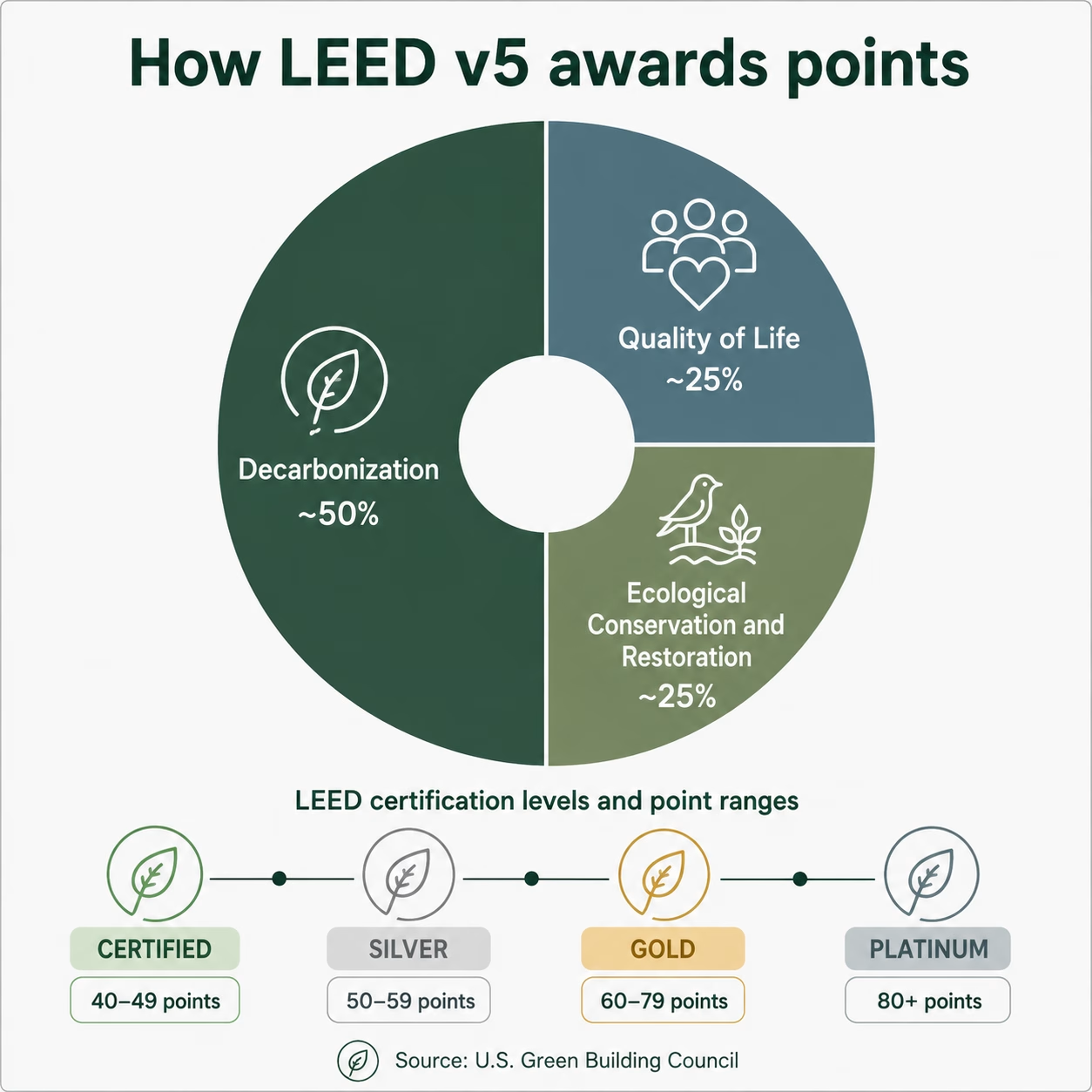
LEED v5 is organised around three impact areas, and the point weighting shows where its priorities sit:
| Impact area | Share of points | What it covers |
| Decarbonization | About half | Operational and embodied carbon, refrigerants, transportation |
| Quality of Life | About a quarter | Occupant health, wellbeing, community and equity impact |
| Ecological Conservation & Restoration | About a quarter | Ecosystem protection, biodiversity, water and land |
Two things changed structurally in v5. Carbon and climate-risk assessments are now mandatory on every project rather than optional credits, and every certified project receives a standardised impact report. A new “project priorities” category lets teams tailor credits to regional and market context.
LEED v5 covers BD+C: New Construction, BD+C: Core and Shell, ID+C: Commercial Interiors and O+M: Existing Buildings. LEED for Homes and LEED for Neighborhood Development remain on LEED v4.
When does LEED v4 retire?
| Date | What happens |
| 1 July 2027 | LEED v5 becomes the only version available for new project registrations, with limited exceptions |
| 30 June 2033 | Final certification deadline for all remaining LEED v4 and v4.1 projects |
LEED Certification Levels
A project’s LEED certification level is determined by how many points it earns:
- Certified — 40 to 49 points
- Silver — 50 to 59 points
- Gold — 60 to 79 points
- Platinum — 80 points and above
Under LEED v5, Platinum additionally carries mandatory performance benchmarks around electrification, renewable energy, efficiency and embodied carbon — the points alone are no longer the whole story. There is more detail in what are the LEED certification levels.
The two LEED credentials for professionals
| LEED Green Associate | LEED AP with specialty | |
| Prerequisite | None | Active LEED GA credential, waived on the combined exam |
| Format | 100 multiple-choice questions, 2 hours, pass mark 170 | 100 multiple-choice questions, 2 hours, pass mark 170 |
| Renewal | 15 CE hours every 2 years, 3 LEED-specific | 30 CE hours every 2 years, 6 LEED-specific |
Exam fees are set by USGBC and are subject to change — check the current fee on the USGBC website before registering.
The LEED AP certification represents a higher degree of preparation compared to LEED GA. Under LEED AP, Building Design + Construction specialty credentials are available for professionals with green building design and construction experience in commercial, residential, educational, and healthcare sectors. The other four specialties are ID+C, O+M, ND and Homes. See the difference between LEED GA and LEED AP for a side-by-side comparison, and how to become a LEED Professional for the exam application walkthrough.
Frequently asked questions
What does LEED stand for?
Leadership in Energy and Environmental Design.
Who runs LEED?
The rating system is developed by the U.S. Green Building Council (USGBC). Exams and project certification are administered by GBCI.
What is the current version of LEED?
LEED v5, launched 28 April 2025. LEED v4 and v4.1 remain available for new registrations until 1 July 2027.
Is LEED only used in the United States?
No. LEED has been applied in more than 180 countries and territories, and the UAE is among the largest markets outside the United States.
Training Options
3FOLD TRAINING offers LEED Green Associate training and LEED AP BD+C training online in a live virtual format, for professionals working across commercial, residential, educational and healthcare sectors. Both are aligned to LEED v5, and the LEED GA and AP BD+C combo course covers both credentials in one programme. Talk to us through the course enquiry form.





2 comments
Leave your reply.