
No. LEED project experience is not required to sit the LEED AP BD+C exam. For the specialty-only exam, you must be 18 or older and hold an active LEED Green Associate or LEED AP with Specialty credential at registration, maintaining that active status through the exam date. USGBC does recommend project experience, in unusually strong terms, and that recommendation is about passing rather than about permission which is a distinction worth understanding before you decide what to do next.
What USGBC actually says
USGBC’s current LEED AP with Specialty guidance and Candidate Handbook are the authoritative sources for eligibility and experience information.
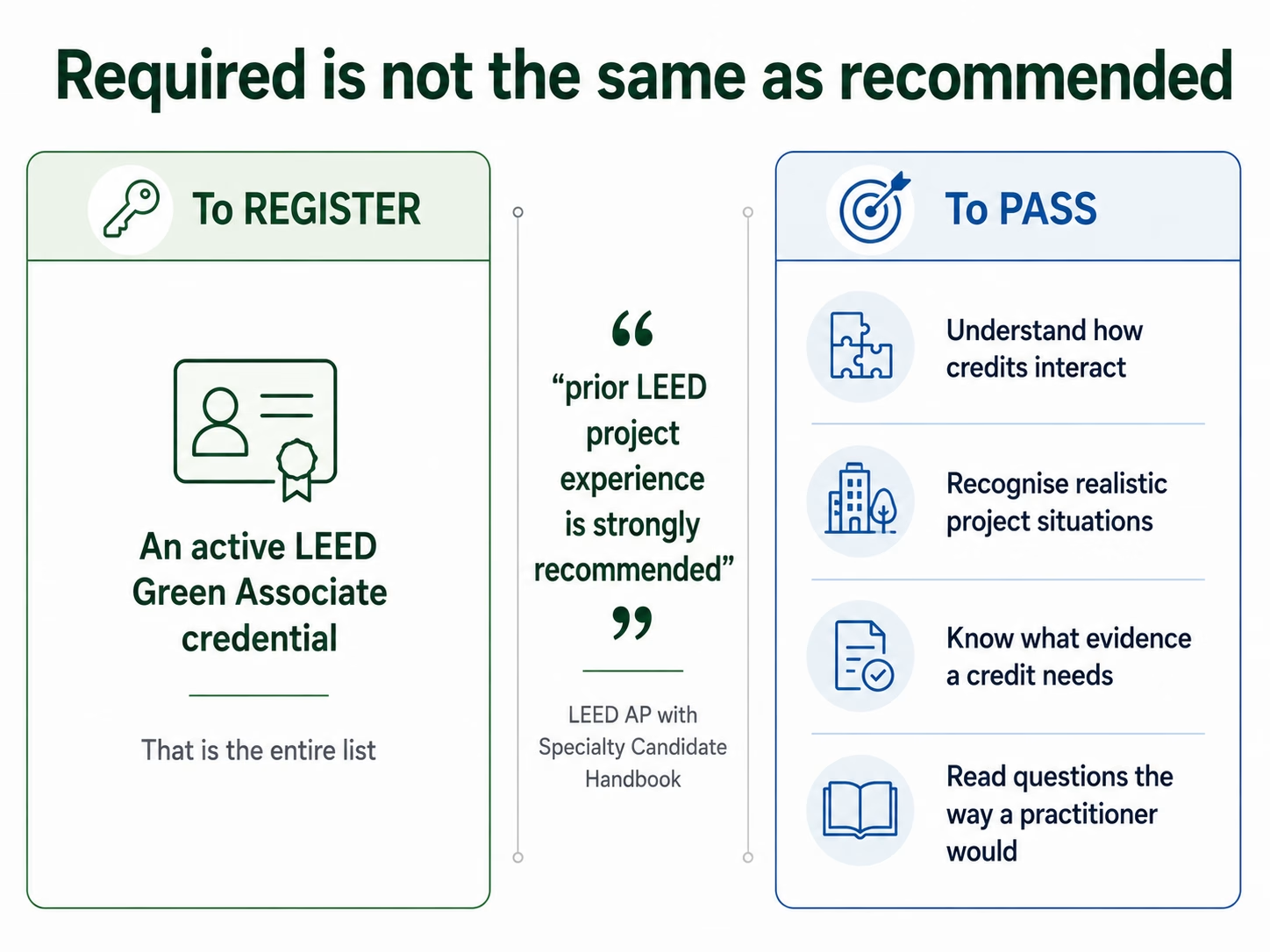
On experience, the handbook says “prior LEED project experience is strongly recommended” and that “practitioner experience is critical to earning the credential”.
On eligibility, USGBC states that candidates must be 18 or older and hold an active LEED Green Associate or LEED AP with Specialty credential at registration, maintaining that active status through the exam date.
Those are two different statements doing two different jobs. The eligibility sentence is the gate. The experience sentence is advice. Strong advice, from the organisation that writes the exam, but advice.
The handbook also says, separately, that “practitioner competency and project proficiency is tested objectively within the exam”. Read alongside the recommendation, that is a description of what the questions are like rather than a warning.
Why this gets misread
Read “critical to earning the credential” quickly and it sounds like a requirement. It is not — it is a claim about difficulty, not about eligibility. Published guides sometimes collapse the two and tell readers they need documented project experience to apply. They do not.
There is also a historical reason for the muddle. Some professional credentials in adjacent fields do require documented experience, verified before you are allowed to sit. People reasonably assume LEED AP works the same way. It does not.
If you have no LEED project experience, you can still be eligible for the LEED AP with Specialty exam if you are at least 18 and hold an active LEED Green Associate or LEED AP with Specialty credential at registration, maintaining that active status through the exam date. Full eligibility detail is in LEED AP requirements: who can sit the exam.
The audit clause, and why it does not change this
The handbook states that GBCI “reserves the right to conduct an audit at any time (including prior to application submission and after credential has been granted) of all current and past exam applications.”
That clause is sometimes read as evidence of a hidden experience check.Eligibility turns on the current eligibility requirements, including age, the credential you hold, and agreement to GBCI policies and credential maintenance requirements; project experience is not an eligibility requirement. What the audit clause asks of you is accuracy: describe your role honestly, and do not claim projects you did not work on. Given that experience is not required, there is nothing to be gained by overstating it — and the clause makes clear that an application remains reviewable after a credential has been granted.
So what is the recommendation really telling you?
Something specific and useful, if you translate it. The AP exam asks questions that assume you have stood in a project meeting.
The distinction between the two LEED exams is not chiefly one of volume. Green Associate largely asks what things are. AP BD+C asks what you would do — which credit applies here, what happens to that credit if this decision changes, what evidence this claim needs, which of several defensible-sounding actions is the right one for this situation.
Someone who has worked on a certification has met those situations. They have watched a substitution ripple through a scorecard and seen documentation get reconstructed after the fact. That is what “practitioner experience” buys, and it is why USGBC recommends it so firmly.
The useful reframing is this: the recommendation is not “you must have done projects”. It is “you must be able to think like someone who has”. Experience is the most reliable route to that. It is not the only one.
What to do if you have none
Three honest options, in the order worth considering them.
1.Get some, if you can. Not necessarily a full certification project from concept to award start by gaining practical exposure to an active LEED project. Ask to sit in on the LEED coordination meetings on a project already running in your organisation. Volunteer to help assemble evidence for one credit category. Ask the sustainability lead to walk you through a scorecard. A few weeks of proximity is worth a great deal.
2.Substitute deliberately, if you cannot. The gap is situational judgement, so close it with situational material: worked examples, credit-interaction scenarios, real scorecards from USGBC’s project directory at usgbc.org, and practice questions written as project decisions rather than definitions.This approach is intended to help you build familiarity with the project situations and tasks reflected in the exam. How to do it properly is in passing LEED AP BD+C without LEED project experience.
3.Wait, if neither applies and nothing is forcing the timing. Sitting an exam you are not ready for means paying the exam registration fee for that attempt, and candidates must pay the exam registration fee for each exam attempt. If a relevant project is starting in three months, that may be the better sequence. It is not the option a training provider has any reason to push, and it is sometimes the right one.
What we will not tell you
Two things, deliberately.
We will not quote a pass rate for candidates without experience. USGBC does not publish pass rates for any of its exams, so any figure you find attached to this question was produced by whoever published it. If a page tells you that candidates without project experience pass at some particular rate, that is a signal about the page rather than about the exam.
We will not tell you a course replaces experience. We sell LEED AP training, so treat that with appropriate scepticism — but the honest position is that good preparation can close a situational-judgement gap and cannot manufacture years on site. What it can do is make sure you have met the situations before you meet them in an exam question.
The short version
| Required to register? | For the specialty-only exam, you must be at least 18 and hold an active LEED Green Associate or LEED AP with Specialty credential at registration and maintain that active status through the exam date. The combined exam does not require an existing active Green Associate credential, but the combined format is not available during the current LEED v5 beta phase. |
| Recommended by USGBC? | Yes, and in strong terms — “strongly recommended”, “critical to earning the credential” |
| Part of the eligibility check? | No. Eligibility turns on the credential you hold |
| Can you pass without it? | Yes, with preparation aimed at the specific gap |
| Should you sit tomorrow with none? | That depends on how you prepare, and it is a real question |
Frequently asked questions
Do you need LEED project experience for the LEED AP BD+C exam?
No. Prior LEED project experience is strongly recommended but is not an eligibility requirement. For the specialty-only exam, candidates must be at least 18 and hold an active LEED Green Associate or LEED AP with Specialty credential at registration and maintain the credential through the exam date.
Why does USGBC say experience is critical if it is not required?
Because the statement is about passing rather than about permission. The handbook explains that practitioner competency and project proficiency is tested objectively within the exam, meaning the questions assume familiarity with real project situations.
Is my experience checked before I sit the exam?
Eligibility turns on holding an active LEED Green Associate or LEED AP with Specialty credential, not on experience. Separately, GBCI reserves the right to audit exam applications at any time, including after a credential has been granted, so your application should be accurate.
Can you pass LEED AP BD+C without any project experience?
Yes, with preparation aimed at the specific gap. The difference experience makes is situational judgement, so worked examples, credit-interaction scenarios, real scorecards and practice questions written as project decisions are the substitute.
What counts as LEED project experience?
USGBC recommends prior LEED project experience without setting a minimum period or defining a qualifying role, because it is a recommendation rather than a requirement. Working on a project pursuing LEED certification, in any capacity that exposes you to how credits are decided and documented, is the substance of it.
How much experience do you need?
None is required. There is no minimum period, because there is no experience requirement to set a minimum against.
Is there a published pass rate for candidates without experience?
No. USGBC does not publish pass rates for any of its exams, so any such figure was produced by whoever published it rather than by USGBC.
Closing the situational gap
3FOLD TRAINING has prepared professionals for certification exams since 2008, across more than 100 countries, including many candidates who came to LEED AP without having run a certification themselves. Our LEED AP BD+C training works through credit interactions and project decisions rather than definitions. No course is required to sit the exam, ours included. Ask through the course enquiry form.





Leave a reply