

These ten are not the hardest facts in the syllabus. They are the ten places where a well-prepared candidate loses a mark anyway — because the rule is one thing and the intuition is another, and under time pressure the intuition wins.
That is a different failure from not knowing something, and it needs a different fix. You cannot revise your way out of a direction error. You can only meet it enough times that the correct move becomes the reflex.
These questions focus on the places where candidates apply a rule to the wrong denominator, run an equation in the wrong direction, remember only one half of a requirement, or carry a familiar rule into a situation where it does not apply.
Attempt all ten before checking the explanations. These questions are worth more to you if you get them wrong here than if the same mistake first appears in a timed mock.
10 tricky LEED AP BD+C practice questions
Take the quiz — get your scored results by email

The pattern underneath all ten
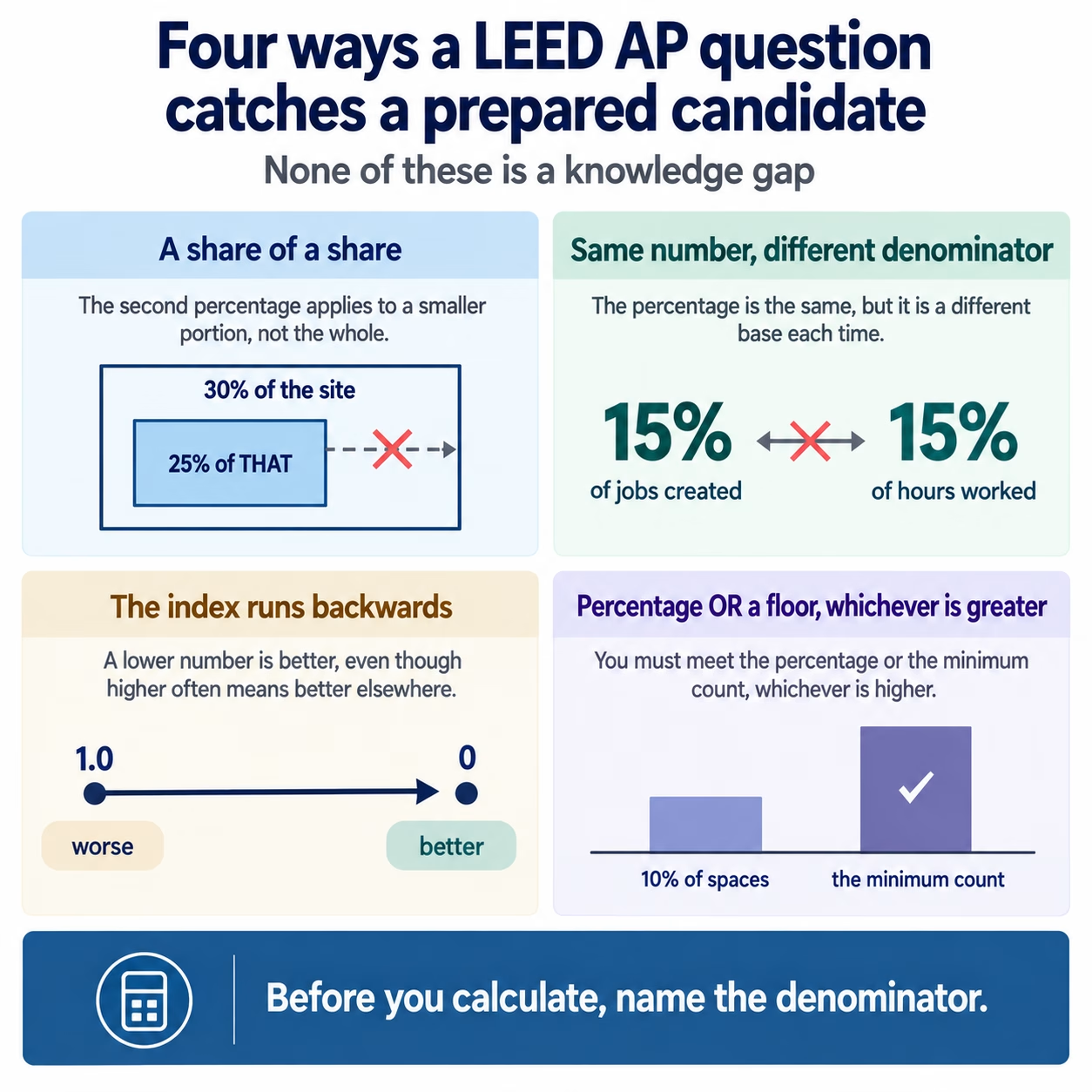
Nine of these ten are not knowledge failures. They are structure failures — the candidate knows the rule and applies it to the wrong thing. A share taken of the site instead of the outdoor space. A percentage measured against hours worked instead of jobs created. A division performed as a multiplication. A cap ignored because the arithmetic before it was correct.
That suggests a specific habit, and it is one of the most useful things to take from this set: before you put a number into a calculation, write down what the denominator is. Not the formula — the denominator. Many avoidable calculation errors come from performing the correct operation on the wrong base, and naming the base first is a quick defence against it.
The other recurring shape is the rule with two limbs where only one is remembered. When a requirement contains words such as “or” or “whichever is greater”, treat that as a flag. Those are exactly the kinds of rules that become oversimplified in revision notes.
What these questions are designed to catch
| Trap | What to check before answering |
|---|---|
| Increased ventilation | Where the 15% increase enters the ventilation calculation and whether system ventilation efficiency must be recalculated |
| Share of a share | Whether the second percentage uses the whole site or the result of the first percentage as its denominator |
| Heat Island Reduction | Whether the weighting factors divide or multiply the qualifying treated areas |
| Equitable Development | Which 15% requirement is measured against jobs created and which is measured against construction hours |
| Electric Vehicles | Both the percentage requirement and the absolute minimum where the rule says whichever is greater |
| Embodied carbon | The difference between the prerequisite's assessment obligation and the credit's reduction requirement |
| Enhanced Water Efficiency | Whether the whole-project pathway can be combined with the other options |
| Performance Index | Whether a higher or lower value represents better building performance |
| Enhanced Energy Efficiency | The difference between total achieved credits, eligible credits and credits above the standard's minimum requirement |
| Exemplary performance | Whether exceeding a requirement is enough, or whether the credit must also be explicitly eligible |
Where candidates lose marks
- Multiplying the final outdoor-air intake by 1.15 on a multiple-zone recirculating system. The increase enters the ventilation calculation earlier and can change system ventilation efficiency.
- Taking 25% of the entire site for the vegetation requirement. The vegetation percentage applies to the required outdoor space.
- Multiplying Heat Island Reduction areas by factors below one. The equation uses those factors as divisors.
- Seeing 15% twice and forgetting the denominator. Local hiring and apprenticeship participation are measured against different bases.
- Calculating only the EV percentage. A fixed minimum may govern a small parking facility.
- Importing the 20% embodied carbon reduction into the prerequisite. The prerequisite requires quantification and assessment rather than that reduction.
- Stacking the whole-project water pathway with the alternative options. The pathways are not all cumulative.
- Assuming a larger Performance Index is better. The index measures performance remaining relative to the baseline, so lower is better.
- Stopping after identifying eligible energy-efficiency credits. The calculation also considers how far total achievement exceeds the standard's requirement.
- Assuming that greatly exceeding any credit automatically creates exemplary performance. Eligibility itself must also be established.
A better way to approach calculation questions
Before calculating, identify four things:
- What is the denominator?
- Does the equation multiply or divide?
- Is higher or lower better?
- Is there another threshold, minimum, maximum or eligibility condition after the calculation?
A correct formula is not enough if it is applied to the wrong quantity. These four checks are designed to catch that before you commit to an answer.
Where these questions came from
Every question here was written for this page. None is taken from a real GBCI exam, from 3FOLD's paid mock exams, from our module quizzes, or from a competitor. Reproducing a real exam question would breach the candidate agreement that every candidate signs, and we are not going to ask you to read one.
Be careful of any site that claims its questions are the real thing — either they are not, in which case you are being misled, or they are, in which case using them could put your own result at risk.
What they are built from: published LEED v5 BD+C requirements and thresholds, and 3FOLD's own teaching handouts. Facts, thresholds and credit names are usable; USGBC's wording is not, so every stem, option and explanation is in our own words. Where our own material and a published source disagree, we left the point out rather than pick a side.
Where to go next
- The eight domain practice sets — 85 questions, one for every scored question on the real paper.
- The full timed mock — 100 questions in two hours, once these stop catching you.
- The numbers and thresholds, in one place — if the direction errors above were the ones that caught you, that is the page to read next.
Frequently asked questions
What is the most common mistake on the LEED AP BD+C exam?
In our teaching it is often not a knowledge gap but a base error: applying a correct rule to the wrong denominator. A share of a share may be taken as a share of the whole, or a percentage may be measured against the wrong quantity. Naming the denominator before you calculate is a useful defence.
Are these real LEED AP exam questions?
No. Every question here was written for this page. Reproducing a real GBCI question would breach the candidate agreement that every candidate signs.
Why do I keep getting calculation questions wrong when I know the formula?
Sometimes the difficulty is not remembering the formula but applying it in the correct direction and against the correct base. Several LEED calculations divide where you may instinctively expect multiplication, while some performance measures improve as the number falls.
Should I do these before or after a full mock?
Before. Use these ten to identify recurring reasoning errors, then move to the full timed mock once these traps have stopped catching you.
If it would help to talk it through
3FOLD TRAINING has prepared professionals for certification exams since 2008, across more than 100 countries. If you have worked through these and want a read on whether you are ready, describe where you are through the course enquiry form. Our LEED AP BD+C training covers the full syllabus. No course is required to sit or pass the exam, ours included — and if these questions are going well, the honest answer may be that you do not need one.



Leave a reply