
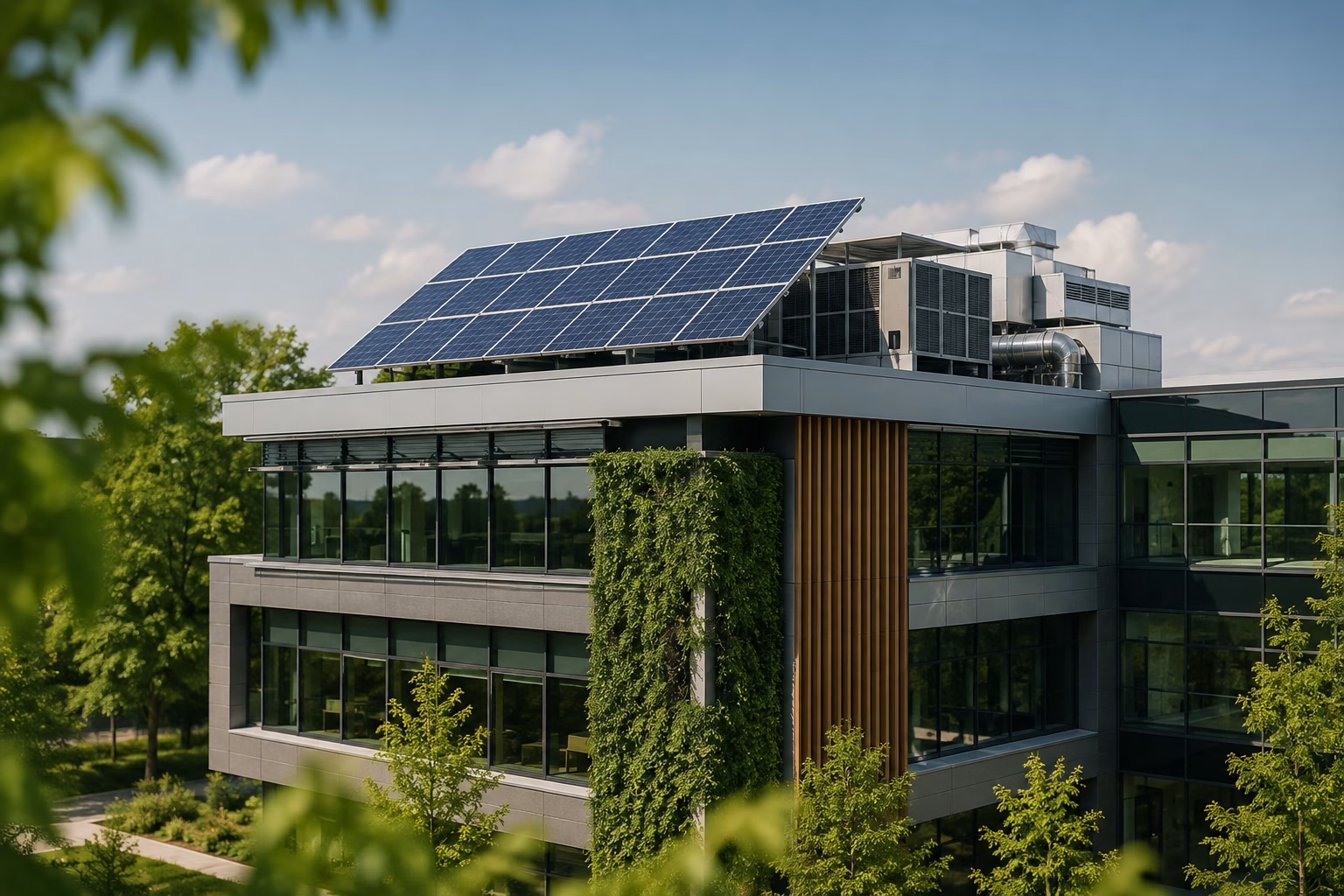
Energy and Atmosphere is worth 18 of the 85 scored questions on the LEED AP BD+C exam, and it rises from 15 on the Green Associate paper. There are 18 questions below, one for each scored question this domain carries. At 18 of the 85 scored questions, this is the largest single domain on the paper, and it grows from 15 on the Green Associate exam. It is also where a decision taken early constrains a credit later: the compliance path chosen for the minimum energy efficiency prerequisite limits what enhanced energy efficiency can go on to earn.
It covers all five prerequisites, and Electrification, Peak Thermal Loads, Enhanced Energy Efficiency, Renewable Energy, Enhanced Commissioning, Grid Interactive and Enhanced Refrigerant Management.
The largest domain on the paper, and the one where the prerequisites do the most work. Three of the four Platinum mandates live here, and a choice made in a prerequisite can cap what a credit will later pay.
18 Energy and Atmosphere practice questions
Attempt all of them before checking the explanations. Write your answers down — deciding in your head and then reading the explanation is how a candidate convinces themselves they knew something they did not.
Take the quiz — get your scored results by email

Recall, Application, Analysis — and why it matters here
The candidate handbook names three cognitive levels: Recall, Application and Analysis. It publishes no split between them, so nobody can tell you what share of your paper will be which. What we can tell you is that only the first is fixed by more reading. Past a point, re-reading the material stops helping and worked problems start.
Each answer in this set is tagged with the level it was written at, so you can see which kind you are losing. If your errors cluster in Recall, revise. If they cluster in Application and Analysis, do more questions — those are the only thing that moves them.
What these questions test
| Area | What you need to understand |
|---|---|
| Operational Carbon Projection | Required site-energy reporting, source and end-use breakdowns, and what belongs in the 25-year decarbonization plan |
| Minimum Energy Efficiency | Referenced ASHRAE editions, registration-date rules and how the prerequisite compliance path constrains later credit options |
| Fundamental Commissioning | Provider timing, experience requirements, building-envelope scope and contractor-document review |
| Energy Metering and Reporting | Electric and nonelectric recording intervals, data retention and the five-year reporting commitment |
| Fundamental Refrigerant Management | The difference between an HCFC prohibition and the evaluation triggered by refrigerants with GWP above 700 |
| Electrification | Capacity-weighted COP, no-on-site-combustion requirements and the link between the credit and the decarbonization-plan path |
| Peak Thermal Loads | Why a lower Performance Index is better and how the tier ladder is interpreted |
| Enhanced Energy Efficiency | The separate simulation ladders, on-site renewable treatment and the measures excluded from the prescriptive route |
| Renewable Energy | Tier 2 versus Tier 3 supply, Core and Shell denominator rules and qualifying procurement |
| Enhanced Commissioning | The special role of enclosure commissioning in Core and Shell |
| Grid Interactive | Electric storage sizing, power resilience and the distinctions between resilience, demand response and automated demand-side management |
| Enhanced Refrigerant Management | Charge-weighted GWP calculations and comparison with benchmark thresholds |
| Platinum mandates | How Electrification, enhanced efficiency and renewable energy connect to the higher certification requirement |
Where candidates lose marks in this domain
- Submitting source energy where the prerequisite asks for site energy. The operational carbon estimate also has to be broken down by source and end use.
- Turning the decarbonization plan into an energy model or binding net-zero promise. It is a short 25-year retrofit narrative with approximate timing and cost.
- Using certification date or construction start for the ASHRAE edition pivot. The rule is tied to registration date.
- Choosing a prerequisite compliance path without considering the credit it unlocks later. The EAp2 path directly limits EAc3.
- Importing enhanced commissioning requirements into fundamental commissioning. Provider timing and review percentages are different.
- Applying 15-minute recording to every energy source. Electricity and nonelectric sources have different intervals.
- Reading GWP 700 as an outright refrigerant ban. Above 700 triggers an alternatives evaluation; HCFCs are the prohibition.
- Averaging heat-pump COP values without weighting them by capacity. The credit uses a capacity-weighted average.
- Reading a Performance Index as a percentage improvement. A lower peak-load index represents better performance.
- Using the renewable-inclusive efficiency figure on the efficiency-only ladder. Enhanced Energy Efficiency has separate ladders.
- Counting measures already rewarded elsewhere. Certain envelope, renewable and monitoring measures are excluded from the prescriptive efficiency route.
- Using whole-building energy as the denominator for Core and Shell renewable calculations. The base-building rule is different.
- Assuming strong MEP commissioning alone earns Core and Shell enhanced commissioning. Enclosure commissioning is foundational there.
- Using thermal-storage ratios for electrical storage. Grid Interactive applies different sizing ratios.
- Confusing power resilience with demand response. Resilience requires critical loads, on-site renewables, storage and islanded operation.
- Averaging refrigerant GWPs without weighting them by charge. The low-GWP route uses a charge-weighted average.
- Assuming partial electrification eliminates the decarbonization plan. The prerequisite path depends on the top Electrification achievement.
Where these questions came from
Every question on this page was written for it. None is taken from a real GBCI exam, from 3FOLD's paid mock exams, from our module quizzes, or from a competitor. Reproducing a real exam question would breach the candidate agreement that every candidate signs, and we are not going to ask you to read one.
What they are built from: the published LEED v5 BD+C rating system requirements and thresholds, and 3FOLD's own teaching handouts. Facts, thresholds and credit names are usable; USGBC's wording is not, so every stem, option and explanation here is in our own words. Where our own material and a published source disagree, we have left the point out rather than pick a side.
Where to go next
- All eight domain sets — work every one and you will have answered 85 questions, weighted exactly as the specification weights the real paper.
- The full timed mock — when you want the whole paper under exam conditions rather than one domain at a time.
- The same domain at Green Associate level — useful if you are preparing for both exams, and a fast way to feel the change in depth.
Frequently asked questions
How many Energy and Atmosphere questions are on the LEED AP BD+C exam?
18 of the 85 scored questions. The paper delivers 100 and scores 85, so the weighting is a share of the 85, not of the 100.
Are these real LEED AP exam questions?
No, and you should be wary of any page that says its questions are. Every question here was written for this page. Reproducing a real GBCI question would breach the candidate agreement.
Is Energy and Atmosphere harder on the AP exam than on the Green Associate exam?
The topics overlap, but the depth is different. The specialty paper asks you to apply commissioning rules, performance indices, energy pathways, storage sizing, renewable-energy denominators and refrigerant calculations rather than simply recognise the concepts.
If it would help to talk it through
3FOLD TRAINING has prepared professionals for certification exams since 2008, across more than 100 countries. If you are working through these and want a read on whether you are ready, describe where you are through the course enquiry form. Our LEED AP BD+C training covers the full syllabus. Related: the Green Associate set for this domain. No course is required to sit or pass the exam, ours included — and free questions are worth more to you than a course you do not need.





Leave a reply