
LEED Process is worth 15 questions on the LEED Green Associate exam, making it the joint largest domain alongside Energy and Atmosphere. It covers how USGBC and GBCI are organised, how a rating system is built, how projects get certified, and what LEED is trying to achieve. Almost all of it is memorisation, which makes it the cheapest marks on the paper.
Candidates routinely treat this domain as background and spend their time on the technical categories. That is the wrong trade. Fifteen questions is nearly a sixth of the exam, and unlike Energy and Atmosphere it asks you to recall facts rather than reason about systems.
Who does what: USGBC and GBCI
The exam tests this distinction reliably, so learn it precisely.
| USGBC | GBCI | |
| Formed | 1993 | 2008 |
| Type | Non-profit | Non-profit |
| Role | Develops and maintains LEED through an open, consensus-based process | Independently certifies projects and administers the professional exams |
USGBC writes LEED. GBCI certifies projects and runs the exams. That separation is what makes LEED third-party verified rather than self-declared, which is why it matters enough to be examined.
Three dates get swapped in questions, so learn them as a set: 1993 USGBC founded, 1998 the first version of LEED piloted, 2008 GBCI formed.
The structure of a rating system
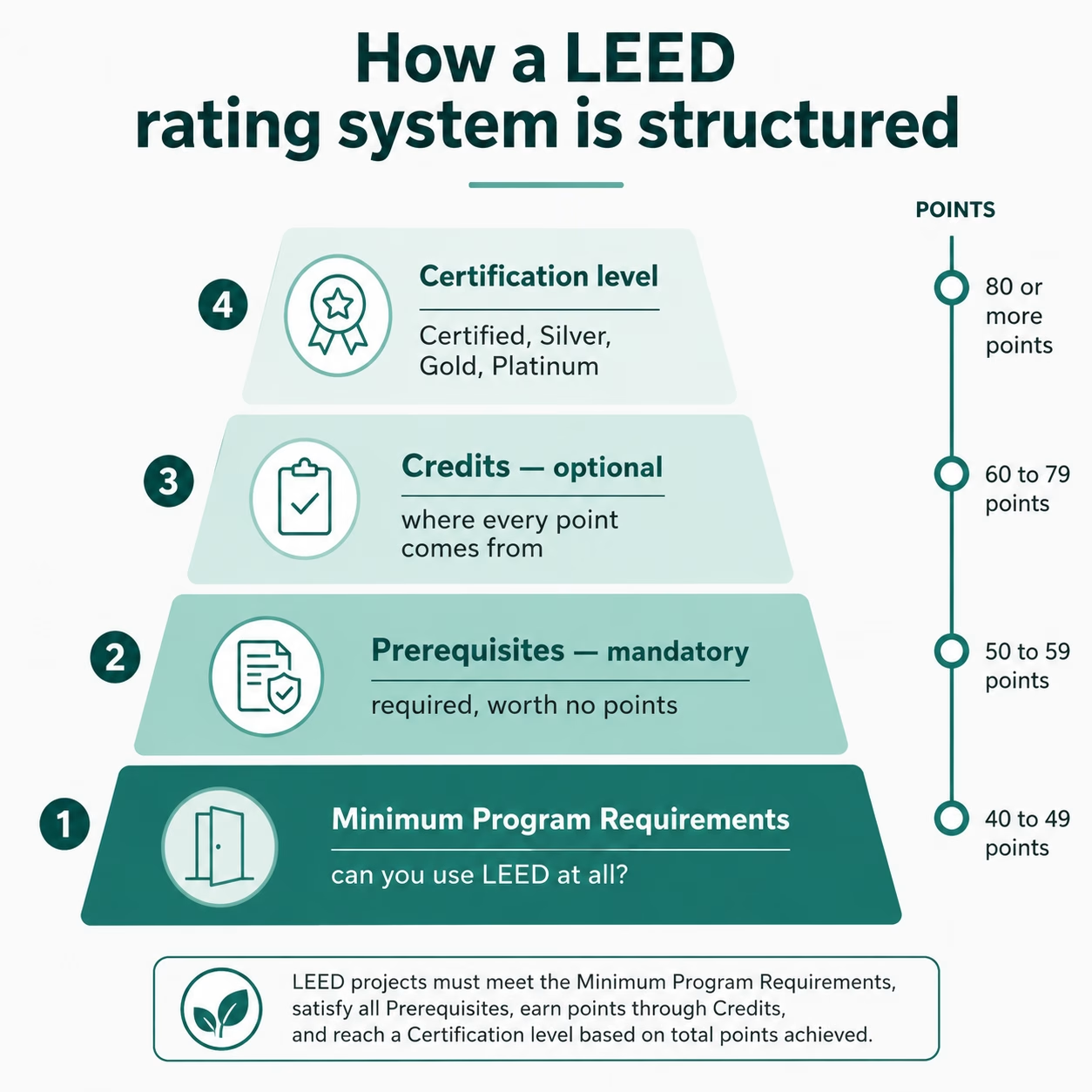
Four layers, and the exam tests the boundaries between them:
- Minimum Program Requirements (MPRs). Gateway eligibility rules a project must satisfy to use LEED at all. The project must be on an existing permanent location, use a reasonable project boundary, and commit to sharing energy and water data.
- Prerequisites. Mandatory items inside each credit category. Every certifying project must meet them, and they earn no points.
- Credits. Optional items teams elect to pursue. Every point comes from here.
- Categories and weightings. Credits are grouped into categories, and points are allocated by impact.
The confusion to avoid: MPRs decide whether you can use LEED. Prerequisites are inside the rating system and decide whether you can certify. They are different things and both are examined.
Credit weighting: points follow impact, not effort
Each credit’s points reflect its expected environmental and human health impact, applied through a consistent and transparent method across categories. Difficulty and documentation cost do not enter into it.
This is why Energy and Atmosphere carries the most points — not because it is hard, but because building energy use is the largest single lever a project has over carbon. Candidates who assume weighting reflects effort get this wrong.
A LEED v5 rating system can have 110 possible points, depending on the rating system and adaptation.
The four certification levels
| Level | Points |
| Certified | 40–49 |
| Silver | 50–59 |
| Gold | 60–79 |
| Platinum | 80+ |
Meeting every prerequisite makes a project eligible to be assessed; it does not certify it. Below 40 points there is no certification to award. Under LEED v5, Platinum additionally requires meeting mandatory performance benchmarks, so 80 points alone is no longer sufficient.
Choosing a rating system
Five families, chosen by matching the system to what the team controls:
| System | For |
| BD+C | New construction and core and shell |
| ID+C | Fit-outs of leased or tenant space |
| O+M | Existing buildings in use |
| ND | Community and district scale |
| Homes | Single-family and low-rise multifamily residential |
The 40/60 rule is the rule of thumb where more than one could apply: if a system clearly fits 60% or more of the project, use it. If none fits at least 40%, LEED may not be appropriate. Between those figures, the team exercises judgement.
The certification process
- Register with GBCI, set the project boundary, select the rating system and version.
- Document — meet the prerequisites, pursue credits, assemble calculations and evidence.
- Submit and review — preliminary review, then final review.
- Certify — GBCI awards the level.
A standard review submits everything at once. A split review submits design-phase credits first and construction credits later, which surfaces problems while they can still be fixed.
Resources the exam expects you to recognise
- LEED Interpretations — a published record of how requirements have been applied to specific situations.
- Addenda — official corrections and clarifications to the rating system.
- LEED Rating System Selection Guidance — helps teams choose between systems.
You are not expected to know their contents. You are expected to know they exist and what each is for.
The LEED v5 impact areas
What LEED v5 is ultimately trying to achieve, and roughly how the points distribute:
- Decarbonization — about half of all points. Operational and embodied carbon, refrigerants, transportation.
- Quality of Life — about a quarter. Occupant health, wellbeing, community and equity.
- Ecological Conservation and Restoration — about a quarter. Ecosystems, biodiversity, water and land.
Do not confuse impact areas with credit categories. Categories are what LEED measures; impact areas are what it is aiming at. More in the three LEED v5 impact areas explained.
Benefits of certification the exam expects you to recognise
Lower operating costs through reduced energy and water use; conserved resources and protected biodiversity; monitored and reduced carbon; healthier and more comfortable occupants; and responsible, transparent supply chains. Market differentiation and market transformation sit alongside these.
What LEED does not claim: exemption from building codes, guaranteed increases in property value, or faster planning approval. Options offering those in a question are wrong.
Key terms to memorise
| Term | Definition |
| Minimum Program Requirement | A gateway eligibility rule a project must satisfy to use LEED at all |
| Prerequisite | A mandatory item within a credit category, earning no points |
| Credit | An optional item a team pursues to earn points |
| Credit weighting | Allocation of points by expected environmental and human health impact |
| 40/60 rule | Rule of thumb for choosing a rating system when more than one could apply |
| Split review | A certification review approach in which design-phase and construction-phase submissions are reviewed separately, where applicable |
| LEED Interpretation | Published precedent on how a requirement applies in a specific situation |
| Addenda | Official corrections and clarifications to the rating system |
Where candidates lose marks
- Confusing MPRs with prerequisites. Eligibility versus mandatory content.
- Confusing USGBC with GBCI develops and maintains LEED, while GBCI administers LEED certification and the professional credentialing exams.
- Assuming weighting follows difficulty. It follows impact.
- Mixing up 1993, 1998 and 2008.
- Thinking prerequisites alone certify a project. A project must meet all applicable prerequisites and earn at least 40 points to achieve the Certified level.
- Confusing impact areas with credit categories.
Revision checklist
You are ready on this domain when you can, without looking:
- State what USGBC does and what GBCI does, and give the year each was formed.
- List the three MPRs.
- Explain the difference between a prerequisite and a credit in one sentence each.
- Recite the four certification levels and their point bands.
- Name the applicable LEED rating systems and say what each is for.
- Explain the 40/60 rule.
- Put the four certification process steps in order and say what a split review is.
- Name the three LEED v5 impact areas and explain what each area is intended to address.
Test yourself
Reading builds recognition; questions build recall, and recall is what the exam tests. Work through our 15 LEED Process practice questions, then the 50-question mock exam.
Frequently asked questions
How many LEED Process questions are on the Green Associate exam?
15 questions on the LEED Green Associate exam.
Is LEED Process the easiest domain?
It is the most memorisable, because it tests organisational and procedural facts rather than technical judgement. That makes it the best return on study time.
Do I need to memorise the certification point bands?
Yes. Certified 40 to 49, Silver 50 to 59, Gold 60 to 79, Platinum 80 or more.
What is the difference between an MPR and a prerequisite?
An MPR decides whether a project may use LEED at all. A prerequisite is a mandatory item inside the rating system that must be met to certify.
Learning this properly
3FOLD TRAINING covers LEED Process as a full module within LEED Green Associate training, written to LEED v5. New to LEED? Start with what is LEED, or ask us through the course enquiry form.




Leave a reply