

Energy and Atmosphere is worth 10 questions on the LEED Green Associate exam and carries more points in the rating system than any other credit category. It addresses energy efficiency, building performance, refrigerants and carbon-related strategies.
Two things make this domain harder than its size suggests. It is technical, so it rewards understanding over rote learning. And the “Atmosphere” half — refrigerants, global warming potential, ozone depletion — catches candidates who assume the category is only about energy.
Loads, envelope and efficiency
Start here, because everything else in the domain follows from it.
An energy-efficient building uses less energy than others to perform the same functions. How efficient it can be is shaped by its shape, size, orientation, climate, materials, glazing and operating schedules — most of which are fixed early in design.
Passive design uses orientation, shading, daylight and natural ventilation to reduce loads before any equipment is specified. It is the cheapest energy strategy available because it has no running cost.
The building envelope is the roofs, walls, windows and foundation separating inside from outside. Two envelope properties are examinable:
- R-value — a material’s resistance to conductive heat flow. Higher means better insulation.
- Thermal bridges — paths where heat conducts through the envelope, bypassing the insulation. Usually structural elements such as steel, concrete or balcony slabs. They undermine an otherwise good envelope and can cause condensation.
A high-performance envelope shrinks heating and cooling loads, which lets the HVAC plant be smaller and more efficient. That chain of consequence is the single most useful idea in the domain.
Where a building’s energy goes
| Load type | What it is |
| Plug loads | Energy drawn by equipment through electrical outlets — computers, monitors, chargers |
| Parasitic loads | Standby draw when devices are notionally “off” |
| Process loads | Energy use that continues when equipment or systems are not actively performing their primary function |
| Demand | The rate at which energy is being used during a specified time interval |
| Peak demand | The maximum power required at one moment |
Demand and consumption are different things. Consumption is a total over time; peak demand is a moment. A building can use modest total energy and still create an expensive, carbon-intensive spike, which is why demand response and storage matter.
A useful energy strategy sequence
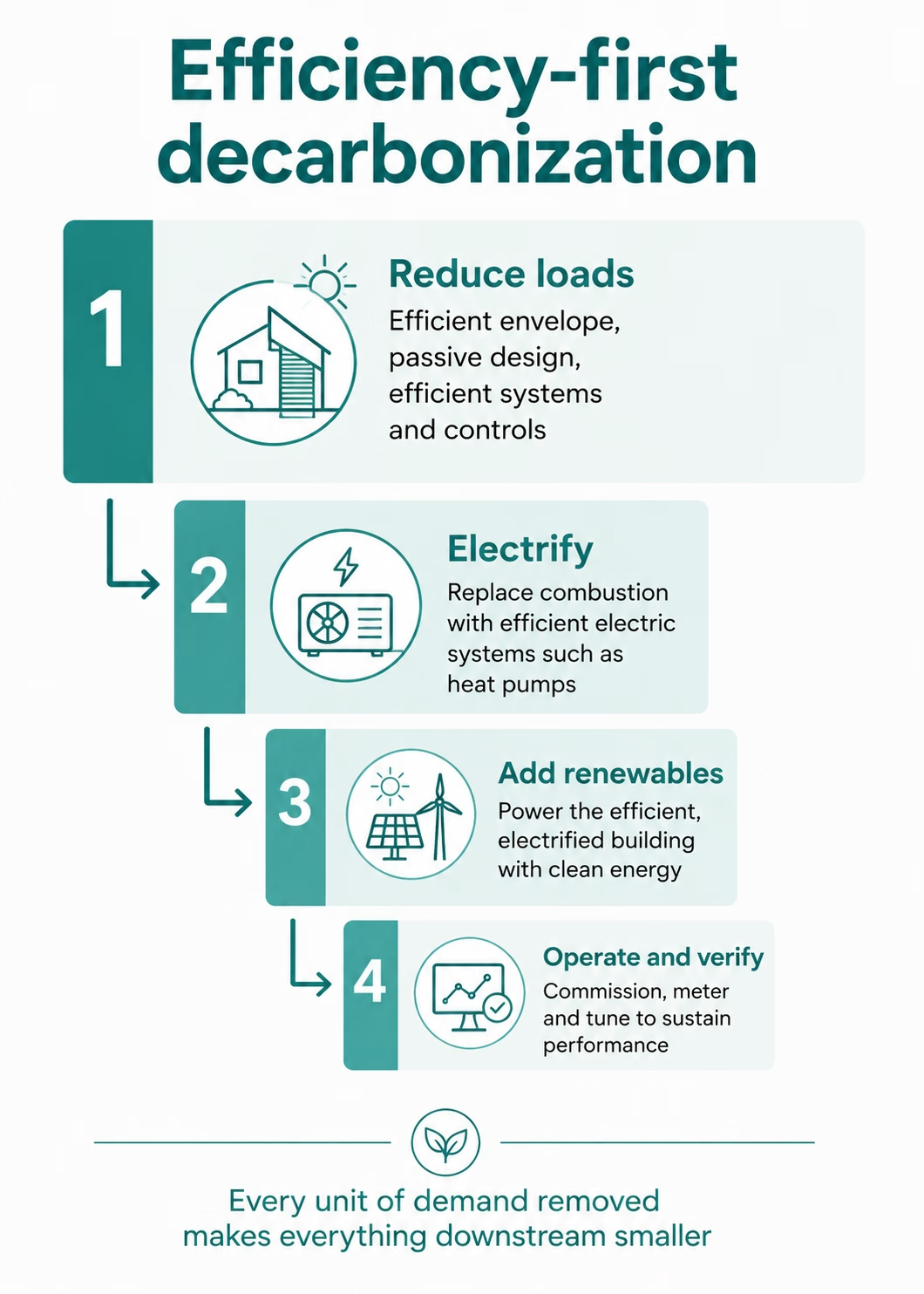
If you learn one practical sequence from this domain, use this one:
1.Reduce energy demand — improve the envelope, use passive strategies, and optimize systems and controls.
2.Electrify — replace combustion-based systems with efficient electric systems such as heat pumps where appropriate.
3.Add renewables — supply the building with renewable energy.
4.Operate and verify — commission, meter and monitor performance to maintain efficiency.
Improving energy efficiency before adding renewable energy can reduce the amount of energy the project needs to supply, making renewable-energy strategies more effective.
Metering and commissioning
Energy meters track use over time; a building automation system (BAS) controls HVAC, lighting and more for efficiency and comfort. Note that metering by itself saves nothing — it creates the information that lets people act. That distinction appears in questions across several domains.
Commissioning (Cx) verifies that systems perform as intended, measured against the Owner’s Project Requirements (OPR). It is repeatedly described as one of the most cost-effective ways to secure energy savings, because it catches faults that would otherwise run unnoticed for years.
Three types, and the exam expects you to tell them apart:
| Type | What it is |
| Building enclosure commissioning (BECx) | Commissioning focused on the building enclosure’s performance |
| Monitoring-based commissioning | Ongoing, data-driven commissioning using metered performance |
| Retro-commissioning | Re-tuning an existing building whose performance has drifted. |
Carbon and refrigerants — the “Atmosphere” half
Decarbonization means reducing or eliminating a building’s greenhouse gas emissions.
Global Warming Potential (GWP) compares how much one tonne of a gas warms the climate against one tonne of carbon dioxide. Carbon dioxide is the baseline.
Refrigerants are fluids that move heat by changing phase. Many are potent greenhouse gases and they leak, so LEED cares about selecting low-GWP refrigerants and managing leakage. This matters independently of how much electricity the cooling system uses — which is exactly why candidates who think of this category as purely about energy get caught.
Clean power and resilience
- Electrification and heat pumps. Heat pumps move heat rather than generating it, serving heating, cooling and hot water efficiently.
- Grid interactivity and demand response. Managing the level and, crucially, the timing of electricity use — shifting load on grid signals to cut peaks.
- Energy storage. Electrical or thermal storage on site for flexibility and backup.
- On-site versus off-site renewables. On-site renewable energy is generated and consumed where it is produced. Off-site is generated elsewhere and delivered.
- Renewable Energy Certificates (RECs). Fund renewable generation and account for green power. A REC is an off-site instrument — no electron reaches your building from that wind farm.
- Islanding. Isolating on-site generation so it can power critical loads when the grid fails. A solar array alone usually shuts down in an outage for safety reasons; islanding capability, generally with storage, keeps critical systems running.
- Passive survivability. A building’s ability to maintain critical liveable conditions if power, fuel or water is lost. It depends heavily on the envelope.
Synergies to recognise
The exam rewards spotting where one decision serves two categories:
- Envelope and comfort. A better envelope cuts energy and improves thermal comfort, which is Indoor Environmental Quality.
- Water and energy. Saving hot water saves water, energy and carbon — see Water Efficiency.
- Ventilation and energy. Energy recovery ventilation and demand-controlled ventilation deliver fresh air without paying full price to condition it.
Key terms to memorise
| Term | Definition |
| Building envelope | Roofs, walls, windows and foundation separating inside from outside |
| R-value | Resistance to conductive heat flow. Higher is better |
| Thermal bridge | A path where heat conducts through the envelope, bypassing insulation |
| Peak demand | The highest rate of electricity use measured during a specified time interval |
| Commissioning | A process of verifying that building systems are designed, installed and operating as intended and in accordance with project requirements |
| Global Warming Potential | How much one tonne of a gas warms the climate versus one tonne of CO2 |
| Renewable Energy Certificate | A tradable instrument representing the non-power attributes of renewable electricity generation |
| Demand response | Shifting or reducing electricity use in response to grid signals |
| Islanding | Isolating on-site generation to power critical loads during an outage |
| Passive survivability | Maintaining critical liveable conditions without power, fuel or water |
Where candidates lose marks
- Forgetting the “Atmosphere” half. Refrigerants, GWP and ozone depletion are all in scope and are easy marks once you expect them.
- Confusing the three types of commissioning. Enclosure, monitoring-based and retro are distinct.
- Confusing demand with consumption. A moment versus a total.
- Putting renewables before efficiency. Efficiency always comes first.
- Treating a REC as on-site generation. Both count as green power; only one produces electricity at the building.
- Confusing R-value with solar reflectance. R-value is conduction through an assembly; SRI is solar gain at a surface, and it belongs to Sustainable Sites.
Revision checklist
1.Define the envelope, R-value and thermal bridge without looking.
2.Distinguish plug, parasitic and process loads, and demand from peak demand.
3.Recite the efficiency-first order and explain why it is that way round.
4.Name the three types of commissioning and what each does.
5.Explain what GWP measures and why refrigerants matter.
6.Distinguish on-site renewables, off-site renewables and RECs.
7.Define islanding and passive survivability.
Test yourself
Work through our 15 Energy and Atmosphere practice questions, then the 50-question mock exam.
Frequently asked questions
How many Energy and Atmosphere questions are on the Green Associate exam?
15 of the 85 scored questions, joint largest with LEED Process.
Do I need to do energy calculations?
No. The Green Associate exam tests concepts and terminology. Calculation-heavy content belongs to the LEED AP specialty exams.
Why does this category carry the most points?
Because credit weighting follows environmental and human health impact, and building energy use is the largest single lever a project has over carbon emissions.
Are refrigerants really examinable?
Yes. Refrigerants and related concepts such as global warming potential, greenhouse gases and ozone depletion are within the Energy and Atmosphere knowledge domain.
Learning this properly
3FOLD TRAINING devotes a full module to Energy and Atmosphere in LEED Green Associate training, written to LEED v5. Ask us through the course enquiry form.



Leave a reply