
Indoor Environmental Quality is 8 of the 100 questions on the LEED Green Associate exam. It covers indoor air quality, thermal comfort, lighting, daylight, views, acoustics, biophilia, accessibility and adaptability.
It is also the domain candidates most often underestimate. The concepts feel intuitive, so people skim them, then lose marks on the two or three questions that turn on a precise definition. This page gives you the whole domain in the order it makes sense, with the definitions the exam actually tests.
Start here: what the domain is really about
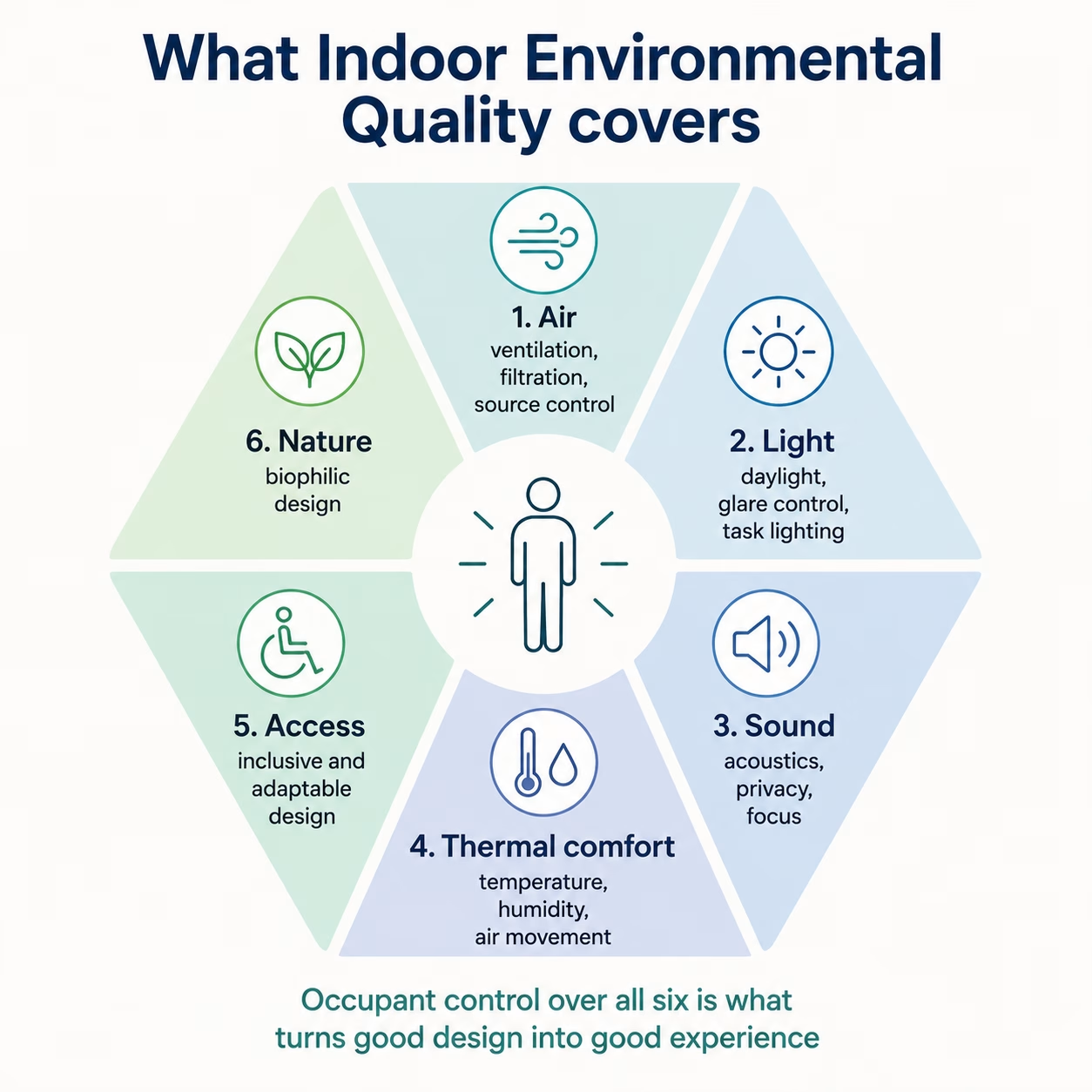
Indoor environmental quality (EQ) addresses indoor conditions that affect occupants’ health, wellbeing, comfort and experience, including air quality, thermal comfort, lighting, acoustics, accessibility and adaptability.
The reason LEED weights this domain so heavily is economic as much as ethical. The cost of a building’s occupants — their salaries, their productivity, their sick days — dwarfs the cost of running the building. A design change that improves concentration or reduces absence pays back faster than almost any energy measure. Two ideas run through everything that follows: prioritise the occupant’s needs, and give the occupant control.
People-centred design: inclusive and adaptable
Inclusive design considers the needs and experiences of a diverse range of occupants, including people with different ages and abilities. LEED v5 also addresses accessibility and adaptability as part of creating more inclusive occupant environments.
Adaptable environments are spaces that flex to changing needs and uses across the building’s life. A building that can become something else without being gutted has a longer useful life, which is a materials and carbon argument as much as a comfort one.
Occupant control gives people greater ability to adjust aspects of their immediate environment to suit their individual needs and preferences. Examples include thermal controls, task lighting, operable windows and adjustable workstations.
Light and sound
Lighting design at Green Associate level means three things: the right quality and quantity of light for the task, glare control, and controllability.
Daylighting is the intentional use of natural light — through windows, skylights and light shelves — to light interior spaces. The exam’s favourite trap is the assumption that more direct sunlight is better. It is not. Good daylighting is mostly indirect and diffused, with shading to control glare and unwanted heat gain. Uncontrolled direct sun creates glare, drives occupants to close blinds permanently, and adds a cooling load — losing the daylight and the energy saving at once. Done properly, daylighting cuts electric lighting energy and supports circadian health.
Acoustic comfort is the management of noise and sound quality within a space. It affects concentration, communication, learning, privacy and stress, and it is the single most common complaint in open-plan offices. The strategies are absorptive finishes, sound isolation between spaces, control of noisy equipment, and sensible layout — keeping loud activity away from quiet work.
Thermal comfort and biophilic design
Thermal comfort is satisfaction with the thermal environment. Note the word: satisfaction. It is a subjective condition, not a temperature. Six factors drive it — temperature, humidity, air movement, radiant conditions, the occupant’s activity level and their clothing — which is why one setpoint never satisfies a whole floor and why controllability matters so much.
Biophilic design incorporates connections to nature into the built environment. Strategies can include daylight and views of nature, natural materials, vegetation, water, and natural patterns and forms. LEED v5 recognizes biophilia as part of creating healthier and more engaging occupant environments.
Indoor air quality: keep pollutants out first
Indoor air quality (IAQ) is the quality of air in and around a building as it relates to occupant health and comfort.
The single most important idea in this section is source control: eliminating the sources of harmful contaminants. It is the first and most effective line of defence. Ventilating and filtering a pollutant out of the air is always more expensive and less reliable than not introducing it. This is where Indoor Environmental Quality meets Materials and Resources — specifying low-emitting materials reduces volatile organic compounds at source, so the paints, adhesives, sealants, flooring and furniture chosen for the project are an air-quality decision.
Sustainable construction management extends the same logic to the build. Jobsite practices that protect worker health and keep contaminants out of the finished building — protecting ductwork from dust, sequencing wet and absorptive materials so the absorptive ones do not soak up emissions, keeping the site dry — determine what the first occupants breathe.
Policies and pollutants
Environmental tobacco smoke (ETS) is secondhand smoke from someone else’s smoking device. No-smoking policies exist to keep it out of the building and away from entries and intakes.
No-vehicle-idling policies address the same problem from a different source. Vehicles idling near a building — at a loading dock, a drop-off, a queue — generate exhaust that outdoor-air intakes draw straight indoors.
Particulate matter (PM) is airborne particles. PM2.5 means particles with an aerodynamic diameter of 2.5 micrometres or smaller. These fine particles can penetrate deeply into the respiratory system and are an important indoor-air-quality concern.
Moisture, cleaning and pests
Mould prevention is primarily a moisture-management issue. Control moisture, address water intrusion promptly and protect moisture-sensitive materials to reduce conditions that support mould growth.
Green cleaning means cleaning processes and products that reduce chemical exposure for occupants and cleaning staff while keeping the building hygienic.
Integrated pest management (IPM) is managing pests using the most effective, lowest-risk options — addressing the food, water and entry points that attract pests before reaching for pesticides.
Both are operational strategies. They matter because a building certified on day one can quietly lose its air quality over ten years of routine maintenance decisions.
Maintaining and optimising over time
Continuous indoor air monitoring means automatically measuring pollutants — carbon monoxide, carbon dioxide, particulates, VOCs — frequently over time, rather than a one-off test at handover. It turns air quality into something a facilities team can manage.
Demand-controlled ventilation adjusts outdoor-airflow rates in response to changing occupancy or other operating conditions. CO₂ sensors are commonly used as an indicator of occupancy and ventilation demand, while required minimum outdoor-air ventilation must still be maintained.
Passive survivability is the ability of a building to maintain critical conditions for occupant safety and habitability during disruptions to essential services. Passive strategies such as insulation, solar control, daylight and natural ventilation can improve resilience during outages.
Key terms to memorise
| Term | Definition the exam expects |
| Indoor environmental quality (EQ) | The conditions in a space that affect occupants’ health, safety, wellbeing and quality of life |
| Inclusive (universal) design | Designing environments to consider the needs and experiences of a diverse range of occupants, including people with different ages and abilities |
| Adaptable environment | A space that flexes to changing needs and uses over the building’s life |
| Daylighting | Intentionally bringing natural light into a space, with shading and glare control |
| Acoustic comfort | Management of noise and sound quality within a space |
| Thermal comfort | Satisfaction with the thermal environment, influenced by air temperature, mean radiant temperature, air speed, humidity, metabolic rate and clothing insulation |
| Biophilic design | Connecting occupants to nature to improve wellbeing and stewardship |
| Indoor air quality (IAQ) | The quality of air in and around a building as it relates to occupant health and comfort |
| Source control | Eliminating the sources of harmful contaminants — the first line of defence for IAQ |
| Low-emitting materials | Products and materials evaluated for relevant chemical emissions that can affect indoor air quality; addressed under Materials and Resources in LEED v5 |
| Environmental tobacco smoke (ETS) | Secondhand smoke from another person’s smoking device |
| PM2.5 | Particulate matter 2.5 micrometres or smaller — fine enough to reach deep into the lungs |
| Integrated pest management (IPM) | Managing pests with the most effective, lowest-risk options |
| Green cleaning | Cleaning processes and products that reduce chemical exposure |
| Continuous indoor air monitoring | Ongoing measurement of specified indoor-air parameters using monitoring equipment at defined intervals |
| Demand-controlled ventilation | Adjusting outdoor airflow to actual occupancy, usually via CO2 sensors |
| Passive survivability | Maintaining critical life-support conditions if power, fuel or water is lost |
Two standards you must not mix up
This is the highest-yield fifteen seconds of revision in the domain, because the exam tests it and candidates routinely get it backwards.
| Standard | What it covers |
| ASHRAE 62.1 | Ventilation and acceptable indoor air quality for nonresidential buildings |
| ASHRAE 55 | Thermal environmental conditions for human occupancy and thermal comfort |
| ASHRAE 90.1 | Energy efficiency of buildings, including requirements affecting building systems |
A memory hook that survives exam pressure: 62.1 has more digits, and it is about the air you breathe; 55 is the shorter number, and it is about how you feel.
Synergies to recognise
Scenario questions reward candidates who can see one strategy delivering two benefits.
- Daylighting and energy. Natural light improves wellbeing and cuts electric lighting load — provided glare and heat gain are controlled, or the cooling penalty eats the saving.
- Low-emitting materials and Materials and Resources. The same specification decision protects air quality and reduces material impact.
- Passive survivability and Energy and Atmosphere. A well-insulated, well-shaded, naturally ventilated envelope is both an energy strategy and a resilience strategy.
- Demand-controlled ventilation and energy. The classic case of two goals that look opposed being resolved by better control rather than by compromise.
- Green cleaning, IPM and the operations phase. Certification is a snapshot; these keep the performance real.
Where candidates lose marks
- Confusing ASHRAE 62.1 with ASHRAE 55. Ventilation versus thermal comfort. Fix it now and it stays fixed.
- Treating daylighting as “maximum glass”. The correct answer nearly always involves diffused light and shading, not more direct sun.
- Reaching for ventilation when the question wants source control. Diluting a pollutant is second best; not emitting it is first.
- Defining thermal comfort as a temperature. It is satisfaction, and it depends on six factors.
- Treating mould as a cleaning issue. It is a moisture issue.
- Forgetting that IEQ includes access and inclusion. Candidates revise air and light and are then surprised by an inclusive-design question.
- Assuming fresh air and energy efficiency are a trade-off. Demand-controlled ventilation exists precisely because they need not be.
Revision checklist
You are ready on this domain when you can, without looking:
1.Define indoor environmental quality in one sentence that mentions health, safety, wellbeing and quality of life.
2.Name the six things IEQ covers — air, light, sound, thermal comfort, access and connection to nature.
3.Explain inclusive design and adaptable environments, and give an example of each.
4.State why good daylighting is indirect and shaded.
5.List four acoustic strategies.
6.List the factors that determine thermal comfort and explain why occupant control matters.
7.Define source control and explain why it beats ventilation.
8.Say what ASHRAE 62.1 and ASHRAE 55 each cover, without hesitating.
9.Explain why PM2.5 is the fraction that matters.
10.Explain what demand-controlled ventilation does and what it senses.
11.Define passive survivability and connect it to resilience.
12.Explain why green cleaning and IPM belong in a design credential’s syllabus.
Test yourself
Reading is not revision. Work through our Indoor Environmental Quality practice questions, then sit the 50-question mock exam under time.
Frequently asked questions
How many Indoor Environmental Quality questions are on the LEED Green Associate exam?
8 of the 100 exam questions.
What is the difference between ASHRAE 62.1 and ASHRAE 55?
ASHRAE 62.1 covers minimum outdoor-air ventilation and indoor air quality. ASHRAE 55 covers thermal comfort.
Is thermal comfort just about temperature?
No. Thermal comfort is satisfaction with the thermal environment, and it depends on temperature, humidity, air movement, radiant conditions, the occupant’s activity level and their clothing.
Why is source control important for indoor air quality?
Because controlling or eliminating pollutant sources can reduce the amount of contamination that needs to be addressed through ventilation or filtration. LEED treats source control, contaminant removal and adequate outdoor-air ventilation as complementary strategies for maintaining good indoor air quality.
Learning this properly
3FOLD TRAINING teaches air, light, sound, comfort and inclusive design as a full module in LEED Green Associate training, written to LEED v5. Ask us through the course enquiry form.




Leave a reply