
LEED AP BD+C is worth it if you work on LEED projects, or want to, in a market that uses LEED. It is not worth it as a general career upgrade, and it is not worth it if nobody around you is certifying buildings. That is a less satisfying answer than a salary figure, and it is the honest one. We sell LEED AP training, so this page also tells you when the answer is no.
Why we will not answer this with a number
Pages on this query tend to lead with a salary figure. We do not publish one anywhere on this site, and the reason is worth understanding before you read anyone else’s.
When we looked at what comes back from a search for what a LEED credential is worth, two kinds of page dominated: aggregator listings built around job titles that are rarely advertised as such, and figures that on inspection described a specific employer’s own roles rather than the market. Neither answers “what will this credential do for my earnings”, and a number lifted from either and presented as the answer is worse than no number, because it looks like evidence.
What the published figures actually show, and why they conflict, is set out in the LEED AP BD+C salary question. We would rather publish nothing on this than publish a number we cannot stand behind.
What the credential actually signals
Start with what it is, because the value follows from that.
LEED Green Associate signals that you understand green building and the LEED framework. It is a knowledge credential.
LEED AP with Specialty is tested against project practice in a particular project type. The handbook states that “practitioner competency and project proficiency is tested objectively within the exam” — the exam is built around judgement rather than recall.
That difference is the whole value proposition. Green Associate is assessed on knowing what LEED is. AP is assessed on the decisions a project throws at you.
The four situations where it is clearly worth it
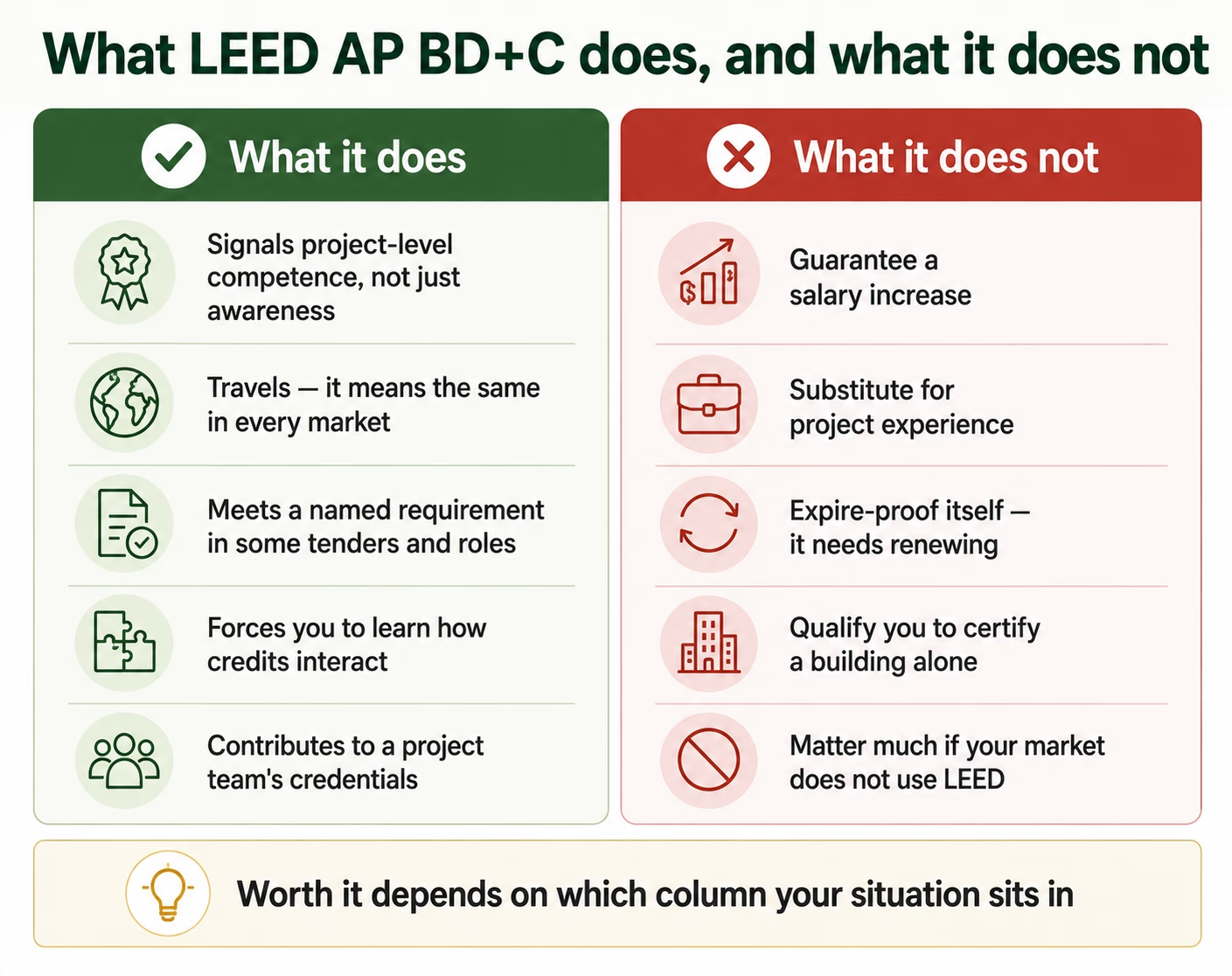
1.You work on LEED projects now. The strongest case, and the simplest. The credential formalises competence you are already using, your day job doubles as preparation, and it removes the awkward gap between what you do and what you can demonstrate.
2.Your market uses LEED heavily. Certified space needs people who know how to document it, and in markets with a lot of LEED activity that is ordinary professional competence rather than a specialism. The Chinese Mainland, Canada, India, South Korea and the United Arab Emirates led GBCI’s 2024 ranking of countries and regions outside the United States, measured by gross square metres of certified space — see which countries use LEED the most.
3.Your organisation bids for work that asks for it. Some tenders and some client frameworks name credentialed professionals on the project team. If yours do, the credential is a business input rather than a personal one, and the value question is your employer’s as much as yours. Which roles actually name it is in LEED AP jobs.
4.You are moving from adjacent work into sustainability delivery. An engineer, architect or project manager stepping toward certification work has a credibility problem that a credential solves efficiently — it is a verifiable, externally assessed signal, which a claim on a CV is not.
The situations where the answer is no
Four where the answer is no, and one where it is not yet.
Your market does not use LEED, and is not going to. If the buildings around you certify under a national system and LEED never comes up, the credential’s value to you is mostly portability — real if you intend to move or work internationally, thin if you do not. The local system may be the better investment. We say the same thing on the market pages, including LEED certification in the GCC.
You want a general career boost and LEED is arbitrary. A credential that has nothing to do with your work is a line on a CV that invites a question you cannot answer. If the goal is progression rather than LEED specifically, something aligned to your actual discipline will do more.
You are hoping it will substitute for experience. It will not, and the exam is designed so that it does not. See the experience question.
Not yet, rather than no: if you have not sat Green Associate and are unsure about the whole area, the AP question is premature. Green Associate is the smaller commitment and is the prerequisite in any case, so taking them in order answers the AP question for you. We sell training for both, so treat that sequencing advice accordingly.
You are choosing the wrong specialty. BD+C is for new construction and major renovations. If your work is operations, interiors, housing or masterplanning, a different specialty is the right credential — and we do not teach those. See which LEED AP specialty should you choose.
What it costs you, beyond the fee
Three things, and only one of them is money.
The exam fee. Published by USGBC and GBCI, and payable in full again on a retake — there is no reduced resit rate. Current fees are in the LEED AP exam cost.
Study time. The AP exam is 100 multiple-choice questions in two hours, scored 125 to 200 with a pass at 170. The current LEED AP BD+C exam specifications include Task Domains covering LEED Project and Team Coordination, LEED Certification Process, Analyses Required for LEED Credits, and Advocacy and Education for Adoption for the LEED Rating System. How much genuinely new material that represents is in from LEED GA to LEED AP.
Maintenance, permanently. This is the cost people forget. LEED AP with Specialty must be renewed every two years by earning and reporting continuing education hours. The credential is a subscription, not a purchase.
The requirement is 30 continuing education hours in each two-year period, at least 6 of them LEED-specific. That is less painful than it sounds, because of an under-published rule: project participation earns continuing education hours, at one hour per credit, uncapped. For a professional working on certifications, a substantial part of the requirement can be met by the work itself. Details in how to maintain your LEED AP BD+C credential and free LEED CE hours.
The question that actually decides it
Not “is LEED AP valuable” — that has no answer in the abstract. Ask instead:
In two years’ time, will I have been on a LEED project?
If yes, get the credential, and get it before the project rather than after. If no, and you cannot see how that changes, the honest answer is that your money and your evenings have a better use.
And if the answer is “I don’t know, but I want to be”, that is the case for Green Associate first. It is the prerequisite, it is the smaller commitment, and it answers the question for you.
Our interest, stated plainly
3FOLD TRAINING sells LEED AP BD+C training. A reader who decides the credential is worth it is a reader who might buy from us, and you should read this page with that in mind.
Which is why the section above exists. A person who takes an exam that does nothing for them does not come back and does not recommend us, so losing that sale costs us less than making it. No course is required to sit this exam, including ours; candidates do pass on self-study, and if that is your route, our LEED AP BD+C study materials page is written to be useful to you whether you buy anything or not.
Frequently asked questions
Is LEED AP BD+C worth it?
It is worth it if you work on LEED projects or intend to, in a market that uses LEED. It is not worth much as a general career upgrade, or in a market where buildings certify under a national system and LEED does not come up.
What is the difference in value between LEED Green Associate and LEED AP?
Green Associate signals that you understand green building and the LEED framework. LEED AP with Specialty signals that you can work on a certification in a particular project type, because the exam tests practitioner competency and project proficiency rather than recall.
Does LEED AP increase your salary?
We do not publish a figure. The published numbers we examined came largely from aggregator listings built around job titles that are rarely advertised as such, and from figures describing a specific employer’s own roles rather than the market. Neither answers the question a candidate is asking.
When is LEED AP not worth it?
Four situations: when your market does not use LEED and you do not intend to work internationally, when you want a general career boost rather than LEED specifically, when you are hoping it substitutes for project experience, and when a different specialty matches your work better. A fifth case is not so much no as not yet: if you have not sat Green Associate, the AP question is premature.
Does the credential expire?
It has to be renewed every two years by earning and reporting continuing education hours: 30 hours per period for LEED AP with Specialty, at least 6 of them LEED-specific. Project participation earns continuing education hours at one hour per credit and is not capped, so for a professional working on certifications part of the requirement is met by the work itself.
Do I need a training course to pass LEED AP BD+C?
No. No course is required to sit or pass the exam, and candidates do prepare successfully by self-study.
Should I do LEED Green Associate first?
Unless you already hold an active LEED AP with Specialty credential, yes: an active Green Associate credential is what makes you eligible to register for the AP exam. It is also the smaller commitment, so it is a reasonable way to find out whether this subject suits you before spending on the larger exam.
If you decide it is worth it
3FOLD TRAINING has prepared professionals for certification exams since 2008, across more than 100 countries. Our LEED AP BD+C training runs online and in person, for individuals and for project teams. Ask through the course enquiry form — including if you want a straight answer about whether the credential fits your situation.




Leave a reply