
The step from LEED Green Associate to LEED AP BD+C is smaller in content than it looks and larger in kind. Both exam specifications are built on the same eight knowledge domains and both carry 85 scored questions. What changes is the weighting — energy and carbon get heavier, LEED process gets much lighter — and, more importantly, what the questions ask you to do with the material. This page puts numbers on it.
What this page is, and is not
If you want to know what each credential is and who holds which, that is the difference between LEED GA and LEED AP.
This page answers a narrower question: having passed Green Associate, how much of AP BD+C is genuinely new?
What stays the same
More than you would guess, and it is worth listing because it is the encouraging half.
| The eight knowledge domains | The same eight, in both exam specifications |
| Scored questions | 85, both exams. The exam is 100 questions; the other 15 are unscored and placed at random |
| Format | 100 multiple-choice questions, two hours |
| Scoring | Scaled 125 to 200, pass at 170 |
| One correct answer per question | Same |
You are not starting a new syllabus. You are being asked different questions, in different proportions, about a structure you already know the shape of. That reframing is the single most useful thing a Green Associate can carry into AP preparation.
What actually changes
The weighting. Both exams contain 85 scored questions distributed across nine Knowledge Domains, weighted differently. Energy and Atmosphere rises from 10 questions on the Green Associate exam to 14 on AP BD+C, while LEED Process falls from 16 to 8:
| Knowledge domain | LEED GA | LEED AP BD+C | Change |
| Project surroundings and Public Outreach | 11 | 4 | -7 |
| Energy and Atmosphere | 10 | 14 | +4 |
| Integrative Strategies | 8 | 9 | +1 |
| Materials and Resources | 9 | 12 | +3 |
| Indoor Environmental Quality | 8 | 11 | +3 |
| Sustainable Sites | 7 | 9 | +2 |
| Location and Transportation | 7 | 9 | −2 |
| Water Efficiency | 9 | 9 | 0 |
| LEED Process | 16 | 8 | −8 |
| Total scored | 85 | 85 | 0 |
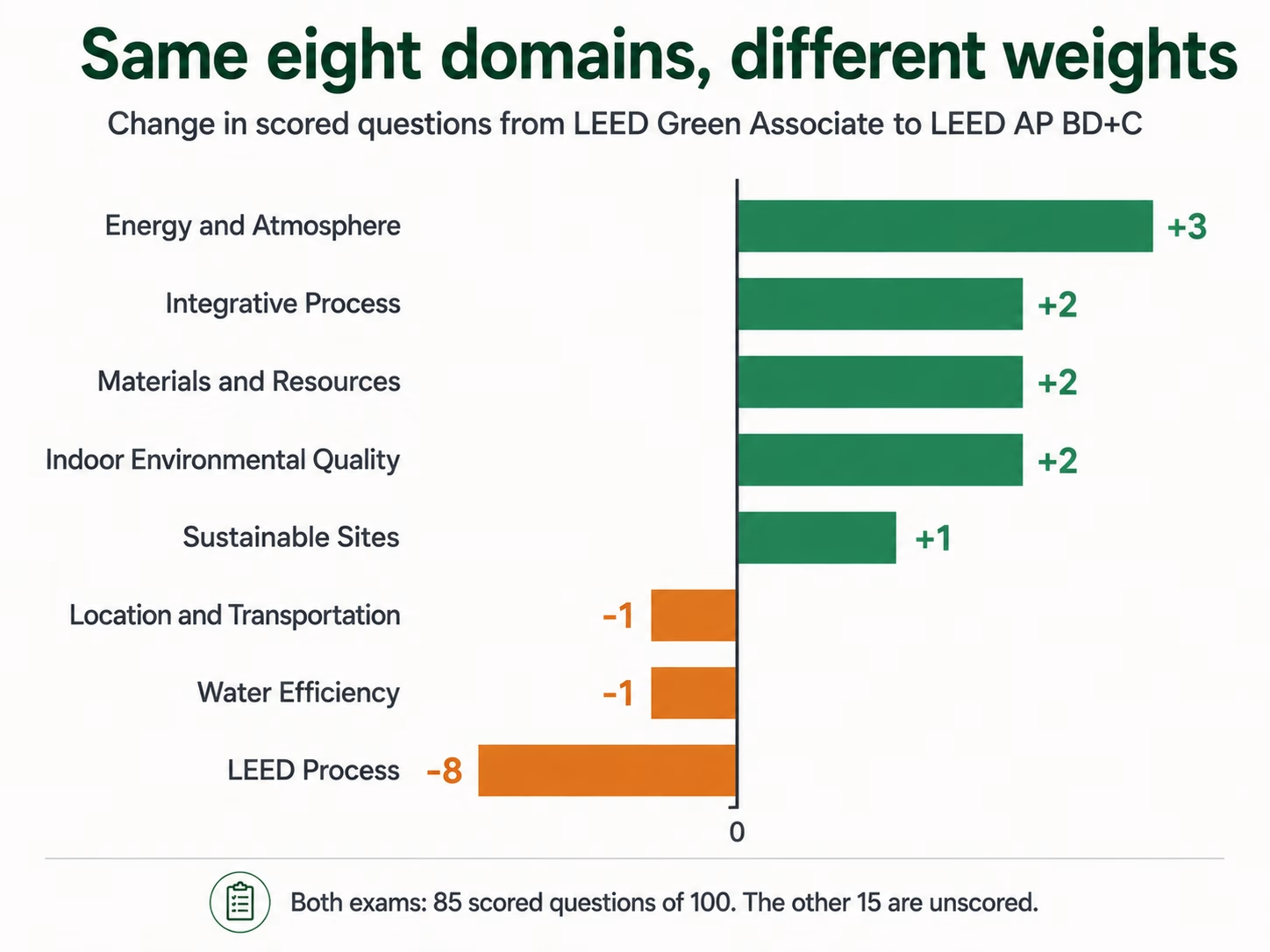
The inversion worth staring at
LEED Process is the joint largest domain on the Green Associate exam at 15 questions, and the smallest on AP BD+C at 7. It more than halves.
That is not because the process stops mattering. It is because Green Associate is testing whether you understand how LEED works as a system — who certifies, how registration and review proceed, what the rating systems are for. At AP level that is assumed. You are past the explanation and into the project.
Energy and Atmosphere goes the other way, from 15 to 18 — the largest single domain on the AP exam. Combined with Materials and Resources at 13 and Indoor Environmental Quality at 13, the three technical delivery domains carry 44 of the 85 scored questions between them.
Read the two movements together and the exam tells you what it is: less about the framework, more about the building.
The change that matters more than the weighting
Now the harder part, which no table shows.
Green Associate largely asks what things are. AP BD+C asks what you would do.
A Green Associate question can reasonably ask which category a credit sits in, or what a prerequisite is for. An AP question is more likely to describe a situation and ask which action follows — where a design change has knock-on effects, where two credits interact, where the obvious answer is the one that fails on evidence.
The handbook is direct about this: “practitioner competency and project proficiency is tested objectively within the exam”, and prior LEED project experience is “strongly recommended” though not required. That is not decoration. It describes the kind of question you will meet.
Which produces the counter-intuitive shape of the step:
| New structure | None — the same nine domains, reweighted |
| New depth | Substantial, concentrated in energy, materials and indoor environment |
| New kind of thinking | The real step. Judgement rather than recall |
Candidates who find AP harder than expected are often not short of knowledge. They are answering a question about a project decision with a definition.
Where to put your preparation
Four things follow directly from the table.
1.Energy and Atmosphere first, and give it disproportionate time. It is the largest domain at 18, it grew, and its subject matter — modelling, systems, commissioning, metering, renewables — is where a Green Associate’s understanding is most likely to be at the level of vocabulary rather than mechanism. Start here: Energy and Atmosphere for LEED AP BD+C.
2.Deepen materials and indoor environment. Both rise to 13, and both are areas where Green Associate-level familiarity with the vocabulary will not carry you — documentation, disclosure and evidence are where the depth sits.
3.Do not abandon the LEED Process, but do not over-study it. Seven questions still exist, and this is the material a Green Associate knows best — which is exactly why it is tempting to keep revising it. Revising what you already know feels like preparation without being it.
4.Change what you practise on. This is the one that matters most and is easiest to skip. If your Green Associate revision was definitions and flashcards, that method has now hit its ceiling. Work on questions written as project decisions — see LEED AP BD+C practice questions and the questions candidates get wrong.
How long it takes
We do not publish an hours figure as though it were official, because USGBC does not publish one and the honest range is wide — it depends almost entirely on whether you have worked on a certification. What we can say from experience, and how to plan around it, is in how long to study for the LEED AP BD+C exam, with a structured schedule in the six-week LEED AP BD+C study plan.
One timing point is genuinely useful though: the gap between the two exams is worth keeping short. The domains are shared, so Green Associate material is AP foundation while it is still fresh. Leaving several years between them means relearning ground you have already covered.
Before you register
Two practical checks.
Your Green Associate credential must be active at the point you register, not merely at the point you sit. A lapsed credential has to be dealt with first — LEED AP requirements covers this.
Confirm which version you are being examined on. BD+C is transitioning to LEED v5 and version arrangements move; see LEED AP BD+C v5 exam changes and check the handbook before you buy study material for the wrong version.
The honest summary
If you passed Green Associate and understood it rather than memorised it, you already hold most of the map. What AP adds is depth in three technical domains and a different kind of question throughout.
The candidates who struggle are the ones who prepared for Green Associate by memorising and are now trying the same method on an exam built to defeat it. The ones who find it manageable are the ones who understood how the credits fit together the first time — and are now being asked to use that.
Frequently asked questions
How much harder is LEED AP than LEED Green Associate?
The subject matter is the same nine knowledge domains, so there is little genuinely new material. What changes is depth, concentrated in energy, materials and indoor environment, and the kind of question: Green Associate largely asks what things are, while AP BD+C asks what you would do in a project situation.
Do LEED GA and LEED AP cover the same domains?
Yes. Both current exam specifications use the same nine Knowledge Domains, weighted differently, and the Knowledge Domain specifications account for 85 scored questions out of the 100-question exam.
How do the domain weights change from GA to AP BD+C?
Energy and Atmosphere rises from 10 to 14; Integrative Strategies rises from 8 to 9; Location and Transportation rises from 7 to 9; Sustainable Sites rises from 7 to 9; Water Efficiency remains at 9; Materials and Resources rises from 9 to 12; Indoor Environmental Quality rises from 8 to 11; LEED Process falls from 16 to 8; and Project Surroundings and Public Outreach falls from 11 to 4.
Why does the LEED Process shrink so much on the AP exam?
Because Green Associate tests whether you understand how LEED works as a system, and at AP level that is assumed. The AP exam moves past the framework and into project delivery, which is why the three technical domains of energy, materials and indoor environment carry 37 of the 85 scored questions between them.
Which domain should I study first for LEED AP BD+C?
Energy and Atmosphere. It is the largest Knowledge Domain at 14 scored questions, up from 10 on the Green Associate specification.
Should I take LEED AP straight after LEED Green Associate?
Keeping the gap short helps, because the two exams share the same domains and Green Associate material is AP foundation while it is still fresh.For the specialty-only AP exam, your Green Associate credential must be active when you register and remain active through the exam date.
Can I use my LEED Green Associate study materials for LEED AP?
Partly. The domains are the same, so the structure carries over, but the depth required in energy, materials and indoor environment is greater, and definition-based revision reaches its ceiling on an exam built around project judgement. Check also that any material matches the LEED version you are being examined on.
Making the step
3FOLD TRAINING has prepared professionals for certification exams since 2008, across more than 100 countries, and trains both credentials. Our LEED AP BD+C training is built around credit interactions and project decisions rather than definitions, which is the specific gap this page describes. No course is required to sit the exam, ours included. Ask through the course enquiry form.


Leave a reply