
LEED AP BD+C for MEP Engineers
You will start ahead and you can still fail. Energy and Atmosphere is the largest knowledge domain in the current LEED AP BD+C exam specification, but technical familiarity does not by itself determine exam performance.
Energy and Atmosphere is the largest knowledge domain in the current USGBC-published AP BD+C exam specification, at 14 questions. If you model buildings for a living, some of this content may already be familiar, but that does not by itself determine exam performance.
The exam is not won there, and in our teaching engineers lose ground by preparing hardest for the part they were already best at.
Your advantage, measured
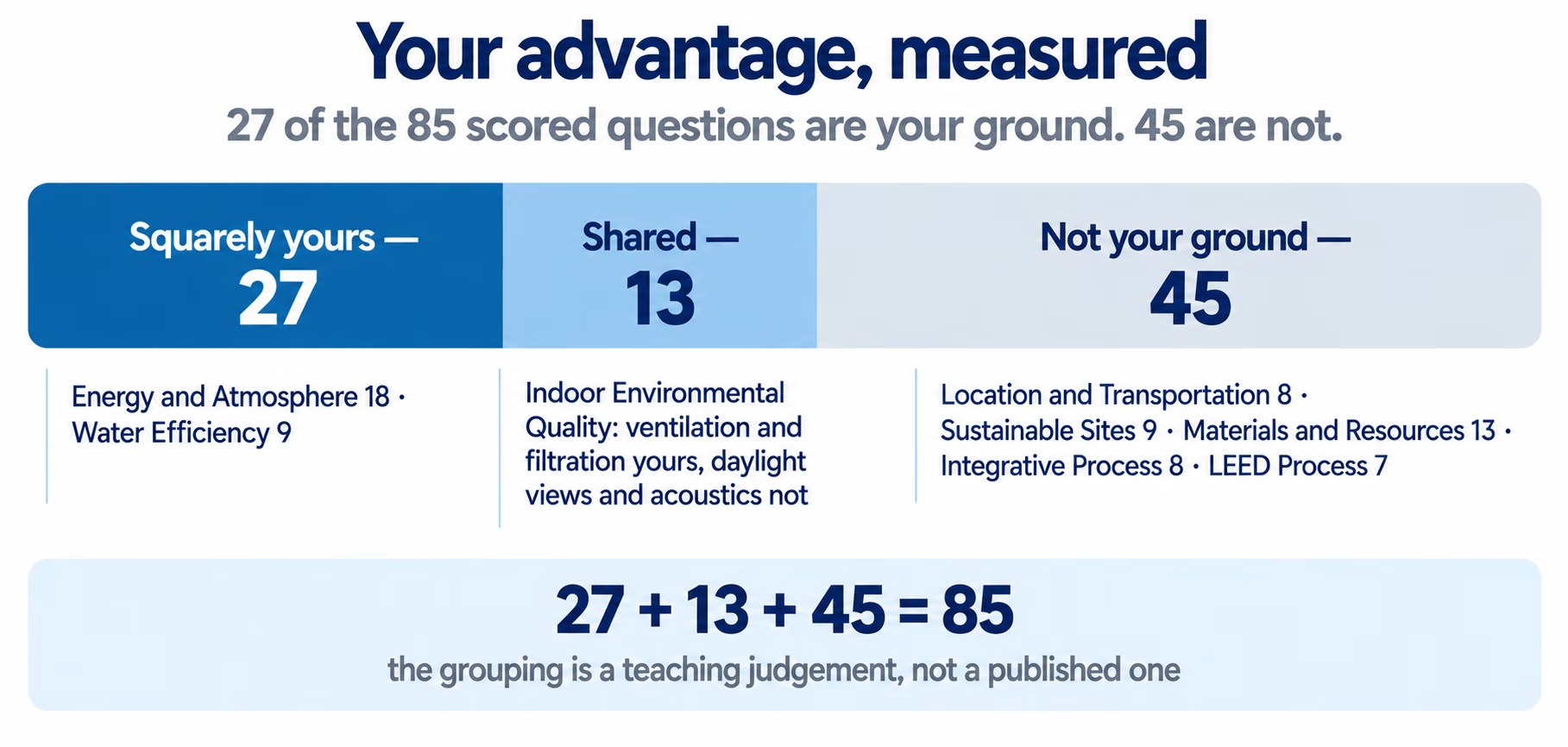
The current USGBC specification organizes the LEED AP BD+C exam content across nine knowledge domains. Grouped by whose daily work they sit in — our judgement, not a published classification — an MEP engineer's position looks like this:
| Territory | Domains | Scored questions |
|---|---|---|
| Squarely yours | Energy and Atmosphere 14 · Water Efficiency 9 | 23 |
| Shared | Indoor Environmental Quality 11 — ventilation and filtration are yours; daylight, views and acoustics are not | 11 |
| Not your ground | Location and Transportation 9 · Sustainable Sites 9 · Materials and Resources 12 · Integrative Strategies 9 · LEED Process 8 · Project Surroundings and Public Outreach 4 | 51 |
| Total | 85 | |
Where knowing the subject is not the same as knowing LEED's version of it
This is the specific failure mode for technically strong candidates, and it happens inside your own domain rather than outside it.
The energy prerequisite's Performance Index is proposed divided by baseline, so a lower index is a better building — and the credit's index path reads the same way, with a lower index earning more points. Almost everything else in LEED reads upwards, and a candidate moving quickly picks the larger figure by reflex.
For LEED v5 BD+C projects registering before January 1, 2028, the energy prerequisite permits either ASHRAE 90.1-2019 with addendum cr or ASHRAE 90.1-2022. Projects registering on or after January 1, 2028, must use ASHRAE 90.1-2022. Under the 2019 option, addendum cr is required.
The Core and Shell energy basis is the greater of metered base building consumption or a share of total estimated building energy use, which is why percentages above 100% are possible. Nothing about that is an engineering question.
Several credits consume another credit's output. Knowing the calculation is not the same as knowing which item feeds it.
Live-project note: The edition rule and the Core and Shell energy basis above are as taught in our LEED AP BD+C v5 course material and reflect LEED v5 BD+C. Confirm against the LEED v5 BD+C Reference Guide and the addenda database before relying on them for a live project.
The domain itself is covered in Energy and Atmosphere for LEED AP BD+C, and the arithmetic traps are covered in the LEED AP BD+C cheat sheet .
The questions that are not yours
Named plainly, because a plan that does not name them will not cover them.
| Domain | Questions | What it actually asks of you |
|---|---|---|
| Materials and Resources | 12 | Documentation and data conformance. What a product declaration must conform to, what belongs in a denominator, which tonne may be counted where. Much of it is documentation rather than technique. |
| Sustainable Sites | 9 | Site ecology, heat island, light pollution, and a resilience credit that depends on an assessment made under a different category. |
| Location and Transportation | 9 | Density, parking, bicycle provision and proximity to transit and amenities. Several of the proximity figures are walking distances rather than straight-line radii — check which measure each credit uses. |
| Integrative Strategies | 9 | The assessments that feed other categories, including the ones your own work depends on. |
| LEED Process | 8 | Boundaries, occupancy, rating system selection and certification levels. Bounded and factual, and in our teaching the quickest domain to bring up to full marks. |
Two of those five are quick. LEED Process and Integrative Process are largely learnable by reading. Materials and Resources is the one to give real time to because a substantial number of questions sit there and little of it is intuitive to an engineer.
Why the credential is worth holding in an engineering role
LEED v5 BD+C awards a project a point where a principal participant of the team is a LEED AP with a specialty appropriate for the project. On many jobs the architect may be the natural holder of that point — but on engineering-led projects, refurbishments and design-build arrangements, the engineer may be the continuous senior presence.
Project-use note: The point value and the credit's requirements are as taught in our LEED AP BD+C v5 course material and reflect LEED v5 BD+C. Confirm against the LEED v5 BD+C Rating System before relying on them for a live project.
The narrower and more reliable reason: you are already doing the work the largest domain describes. The credential lets your practice put that on a bid sheet as a named accreditation rather than as an assertion about capability.
How to plan it if you are an engineer
Do not start with Energy and Atmosphere. Starting where you are strongest feels productive and buys you almost nothing. Our six-week plan puts it in week four for everyone; if you are an engineer, treat that week as a review rather than as learning.
Give Materials and Resources a full share. It is unfamiliar territory for many engineers and focuses heavily on the documentation, data and requirements used to demonstrate compliance.
Take LEED Process and Integrative Strategies early and finish them. Together they account for 17 questions on the current exam specification.
Practise the direction check on every ratio. Ask what the quantity measures. Ratios to a baseline and hazard measures read downwards; almost everything else reads upwards.
Work problems rather than reading. Technical confidence is not a substitute for practice on the documentation and denominator questions, which is where this domain's marks actually sit.
Frequently Asked Questions
Is LEED AP BD+C easier for MEP engineers?
In part. Energy and Atmosphere is the largest knowledge domain at 14 of the 85 scored questions, and Water Efficiency adds 9, so 23 questions fall in areas that may be especially familiar to MEP professionals. But the remaining domains still cover substantial areas outside a typical MEP engineer's day-to-day work. That grouping is our teaching judgement rather than a published classification.
Which LEED AP BD+C domains are hardest for engineers?
Materials and Resources, at 12 scored questions, can be particularly unfamiliar. Much of it is documentation and data conformance rather than technique. Sustainable Sites and Location and Transportation add further material in territory an MEP engineer may rarely touch.
How does the LEED energy Performance Index work?
It is proposed divided by baseline, which means a lower index is a better building. The energy credit's index path reads the same way, with a lower index earning more points. Almost everything else in LEED reads upwards.
Do I need to be an energy modeller to pass LEED AP BD+C?
No. The exam asks what the prerequisites require, what the compliance paths are, which edition of the energy standard applies to a given registration date, and which direction the index reads in. Modelling experience helps you recognise the vocabulary; it does not answer all of the documentation and denominator questions.
Can an engineer be the LEED AP on a project?
Yes. The credit requires at least one principal participant of the project team to be a LEED AP with a specialty appropriate for the project, and it does not specify a profession. An engineer can therefore qualify when they are a principal participant and hold the appropriate LEED AP specialty.
Where should an MEP engineer start studying for LEED AP BD+C?
Not with Energy and Atmosphere. Starting where you are strongest feels productive and gains little. Take LEED Process and Integrative Strategies early, give Materials and Resources a full share of the time, and treat the energy week as review rather than as learning.
Is Water Efficiency straightforward for engineers?
The fixture and irrigation arithmetic may be familiar, but the v5 Water Efficiency category covers four requirements: two prerequisites and two credits. Studying it only from the scorecard can therefore miss the range of requirements within the category.
Does LEED AP help an engineer more than a professional licence?
They do different things and neither substitutes for the other. A licence establishes what you may sign; the LEED credential allows a qualifying project team member to meet the LEED AP requirement when the applicable credit conditions are satisfied.
If you want to know how far ahead you actually are
3FOLD TRAINING has prepared professionals for certification exams since 2008, across more than 100 countries. Tell us what you work on through the course enquiry form and we will give you a straight read on which parts of the syllabus you can move through quickly and which you cannot.
Our LEED AP BD+C training is one route and no course is required to sit or pass the exam, ours included.
Prepare for the LEED AP BD+C Exam
Explore our LEED AP BD+C training for structured exam preparation across the full syllabus, including the domains that may be less familiar even when you already have strong MEP engineering experience.


Leave a Reply
Your email is safe with us.