

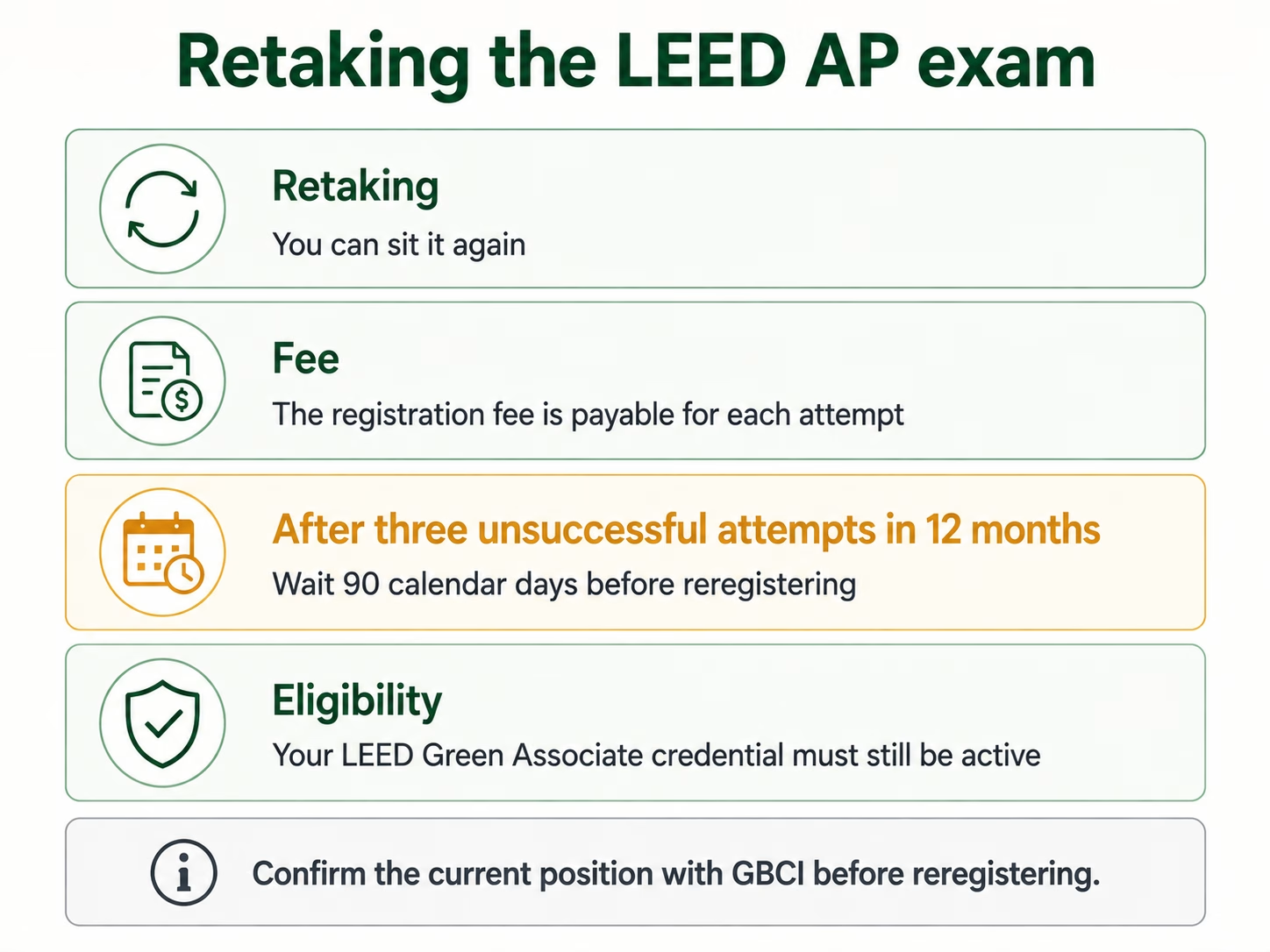
You can retake it. The handbook sets out two things: the registration fee is payable for each attempt, and after three unsuccessful attempts within 12 months you must wait 90 calendar days before reregistering. Below are the rules, and then a recovery plan you can run yourself — which matters, because you will not be able to review the paper.
The rules, quickly
| Can you retake it? | Yes |
| Cost | The exam registration fee is payable for each attempt |
| After three unsuccessful attempts in 12 months | Wait 90 calendar days before reregistering |
| Eligibility | Your LEED Green Associate credential must be active when you reregister |
| Anything else? | If you are approaching repeated attempts, confirm the current position with GBCI rather than with any summary |
Fees are published by USGBC and GBCI — see the LEED AP exam cost. Registration works the same way as the first time: how to register for the LEED AP BD+C exam.
The 90-day rule, read properly
Two clocks, and people confuse them.
The 12 months is the window in which three unsuccessful attempts trigger the wait. The 90 calendar days is the wait itself, running from the third failure.
So a candidate who fails in January, March and May is waiting 90 days from May. A candidate whose three attempts straddle more than 12 months may not trigger it at all.
If the rule has caught you, the question worth asking is what would be different about a fourth attempt. Three attempts inside a year without a change of approach is three attempts at the same exam. The 90 days is not optional, so the useful thing is to spend it changing something rather than waiting.
What your score report will and will not tell you
Set expectations here, because recovery advice often assumes a diagnosis the report may not give you.
You get: your scaled score on screen at the end of the session, and a score report emailed to your registered address within 24 hours.
You do not get a question-by-question review. GBCI states that it “does not release exam content or answers or allow candidates to review proprietary content under any circumstances.”
That is standard for a professional credentialing exam — the questions have to stay confidential for the credential to mean anything — but it has a practical consequence: do not plan on going back through the paper, because you cannot.
Which leaves self-diagnosis, and that is the better tool anyway, because you can run it repeatedly and before the next exam rather than once and after the last one.
Diagnosing it yourself
Work through these in order. It takes an evening.
1. Was it knowledge, timing, or question style?
Three different failures with three different fixes, and they are easy to confuse with each other.
| What it felt like | What it probably was |
| Questions on topics you could not place at all | Knowledge. Coverage gaps in specific domains |
| You knew the material but ran out of time, or rushed the last stretch | Timing. A practice problem, not a knowledge one |
| You recognised every topic but kept choosing between two answers that both looked right | Question style. The one to suspect first at AP level |
The third is the characteristic AP failure and it is not fixed by more revision. The AP exam asks what you would do on a project rather than what something is, and a candidate who prepared by memorising definitions will keep meeting questions where the definitional answer is one of the plausible wrong ones. See from LEED GA to LEED AP.
2. Run timed domain sets and score them
You can generate this in a couple of hours, and it is the part you control. Work through practice questions one domain at a time, against the clock, and write down the score for each.
The weak domains will declare themselves. Those are your plan.
Start with LEED AP BD+C practice questions and the questions candidates get wrong.
3. Weight the plan by the specification
A weak domain worth 14 scored questions is not the same problem as a weak domain worth 4. Energy and Atmosphere at 14, Materials and Resources at 12 and Indoor Environmental Quality at 11 carry 37 of the 85 scored questions between them, so weakness there can have a greater impact on your overall performance. Weights are in the exam format, and a structured schedule to hang the plan on is in the six-week LEED AP BD+C study plan.
4. Check you studied the right version
Worth ruling out early, because it is completely fixable. BD+C is transitioning to LEED v5, and preparing against the wrong version produces exactly the experience of recognising topics and choosing wrong answers. See LEED AP BD+C v5 exam changes, and confirm against the handbook.
When to sit it again
There are two ways to get the timing wrong, and they point in opposite directions.
Rebooking immediately, while it still stings, and sitting essentially the same exam with essentially the same preparation. That is a fee spent on a repeat rather than a retake.
Leaving it indefinitely, until the material has faded and you are starting again. Momentum is worth something real here.
The useful rule is not a number of weeks. It is: rebook once your diagnosis is done and your plan has actually been worked through, not before. If that is four weeks, rebook in four. If your practice sets say the gap is larger, it is larger.
And remember the deadline on the other side: rescheduling closes at midnight on the third day before the appointment, so book a date you are confident about.
Some perspective, briefly
Four things that are true and worth holding on to.
What you already hold, you still hold. An unsuccessful AP attempt is not a re-examination of your LEED Green Associate credential — and that credential needs to stay active anyway, because it is what makes you eligible to reregister.
The exam is built to test practitioner judgement. The handbook says prior LEED project experience is “strongly recommended” and that “practitioner competency and project proficiency is tested objectively within the exam”. If you have not worked on a certification, that is the specific thing the exam is testing and the specific thing to close. How, without project experience, is in passing LEED AP BD+C without LEED project experience.
You now know what the exam is like. You have seen the question style, felt the timing, and located the gaps. A first-time candidate has none of that.
We do not publish pass rates, here or anywhere, because USGBC publishes none for any of its exams. So we cannot tell you how many people fail this exam.
Frequently asked questions
Can I retake the LEED AP exam?
Yes. The exam registration fee is payable for each attempt, and after three unsuccessful attempts within 12 months you must wait 90 calendar days before reregistering.
How long do I have to wait to retake the LEED AP exam?
The handbook states that after three unsuccessful attempts within 12 months you must wait 90 calendar days before reregistering. Confirm the current position with GBCI for your own circumstances.
Do I pay again to retake the LEED AP exam?
Yes. The handbook states that candidates must pay the exam registration fee for each exam attempt.
Do I need my LEED Green Associate credential to still be active to retake?
Yes. An active LEED Green Associate credential, or an active LEED AP with Specialty credential, is the eligibility requirement at the point you register, and that applies to a retake as it did to the first attempt.
Can I see what I got wrong on the LEED AP exam?
No. You receive your scaled score on screen at the end of the session and a score report by email within 24 hours, but GBCI states that it does not release exam content or answers or allow candidates to review proprietary content under any circumstances.
How should I prepare for a retake?
Work out first whether the failure was knowledge, timing or question style, since the fixes differ. Then run timed practice one domain at a time and score each set, and weight your plan by the specification so that a weak high-value domain gets the most time.
How soon should I rebook?
Once your diagnosis is done and your revision plan has actually been worked through, rather than after a fixed number of weeks. Rebooking immediately tends to repeat the attempt rather than improve on it, and leaving it indefinitely loses the material you still hold.
What is the pass rate for the LEED AP exam?
USGBC does not publish pass rates for any of its exams, so there is no official figure.
If a course would help
Work through the diagnosis above first — it costs nothing and it may be all you need. No course is required to sit or pass this exam, ours included.
If the gap turns out to be wider than self-study will close, 3FOLD TRAINING has prepared professionals for certification exams since 2008, across more than 100 countries, and our LEED AP BD+C training is built around credit interactions and project decisions. The course enquiry form is there when you want it.


Leave a reply