
Materials and Resources is 13 of the 85 scored questions and 18 points for New Construction. Embodied carbon runs through it: it is a prerequisite, it is the largest credit in the category, and a 20% embodied carbon reduction is one of the four things a project must achieve to certify Platinum. Three of the nine exam sub-topics are about carbon.
The shape of the category
| 13 of the 85 scored questions | Joint second-largest domain, with Indoor Environmental Quality |
| 18 points New Construction | And 21 for Core and Shell |
| Two prerequisites | One of which is about embodied carbon |
| One Platinum mandate | The only one outside Energy and Atmosphere |
Note the second row. Materials and Resources is one of only two categories in which Core and Shell is worth more than New Construction — 21 against 18. The other is Integrative Process. Every other category is equal or smaller for Core and Shell, so this inversion is worth remembering precisely because it breaks the pattern.
What the domain covers
Nine sub-topics, and reading them in order tells you the story of what changed:
| Whole-building life-cycle assessment | Life-cycle stages and modules, standards, building scope, high-impact materials, quantifying global warming potential |
| Procurement of low-embodied-carbon materials | Environmental product declarations, embodied carbon conservation measures, multi-attribute products, buy-clean programmes |
| Carbon emissions from construction activities | Tracking fuel and utility use, reducing transport emissions |
| Building and material reuse | Partial and whole building, enclosure, permanently installed interior elements, reuse brought in from off site |
| Material stewardship | Provenance, end of life, recovering value, durability, extended producer responsibility, recycled content |
| Low-emitting materials | Paints and coatings, adhesives and sealants, flooring, ceilings, walls, insulation, composite wood, furniture |
| Human and ecological health impacts | Evaluation criteria, ingredient reporting and optimisation, emissions and content, toxicity |
| Construction and demolition waste | Reduction, diversion, recycling and salvage, the waste management plan, source separation |
| Ongoing waste management | Storage and collection of recyclables, safe storage for batteries and lamps, organic waste |
Three of those nine are about carbon — life-cycle assessment, low-carbon procurement, and the emissions of construction activity itself. The centre of gravity in this category is what a material’s manufacture emitted before it ever reached site.
The two prerequisites
| Prerequisite | The thing to know |
| Planning for Zero Waste Operations | Six separated streams including organics, which may never be commingled. Space must be provided whether or not local collection exists — the requirement is about the building, not the municipality |
| Quantify and Assess Embodied Carbon | Product-stage carbon for structure, enclosure and hardscape, and identifying the largest sources. No reduction is required — this prerequisite is measure-and-report only |
Hold on to that distinction. The prerequisite requires you to quantify. The credit requires you to reduce. A question that describes a project measuring its embodied carbon and asks what it has achieved is asking whether you know the difference.
The five credits
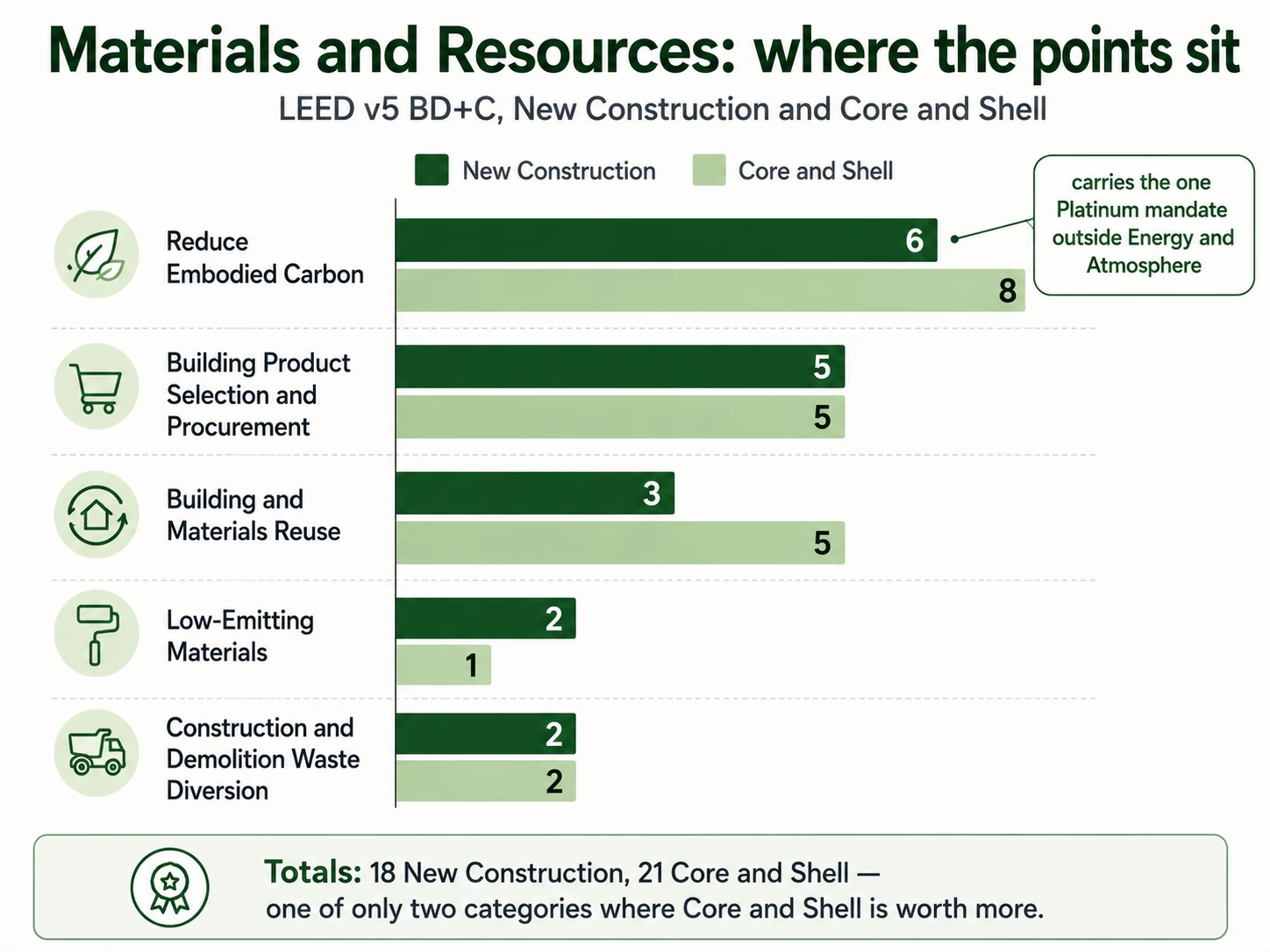
| Credit | NC | CS | What it rewards |
| Reduce Embodied Carbon | 6 | 8 | An actual reduction against a baseline. Carries the Platinum mandate |
| Building Product Selection and Procurement | 5 | 5 | Choosing products with disclosure and optimisation behind them |
| Building and Materials Reuse | 3 | 5 | Keeping existing structure and materials in use |
| Low-Emitting Materials | 2 | 1 | What products release into the space |
| Construction and Demolition Waste Diversion | 2 | 2 | Keeping construction waste out of landfill |
| Total | 18 | 21 |
Point allocations as taught in our LEED AP BD+C v5 course material. Confirm against the LEED v5 BD+C Rating System before relying on them for a live project.
Two structural points worth noticing.
Three credits move between the two rating systems, and it is worth doing the arithmetic. Building and Materials Reuse pays 5 for Core and Shell against 3, and Reduce Embodied Carbon pays 8 against 6 — two points each. Low-Emitting Materials goes the other way, 1 against 2, which makes sense once you remember that a Core and Shell project is not fitting out the interior. Net: plus three, and 18 becomes 21.
The Platinum mandate
A project certifying Platinum under LEED v5 must achieve a 20% embodied carbon reduction under the Reduce Embodied Carbon credit. This applies to both New Construction and Core and Shell.
It is one of four such requirements; the other three are in Energy and Atmosphere and are set out in the Energy and Atmosphere deep dive. Miss any of the four and the project certifies Gold regardless of its point total.
Which is worth pausing on. A category worth 18 of 110 points holds a veto over the top certification level. The rating system is telling you that reducing embodied carbon is not a nice-to-have that can be traded against something else. Expect the exam to make the same point.
Where candidates lose marks
- Quantify versus reduce. Covered above and worth repeating. The prerequisite measures. The credit reduces. Only the credit pays.
- Reuse versus waste diversion. These sound similar and are counted differently. Material kept in place and used in the building is reuse. Material that leaves the site and is diverted from landfill is waste diversion. The same physical material can only count once, and which credit it lands in depends on whether it left.
- Treating waste diversion as a single percentage. The credit pairs an overall diversion rate with a source-separation requirement, and unverified mixed waste is capped. A project claiming a high diversion rate through commingled collection alone has not earned what it thinks.
- Missing that product selection is measured against a denominator. The relevant proportion is calculated over the products in the category, not over some subset the team finds convenient — and the threshold is one the calculation must exceed rather than reach.
- Ignoring the Core and Shell column. This is the category where it matters most, because the totals invert. If a scenario names Core and Shell, the arithmetic has changed.
- Revising from material written for an earlier version. Check that whatever you are studying from puts embodied carbon at the centre of this category, because that is where the LEED v5 rating system puts it. See LEED AP BD+C v5 exam changes.
A revision checklist for this domain
- Name both prerequisites and state exactly what each requires — and what neither requires.
- State the five credits with their New Construction and Core and Shell points.
- State the Platinum mandate in this category and what happens if it is missed.
- Explain the difference between reuse and waste diversion, and where material that leaves site is counted.
- Explain why the category is worth more for Core and Shell, naming the credit that drives it.
- Say what an environmental product declaration is for, and where it earns.
- Explain what is capped in construction and demolition waste diversion, and why.
Then practise it
Work through Materials and Resources practice questions against the clock. The cross-category picture is in LEED AP BD+C credit categories, and the other joint-second domain in Indoor Environmental Quality.
Frequently asked questions
How many questions on Materials and Resources are in the LEED AP BD+C exam?
13 of the 85 scored questions, which makes it joint second-largest with Indoor Environmental Quality.
How many points is Materials and Resources in LEED v5 BD+C?
18 points for New Construction and 21 for Core and Shell. It is one of only two categories worth more for Core and Shell than for New Construction, the other being Integrative Process.
What is the difference between the embodied carbon prerequisite and the credit?
The prerequisite requires a project to quantify and assess its embodied carbon and identify the largest sources, with no reduction required. The credit requires an actual reduction against a baseline, and only the credit earns points.
Is embodied carbon required for LEED Platinum?
Yes. A 20 percent embodied carbon reduction under the Reduce Embodied Carbon credit is one of four additional achievements a Platinum project must make under LEED v5, and the only one outside Energy and Atmosphere. Miss any of the four and the project certifies Gold.
What is the difference between material reuse and waste diversion in LEED?
Material kept in place and used in the building counts as reuse. Material that leaves the site and is kept out of landfill counts as construction and demolition waste diversion. The same material cannot count under both.
Why is Materials and Resources worth more for Core and Shell?
Three credits move. Building and Materials Reuse pays 5 for Core and Shell against 3 for New Construction, and Reduce Embodied Carbon pays 8 against 6, so both gain two points. Low-Emitting Materials moves the other way, 1 against 2, which is consistent with a Core and Shell project not fitting out the interior. The net effect is plus three, so 18 becomes 21.
How important is embodied carbon in LEED v5 Materials and Resources?
Central. It is a prerequisite, it is the largest credit in the category at 6 points for New Construction and 8 for Core and Shell, three of the nine exam sub-topics are about carbon, and a 20 percent reduction is one of the four requirements for Platinum certification.
Getting the carbon material right
3FOLD TRAINING has prepared professionals for certification exams since 2008, across more than 100 countries. Our LEED AP BD+C training is written to LEED v5, which matters most in this category, where older material is actively misleading. No course is required to sit or pass the exam, ours included. Ask through the course enquiry form.



Leave a reply