
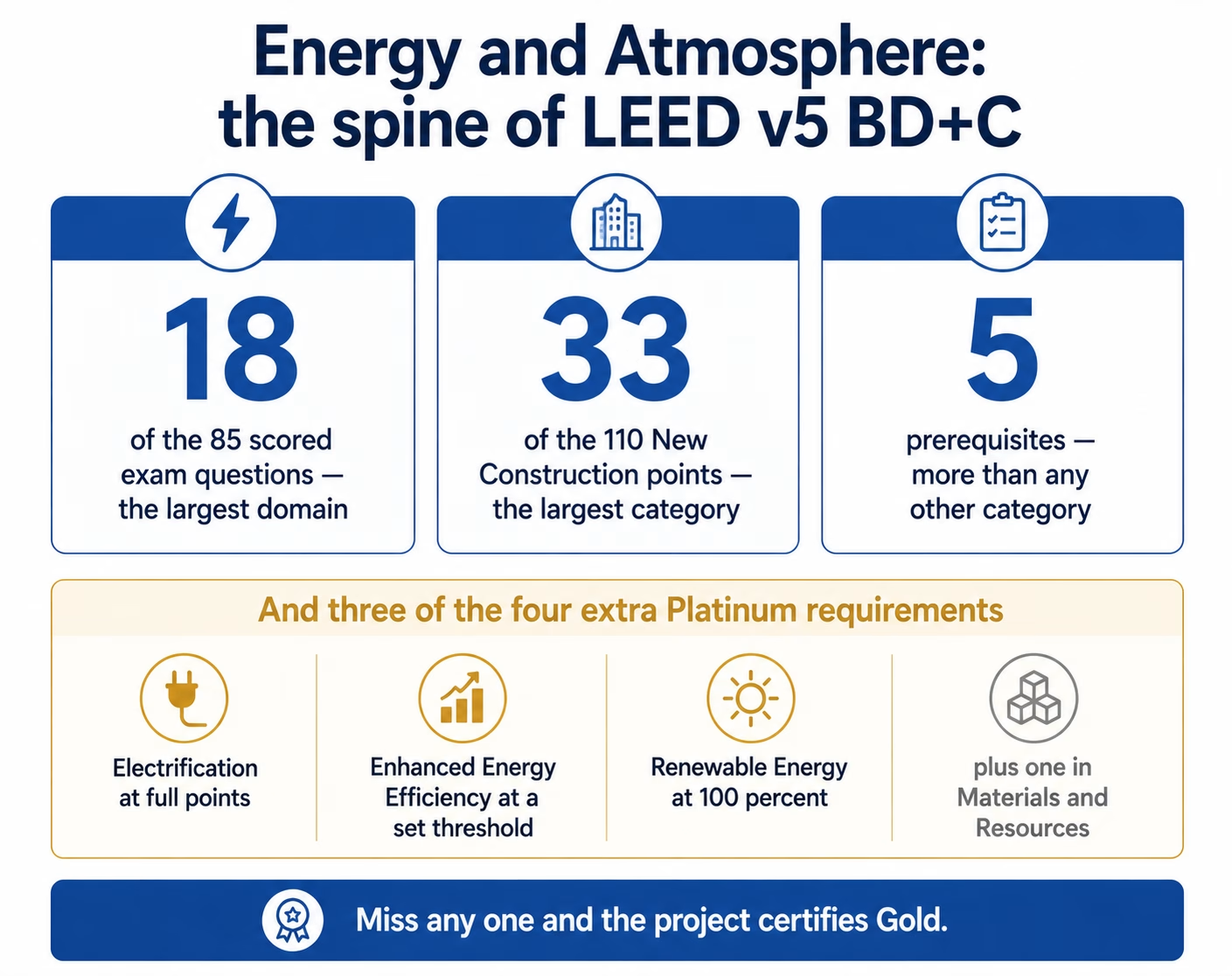
Energy and Atmosphere is the largest knowledge domain on the LEED AP BD+C exam at 18 of the 85 scored questions, the largest credit category in the rating system at 33 points for New Construction, and the home of five prerequisites — more than any other category. It also contains three of the four additional achievements a project must make to certify Platinum. If you are short of time, this is the domain to be least short of.
Why this domain decides the exam
Three numbers, and they point the same way.
| 18 of the 85 scored questions | The largest domain. More than one question in five |
| 33 of the 110 New Construction points | The largest category, and 27 of 110 for Core and Shell |
| Five prerequisites | More than any other category. They earn nothing and cannot be skipped |
Add the Platinum requirements below and the conclusion is not subtle. LEED v5 is a decarbonisation-led rating system, and Energy and Atmosphere is where the decarbonisation lives.
What the domain covers
Nine sub-topics, as we teach them in our LEED AP BD+C course. Knowing the list is worth more than it looks, because it tells you the shape of the questions you will meet:
| Energy performance and efficiency | Referenced standards, building performance factors, the prescriptive path and the performance path with energy modelling |
| Electrification | Limiting on-site combustion, electrification readiness |
| Peak thermal loads | Ventilation, thermal bridging, infiltration |
| Renewable energy supply | On-site and off-site, readiness, photovoltaic, solar thermal, wind, low-impact hydro, energy attribute certificates |
| Refrigerants | Global warming potential benchmarks, installation, leakage |
| Commissioning | The commissioning authority, owner’s project requirements, basis of design, monitoring-based and envelope commissioning, training, the operations and maintenance plan |
| Advanced energy metering | Measurement, building automation controls, benchmarking |
| Emergency and future proofing | Energy storage, renewable readiness, power resiliency, critical loads |
| Grid interactivity | Grid efficiency and reliability, demand response, load shifting |
Notice what that list is mostly about. Electrification, grid interactivity, energy storage, resilience — this domain is not simply about using less energy. It is about what the building runs on, and how it behaves when the grid does not cooperate.
The five prerequisites
Worth zero points. Miss one and the project does not certify at any level. Learn them as a set.
| Prerequisite | What it is about |
| Operational Carbon Projection and Decarbonization Plan | Projecting site energy by source and by end use, and planning the route down |
| Minimum Energy Efficiency | The floor, set against a referenced standard. The path you choose here caps what the enhanced efficiency credit can pay |
| Fundamental Commissioning | Now with the building envelope in scope, which is the change to know |
| Energy Metering and Reporting | Interval electricity data, monthly data for other fuels, and a reporting commitment measured in years |
| Fundamental Refrigerant Management | No HCFCs in new equipment. A high global warming potential triggers an evaluation, not a prohibition — a distinction the exam likes |
The commissioning scope is the one to underline. The building envelope is now within the scope of the fundamental prerequisite, which means it is not an optional enhancement. If a source you are revising from treats envelope commissioning as an extra, check which version it was written for.
The seven credits
| Credit | NC | CS | What it rewards |
| Enhanced Energy Efficiency | 10 | 7 | Performance beyond the prerequisite floor, and the largest single credit in this category |
| Electrification | 5 | 4 | Getting combustion out of the building |
| Reduce Peak Thermal Loads | 5 | 5 | Envelope and ventilation performance, so the plant has less to do |
| Renewable Energy | 5 | 4 | On-site first, off-site second, certificates third and capped |
| Enhanced Commissioning | 4 | 3 | Beyond fundamental. Enclosure commissioning is the foundation for Core and Shell |
| Grid Interactive | 2 | 2 | Storage, demand response and load shifting |
| Enhanced Refrigerant Management | 2 | 2 | Weighted average global warming potential against a benchmark |
| Total | 33 | 27 |
Point allocations as taught in our LEED AP BD+C v5 course material. Confirm against the LEED v5 BD+C Rating System before relying on them for a live project.
The Platinum mandate
This changes how you should read the whole rating system.
Under LEED v5, 80 points does not earn Platinum on its own. A Platinum project must also meet four specific achievements. Three of them are here:
| Requirement | New Construction | Core and Shell |
| Electrification | The full 5 points | The full 4 points |
| Enhanced Energy Efficiency | 8 of the 10 points | 5 of the 7 |
| Renewable Energy | 100% of site energy | 100% of base building energy |
The fourth sits in Materials and Resources — a 20% embodied carbon reduction — and is covered in the Materials and Resources deep dive.
Miss any one of the four and the project certifies Gold, whatever its point total.
Three consequences worth carrying into the exam room:
1.Platinum is largely an energy decision. Three of the four mandates are in this category.
2.A project can lose Platinum without losing a point. 82 points with Renewable Energy at 90% of site energy is a Gold building. This is exactly the shape of scenario an AP question is built from.
3.The mandates are thresholds inside credits, not extra credits. They do not add points. They constrain which points count toward the top level.
How the levels compare more generally is in LEED Gold vs LEED Platinum.
Where candidates lose marks
Five patterns, each of which is a question waiting to be asked.
1.Confusing the fundamental and enhanced versions of the same thing. Commissioning and refrigerant management both come in a required flavour and a scored flavour, and the boundary between them is exam territory. The reliable habit: for any Energy and Atmosphere topic, ask what is the compulsory minimum, and what earns points beyond it?
2.Assuming a high global warming potential refrigerant is banned. Under the fundamental prerequisite it triggers an evaluation requirement rather than a prohibition. “Must be evaluated” and “must not be used” are different statements, and only one of them is right.
3.Missing that the prerequisite path constrains the credit. The compliance path chosen for minimum energy efficiency caps what enhanced energy efficiency can pay. One decision, taken early, governing both — so a scenario that changes the prerequisite path has quietly changed the credit’s ceiling too.
4.Treating renewable energy as one pool. It is tiered: on-site, then new off-site, then certificates, with the lowest tier capped. A project cannot buy its way to full points through the cheapest route.
5.Forgetting Core and Shell is a different scorecard. Energy and Atmosphere is 33 points for New Construction and 27 for Core and Shell, and several credits pay differently. If a question names Core and Shell, that is not decoration.
A revision checklist for this domain
1.Name all five prerequisites without looking, and say what each requires.
2.For each of the seven credits, state its New Construction points and what it rewards.
3.State the four Platinum mandates and which categories they sit in.
4.Explain how the minimum energy efficiency path constrains the enhanced efficiency credit.
5.Explain the renewable energy tiers and which one is capped.
6.Distinguish fundamental from enhanced commissioning, and say what changed about envelope scope.
7.Say what a high global warming potential triggers under the prerequisite, and what it earns under the credit.
8.For any credit, state the Core and Shell figure as well as the New Construction one.
9.If you can do all eight cold, this domain is not going to be what stops you.
Then practise it
Reading a domain and being examined on it are different activities, and this domain is full of interactions between prerequisites and credits that a summary cannot rehearse for you. Work through Energy and Atmosphere practice questions against the clock, and see the questions candidates get wrong.
The full cross-category picture is in LEED AP BD+C credit categories.
Frequently asked questions
How many questions on Energy and Atmosphere are in the LEED AP BD+C exam?
18 of the 85 scored questions, which makes it the largest knowledge domain on the exam.
How many points is Energy and Atmosphere in LEED v5 BD+C?
33 points for New Construction and 27 for Core and Shell, which makes it the largest credit category. Confirm the allocation against the LEED v5 BD+C Rating System before relying on it for a live project.
How many prerequisites does Energy and Atmosphere have?
Five, more than any other category: Operational Carbon Projection and Decarbonization Plan, Minimum Energy Efficiency, Fundamental Commissioning, Energy Metering and Reporting, and Fundamental Refrigerant Management. They earn no points and cannot be skipped.
Does reaching 80 points earn LEED Platinum under v5?
Not on its own. A Platinum project must also meet four specific additional achievements, three of which are in Energy and Atmosphere: Electrification at full points, Enhanced Energy Efficiency at a set threshold, and Renewable Energy at 100 percent of site energy for New Construction. The fourth is a 20 percent embodied carbon reduction in Materials and Resources. Miss any one and the project certifies Gold.
What is the largest credit in Energy and Atmosphere?
Enhanced Energy Efficiency, at 10 points for New Construction and 7 for Core and Shell.
Are high global warming potential refrigerants banned in LEED v5?
Not under the fundamental prerequisite. A high global warming potential triggers an evaluation requirement rather than a prohibition, which is a distinction the exam tests. The prerequisite does prohibit HCFCs in new equipment.
Why does the minimum energy efficiency path matter?
Because the compliance path a project chooses for the prerequisite caps what the enhanced energy efficiency credit can pay. One decision taken early governs both, so a scenario that changes the prerequisite path has changed the credit’s ceiling too.
Is Energy and Atmosphere different for Core and Shell?
Yes. The category is worth 33 points for New Construction and 27 for Core and Shell, and several credits pay differently between the two. If an exam question names Core and Shell, the figures change.
Getting this domain right
3FOLD TRAINING has prepared professionals for certification exams since 2008, across more than 100 countries. Our LEED AP BD+C training gives Energy and Atmosphere the largest share of the course, in proportion to the exam, and works through the credit interactions rather than listing thresholds. No course is required to sit or pass the exam, ours included. Ask through the course enquiry form.




Leave a reply