
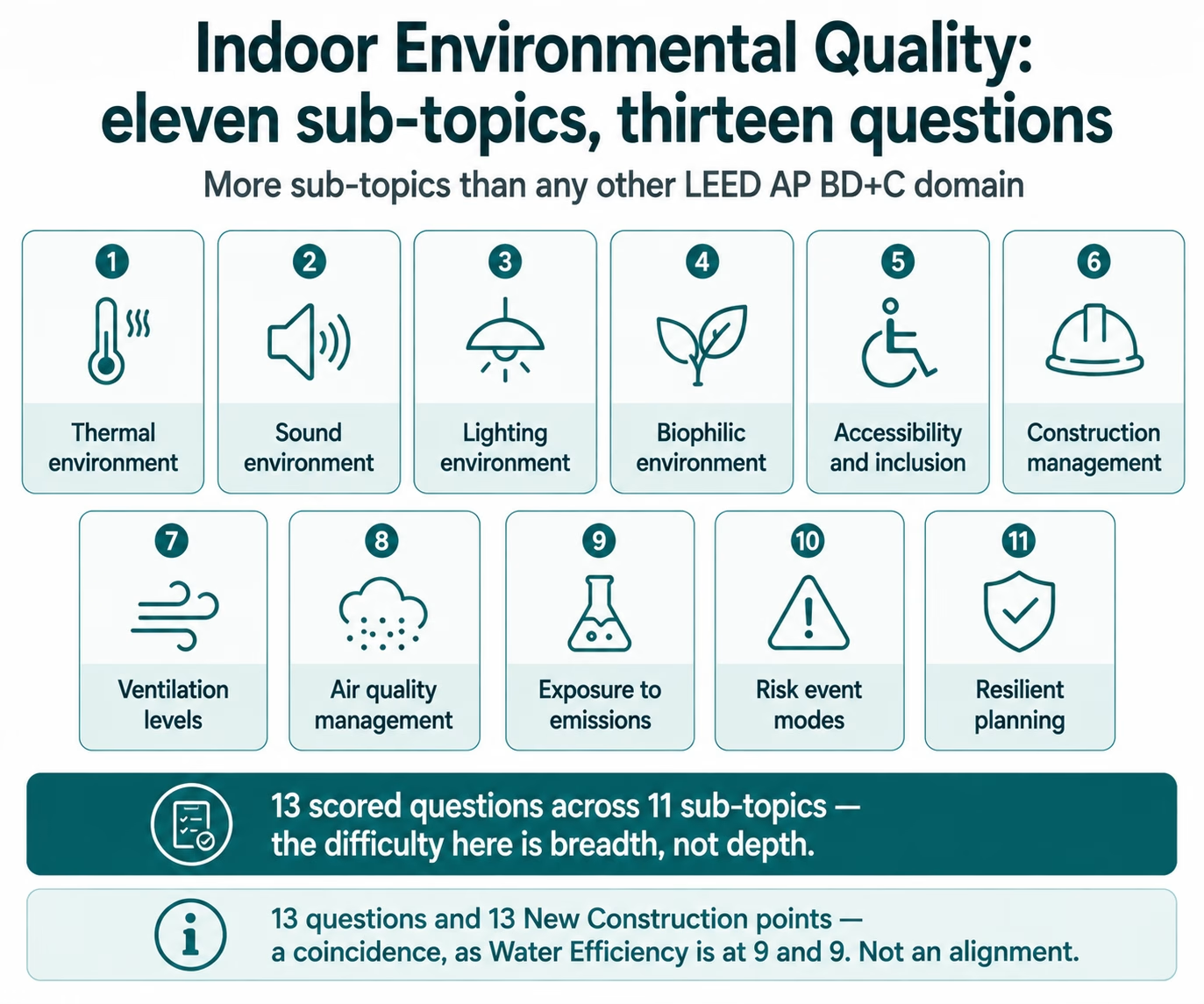
Indoor Environmental Quality is 13 of the 85 scored questions and 13 points for New Construction. That match is a coincidence rather than an alignment — Water Efficiency does the same thing at 9 and 9, and no other category comes close. What makes this domain hard is not depth. It is that 13 questions are spread across eleven sub-topics, more than any other domain, running from acoustics to wildfire smoke.
The shape of the domain
| 13 of the 85 scored questions | Joint second-largest, with Materials and Resources |
| 13 points New Construction | And 11 for Core and Shell |
| Eleven sub-topics | More than any other domain |
| Three prerequisites | All three about protecting people during and after construction |
Do not read anything into the 13 and 13. One counts exam questions, the other counts points a project earns; they measure different things and happen to coincide, as they also do for Water Efficiency at 9 and 9. Check Energy and Atmosphere — 18 and 33 — and the idea of an alignment collapses. The distinction is set out in LEED AP BD+C credit categories.
Eleven sub-topics
| Thermal environment | Over-cooling, heating, thermal safety, cooling and fans, comfort control |
| Sound environment | Exterior and interior noise, background noise, reverberation, acoustic comfort and privacy, quiet and sensory zones |
| Lighting environment | Colour rendering, surface reflectance, luminance, glare, controls, daylight and its annual metrics |
| Biophilic environment | Connection to the outdoors, direct line of sight, sustained engagement with nature, quality views |
| Accessibility and inclusion | Accessibility codes, safety and ageing, social health, wayfinding, neurodiversity, adaptable environments |
| Construction management | Smoking, heat protection, protecting the HVAC system, source control, pathway interruption, housekeeping, scheduling |
| Ventilation levels | Natural versus mechanical, outdoor air, regional climate, local air quality, the indoor air quality procedure |
| Air quality management | Filtration, air cleaning, testing, ongoing monitoring |
| Exposure to emissions | Prohibiting smoking, prohibiting vehicle idling |
| Risk event modes | Infection risk management, wildfire, power outages |
| Resilient planning and design | Thermal safety, extreme heat and cold, operable windows |
The last two are the ones candidates least expect. Designing a building so that it remains habitable through a power outage, a heatwave or a smoke event is examinable content, and it is not what most people picture when they hear “indoor environmental quality”.
How to revise a broad domain
Worth pausing on, because the usual method fails here.
With 13 questions across eleven sub-topics, there is not room to ask much about any one of them. Studying acoustics exhaustively and skipping risk events trades depth for coverage in the wrong direction.
Two consequences:
Go wide before you go deep. Be able to say what each of the eleven is about before you know any of them in detail. With 13 questions across 11 sub-topics, a skipped sub-topic is a bigger exposure than a shallow one.
Learn the vocabulary. This domain is dense with named metrics and defined terms — glare ratings, daylight autonomy, filtration classes, reverberation. Being able to say what each one measures is a different and more useful skill than being able to calculate with it.
The three prerequisites
| Prerequisite | The thing to know |
| Construction Management | A set of practice areas covering the site during construction, including protecting the installed HVAC system and replacing filters before balancing |
| Fundamental Air Quality | A minimum filtration standard, plus entryway systems at primary entrances |
| No Smoking or Vehicle Idling | Smoking prohibited within a set distance of entries, air intakes and operable windows. The vehicle idling prohibition is new in v5 |
All three are about what reaches the people inside — from the construction process, from the front door, and from what is running outside the windows. That framing holds them together better than three unrelated rules.
The five credits
| Credit | NC | CS | What it rewards |
| Occupant Experience | 7 | 7 | Thermal, acoustic, lighting and biophilic quality. Over half the category |
| Resilient Spaces | 2 | 2 | Habitability through an outage, including operable windows |
| Air Quality Testing and Monitoring | 2 | — | New Construction only |
| Enhanced Air Quality | 1 | 1 | More outdoor air to occupied spaces than the minimum |
| Accessibility and Inclusion | 1 | 1 | Compliance and strategies beyond code |
| Total | 13 | 11 |
Point allocations as taught in our LEED AP BD+C v5 course material. Confirm against the LEED v5 BD+C Rating System before relying on them for a live project.
Occupant Experience is over half the category on its own, and it is structured as a menu: several options whose available points add up to more than the credit can pay, so the credit caps. A project cannot bank the surplus. When a credit’s options sum above its ceiling, the ceiling is the answer — and that structure appears elsewhere in the rating system too.
The two-point difference between New Construction and Core and Shell is accounted for by Air Quality Testing and Monitoring, which Core and Shell cannot pursue. That is logical once you see it — there is no fitted-out space to test.
Where candidates lose marks
1.Missing the cap on a menu credit. Occupant Experience is the clearest case: its options can add up past what the credit pays, and the credit still pays its ceiling.
2.Reading “and” as “or”. Several requirements in this domain are conjunctive: smoking is prohibited near entries and intakes and operable windows; the accessibility credit needs code compliance and strategies beyond it. A distractor that satisfies one limb is the standard wrong answer.
3.Confusing enhanced performance with exemplary performance. Exceeding a credit’s threshold by a further margin is not automatically another point. Where a credit pays one point, doing considerably more may be exemplary practice and still pay one.
4.Forgetting a credit is unavailable to Core and Shell. Air Quality Testing and Monitoring is New Construction only. A Core and Shell scenario that appears to reach 13 has gone wrong somewhere.
5.Treating this as the “soft” category. It is the broadest domain on the paper, it carries three prerequisites, and it is dense with defined metrics. It sounds less technical than energy and it is not.
The WELL overlap
If you also work with the WELL Building Standard, this is the LEED category that shares most ground with it — air, light, thermal comfort, sound and materials appear in both, assessed differently.
Worth knowing for two reasons. On a project pursuing both, the same design decisions can serve each. And in an exam, the overlap is a place to be careful: a strategy that is right under one system is not automatically what the other rewards. The comparison is in LEED vs WELL.
A revision checklist for this domain
1.Name all eleven sub-topics. Not in detail — just name them.
2.Name the three prerequisites and what each protects against.
3.State the five credits with New Construction and Core and Shell points, and say which credit Core and Shell cannot pursue.
4.Explain how a menu credit with a cap behaves when the options sum above it.
5.List the requirements in this domain that are conjunctive rather than alternative.
6.Define the named metrics for daylight, glare, filtration and acoustics — what each measures, not how to calculate it.
7.Say what the risk-event and resilience sub-topics cover, since they are the least expected.
Then practise it
A broad domain is hard to self-assess by reading, and easy to self-assess by sampling. Work through Indoor Environmental Quality practice questions against the clock, and note which of the eleven sub-topics your wrong answers cluster in — that is your revision list.
The other joint-second domain is Materials and Resources, and the largest is Energy and Atmosphere.
Frequently asked questions
How many questions on Indoor Environmental Quality are in the LEED AP BD+C exam?
13 of the 85 scored questions, joint second-largest with Materials and Resources.
How many points is Indoor Environmental Quality in LEED v5 BD+C?
13 points for New Construction and 11 for Core and Shell, as taught in our LEED AP BD+C v5 course material. The match between 13 scored questions and 13 points is a coincidence, since the two numbers count different things, and Water Efficiency coincides in the same way at 9 and 9.
Why is Indoor Environmental Quality considered a broad domain?
Because its 13 scored questions are spread across eleven sub-topics, more than any other domain, running from thermal comfort and acoustics through to wildfire smoke and power outages. The difficulty is breadth rather than depth.
What are the Indoor Environmental Quality prerequisites?
Three: Construction Management, Fundamental Air Quality, and No Smoking or Vehicle Idling. All three are about protecting occupants from what the building does to them during construction, at the entrance and outside the windows.
Which is the largest credit in Indoor Environmental Quality?
Occupant Experience, at 7 points for both New Construction and Core and Shell, which is over half the category. It is structured as a menu whose options can sum to more than the credit pays, so the credit caps.
Which Indoor Environmental Quality credit is unavailable to Core and Shell?
Air Quality Testing and Monitoring, which is New Construction only. That accounts for the two-point difference between the two rating systems in this category.
Does LEED v5 Indoor Environmental Quality cover resilience?
Yes. Two of the eleven sub-topics address it: management modes for risk events such as infection, wildfire and power outages, and resilient planning covering thermal safety and extreme heat and cold. The Resilient Spaces credit is worth 2 points.
How does Indoor Environmental Quality relate to WELL certification?
It is the LEED category that shares most ground with the WELL Building Standard: air, light, thermal comfort, sound and materials appear in both, assessed differently. On a project pursuing both, the same design decisions can serve each, but a strategy that satisfies one is not automatically what the other rewards.
Covering the breadth
3FOLD TRAINING has prepared professionals for certification exams since 2008, across more than 100 countries. Our LEED AP BD+C training works through all eleven sub-topics, which is the specific risk in a domain this broad. No course is required to sit or pass the exam, ours included. Ask through the course enquiry form.


Leave a reply