

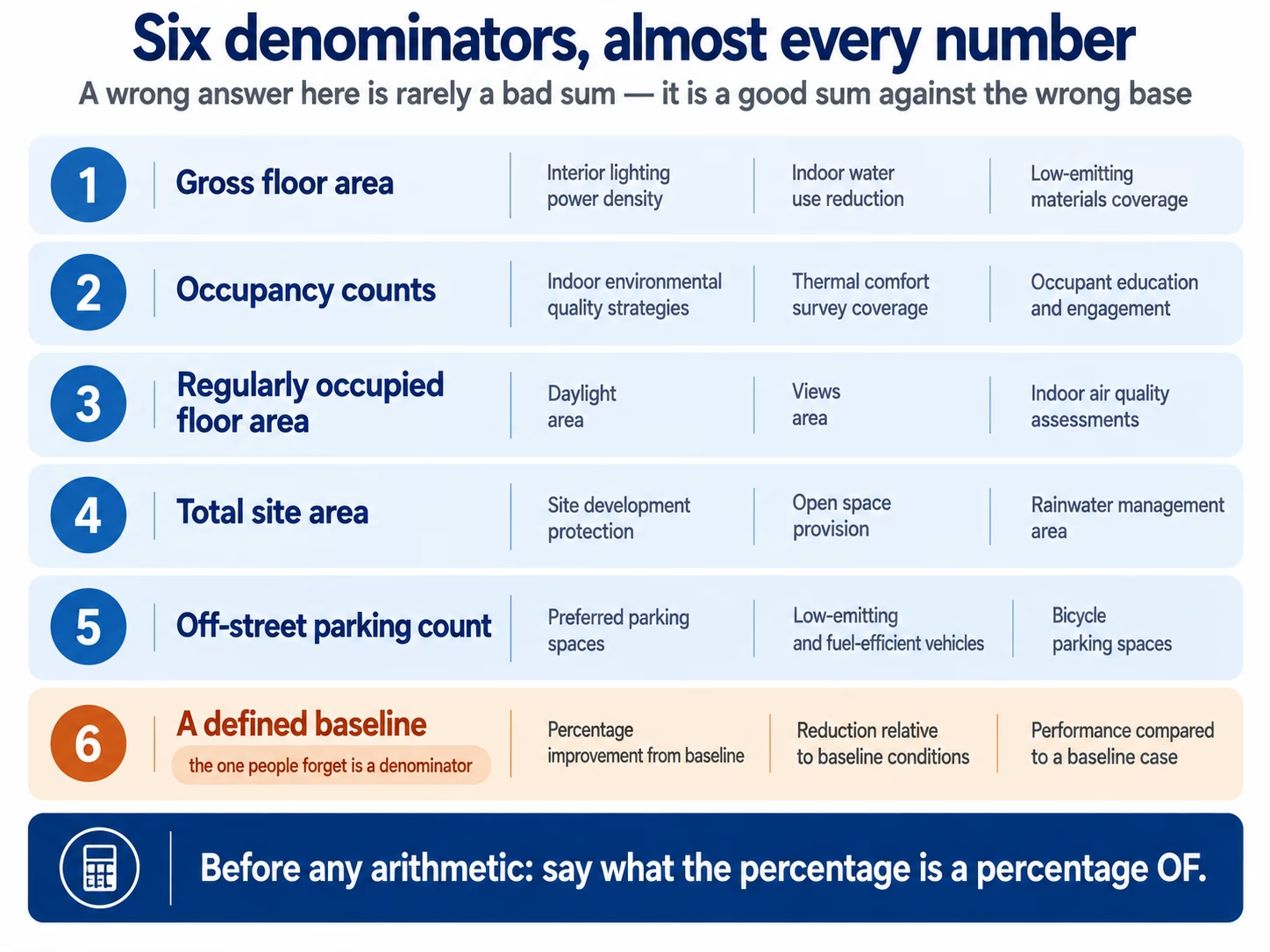
Cheat sheets usually order the numbers by the credit they came from. That is the ordering that lets them down. On the exam a figure arrives with no credit attached, and the question you have to answer first is not “what is the number” but “a percentage of what?” — so this page files the numbers by what they divide by.
In our own course material every figure is filed under one of six denominators. Learn those, and a figure you half remember becomes checkable rather than a guess.
The six denominators
| # | Denominator | What it drives |
| 1 | Gross floor area | Rating system selection · the project type trigger · the minimum project size under Minimum Program Requirement 3 |
| 2 | Occupancy counts | Long-term and short-term bicycle storage · showers · the fixture calculations in the water prerequisite and credit · social area seating · meeting spaces |
| 3 | Regularly occupied floor area | Filtration scope · ventilation coverage · quality views · proximity to windows · daylight · operable windows |
| 4 | Total site area | Accessible outdoor space — including the building footprint. And, as paved area plus roof area, the heat island target |
| 5 | Off-street parking count | Electric vehicle supply equipment ratios · parking under cover · the parking reduction against base ratios |
| 6 | A defined baseline | Fixture baselines · irrigation · the energy baseline · the embodied carbon baseline · natural land cover runoff |
In our teaching the sixth is the one that has to be pointed out. A large share of LEED’s numbers are not absolute at all — they are reductions against a baseline the project itself computes. Which is why the definition of the baseline matters more than the percentage applied to it, and why “30% reduction” is only half a fact until you know what it is a reduction from.
Occupancy: the three rules that are not in any table
Default occupancy figures — square feet per occupant, by space type — are in the course material and in the reference guide. These three are not, and they are where the marks go.
| Case | Method | The step that gets dropped |
| Residential | (bedrooms per unit + 1) × number of units | The plus one. A two-bedroom unit houses three |
| Hotel and motel | 1.5 × guest rooms, then × 60% | The 60% step. 200 rooms → 300 → 180. In our teaching this is the step candidates most often drop in this calculation |
| The basis rule | Defaults serve as both daily average and peak | Water runs on daily average; ventilation, thermal comfort and egress run on peak |
Two shapes worth noticing rather than memorising, because they let you sanity-check a figure you half remember. The table is square feet per occupant, so a bigger number means fewer people. And warehouse storage is the largest figure in the table by a wide margin — if a warehouse figure you have recalled produces a crowd, you have recalled the wrong one.
One further rule that is examinable and easy to lose: defaults apply only where occupancy is unknown and cannot reasonably be projected, and structured parking is excluded from the area before you divide.
Two different 60% tests, one denominator
Both divide by gross floor area. They have different numerators and entirely different consequences.
| Test | Numerator | Rule |
| 1. Which rating system | Gross floor area that is complete | New Construction: at least 60% complete. Core and Shell: at least 40% incomplete |
| 2. Which project type requirements | Gross floor area of a use type | Requirements apply where 60% or more of the gross floor area is that project type |
Worked cases for the second test: 75% residential and 25% retail — residential requirements apply. 60% healthcare and 40% office — healthcare applies. 55% residential and 45% office — neither project type is automatically mandatory under the 60% threshold, but the project may follow the requirements for either applicable project type unless the specific requirement states otherwise or applies on a space-by-space basis.
The first test carries an attached rule that is easy to lose: prerequisite calculations include the completed scope only, while credit calculations include both scopes, with the incomplete scope held at baseline.
A stem that says “60% of the floor area” tells you nothing until you find out 60% of what.
The nested percentage
Accessible outdoor space is the clearest example of a number that is right and an answer that is wrong.
At least 30% of the total site area, including the building footprint, must be accessible outdoor space. Then at least 25% of that required outdoor space — not 25% of the site — must be vegetated.
| Step | Result | Meaning |
| Site | 100,000 sq ft | Total site area including the building footprint |
| × 30% | 30,000 sq ft | Accessible outdoor space required |
| × 25% | 7,500 sq ft | Vegetated portion of that outdoor space |
| As a share of the site | 7.5% | Not 25% |
25,000 sq ft is 25% of the site. It is arithmetically correct and it answers a question nobody asked. The habit to build: when a requirement contains two percentages, ask what the second one is a percentage of. In LEED it is almost always a percentage of the first result.
Divide, do not multiply
The heat island calculation is the clearest place where doing the obvious thing inverts the answer.
( nonroof measures ÷ 0.5 ) + ( high-reflectance roof ÷ 0.75 ) + ( vegetated roof ÷ 0.75 ) ≥ total site paved area + total roof area
Worked quickly: a site with 20,000 sq ft paved and 30,000 sq ft of roof has a target of 50,000. Divide the measures — not multiply — and a project with 12,000 sq ft of nonroof measures and 22,500 sq ft of qualifying roof reaches 54,000, which clears it.
The smaller divisor gives the larger value. A square foot of nonroof measure counts double because it is divided by 0.5; a square foot of roof measure counts one and a third. Multiplying by those figures instead of dividing does not just give a wrong number — it reverses which measure the credit rewards.
Three attached rules go with it. Each surface counts once, so a shaded high-reflectance pavement claims one measure and not two. Shade is measured in plan view at noon, using plants at their ten-year canopy width. And applicable roof area excludes mechanical equipment, solar panels, skylights and other appurtenances.
Three scales that read backwards
Almost everything in LEED reads upwards — more is better. Three things do not, and a candidate moving quickly picks the larger figure by reflex.
| Where | Quantity | Direction |
| The energy prerequisite | Performance Index — proposed ÷ baseline | Lower is a better building |
| The energy credit’s index path | Performance Index table | A lower index earns more points. 0.3 beats 0.5 |
| The habitat credit’s bird option | Bird threat factor | Lower is better, and the credit sets a maximum |
The check that replaces memorising the list: ask what the quantity measures. A ratio to a baseline measures how much energy the building still uses. A threat factor measures harm. Ratios and hazards read downwards; everything else reads upwards.
Same number, different reference point
A repeated figure feels like a gift. It is the opposite — recognising the number is the easy half, and the question is which credit’s version of it you are being asked about.
| Figure | Why it repeats, and why that matters |
| 25 feet | One indoor environmental quality prerequisite measures it from the building. The residential prerequisite measures it from entries, outdoor air intakes and operable windows. Same number, different datum |
| 0.5 miles / 800 m | Rail, ferry and bus rapid transit · the diverse uses option · the jobs-to-housing catchment · the transportation assessment exemption. Always a walking distance, never a radius |
| 0.25 miles / 400 m | The density offset · bus and streetcar · off-site showers · the emergency cooling station |
| 600 ft / 180 m | Bicycle network proximity and short-term storage. Long-term storage uses 300 feet |
| 20 µg/m³ | The formaldehyde limit — the rare case where the repeat genuinely helps, because it is identical in both places it appears |
What may never be counted twice
This is the part a list of figures cannot teach you. It is not a set of numbers at all — it is a set of relationships between credits.
Two of the cases we teach, and then the rule that generates the rest:
- Material kept on site earns the building reuse credit and is excluded entirely from the waste diversion calculation. The same tonne cannot serve both.
- The project boundary itself. Carving a car park or service yard out of the boundary to ease heat island or rainwater requirements is not permitted — the denominator may not be gamed.
But one overlap is allowed. Harvested rainwater earns the rainwater management reuse point and counts as alternative water in the water use reduction credit.
The rule underneath is worth more than the four examples: a physical quantity may serve two credits when the credits measure different things about it. It may not serve two credits measuring the same thing. Rainwater is credited once for being retained on site and once for displacing potable water — two different measurements. A tonne diverted and a tonne reused are the same measurement, so they cannot both be claimed.
Four traps worth carrying into the exam
A selection from the longer list we teach. Each one is a place where the arithmetic is easy and the base is not what it looks like.
| Where | What the denominator actually is |
| The optimised materials credit | The denominator includes every product in the category, including products with no attributes at all. Omitting them inflates the percentage |
| Waste diversion | The sub-requirement is a share of diverted tonnage, not of total waste — and it is not additional to the diversion rate |
| Core and Shell energy | Base building energy is the greater of metered base building consumption or 25% of total estimated building energy use. Because the denominator is base building rather than whole building, percentages above 100% are possible |
| Local hiring | Two different 15% figures: local hires as a share of jobs created, apprentices as a share of hours worked |
Thresholds, denominators and worked examples on this page are as taught in our LEED AP BD+C v5 course material and reflect LEED v5 BD+C. Confirm against the LEED v5 BD+C Reference Guide and the addenda database before relying on any of them for a live project.
What is not on this page
This is a selection. The full default occupancy table, the complete list of places where a repeated figure changes its reference point, the whole wrong-denominator list and the compressed teaching notes that go with each are course material and stay there. What is above is the structure — the six denominators, the direction rule, the double-counting rule and the calculations we most often have to unpick in class — which is the part that makes the figures usable and which you can apply to any figure you meet elsewhere.
How to use this page
Not as a list to memorise the week before. Three things, in order:
1.Learn the six denominators first, before any figures. They are the index everything else hangs from.
2.Work the two nested calculations by hand — the outdoor space percentage and the heat island formula — until you can do them without the page.
3.Say the direction rule out loud whenever you meet a ratio: what does this quantity measure, and does more of it mean better or worse?
The figures matter, but they are the part that a good week of revision fixes. The denominators are the part that decides whether a figure you have learned is any use to you. The six-week study plan puts the calculations in week six for exactly that reason, and the exam technique is in ten tips to pass.
Frequently asked questions
What numbers do I need to memorise for the LEED AP BD+C exam?
Fewer than most cheat sheets suggest, and in a different order. Our own course material files every figure under one of six denominators: gross floor area, occupancy counts, regularly occupied floor area, total site area, off-street parking count, and a defined baseline. Learn those first, then the figures that hang from each one. In our teaching a wrong answer on this exam is rarely a bad sum, it is a good sum against the wrong base.
How do you calculate occupancy for a hotel under LEED?
Multiply guest rooms by 1.5, then take 60% of that figure. A 200-room hotel gives 300, then 180 regular occupants. In our teaching the 60% step is the step candidates most often drop in this calculation. Residential is different again: bedrooms per unit plus one, multiplied by the number of units, so a two-bedroom unit houses three.
What is the 60% rule in LEED v5 BD+C?
There are two, and they share a denominator. New Construction applies where at least 60% of gross floor area is complete, and Core and Shell where at least 40% is incomplete. Separately, a project type’s requirements apply where 60% or more of the gross floor area is that project type. A stem saying 60% of the floor area tells you nothing until you find out 60% of what.
How much of a LEED site has to be vegetated?
It is a nested percentage, which is why it is answered wrongly. At least 30% of the total site area, including the building footprint, must be accessible outdoor space. At least 25% of that required outdoor space, not 25% of the site, must be vegetated. On a 100,000 sq ft site that is 30,000 sq ft of outdoor space and 7,500 sq ft vegetated, which is 7.5% of the site.
Which LEED calculations read backwards?
Three. The energy prerequisite’s Performance Index is proposed divided by baseline, so a lower index is a better building. The energy credit’s index path reads the same way, with a lower index earning more points. And the bird threat factor is lower-is-better with a maximum. The check that replaces the list: ratios to a baseline and hazard measures read downwards, everything else reads upwards.
Can the same material count for two LEED credits?
Sometimes, and the rule is precise. A quantity may serve two credits when they measure different things about it, which is why harvested rainwater earns the rainwater reuse point and also counts as alternative water. It may not serve two credits measuring the same thing, which is why a tonne kept on site for building reuse is excluded from the waste diversion calculation entirely.
Is a cheat sheet enough to pass LEED AP BD+C?
No, and it is worth being clear about why. The exam is written at three cognitive levels and only the first is memory. A sheet of figures prepares you thoroughly for the first and not at all for the other two, and the credit interactions and double-counting rules are not memory problems. Use a cheat sheet to fix the figures and worked problems to fix everything else.
Do I get scratch paper or a calculator in the LEED AP exam?
Check the current test centre rules when you book. They sit outside the exam specification and they change. Do not build a revision plan that depends on either being available. The calculations that appear are short. The check that matters most is not arithmetic at all.
Where this comes from
3FOLD TRAINING has prepared professionals for certification exams since 2008, across more than 100 countries. This page is a selection from the calculations material in our LEED AP BD+C training, which files every figure this way and works the calculations in class. The page above is complete enough to use on its own, and no course is required to sit or pass the exam, ours included. Questions through the course enquiry form.



Leave a reply