

You have done the reading. What follows is technique — the things that change a score without changing what you know. The first four are one protocol, taught as a unit, and they are the part worth drilling.
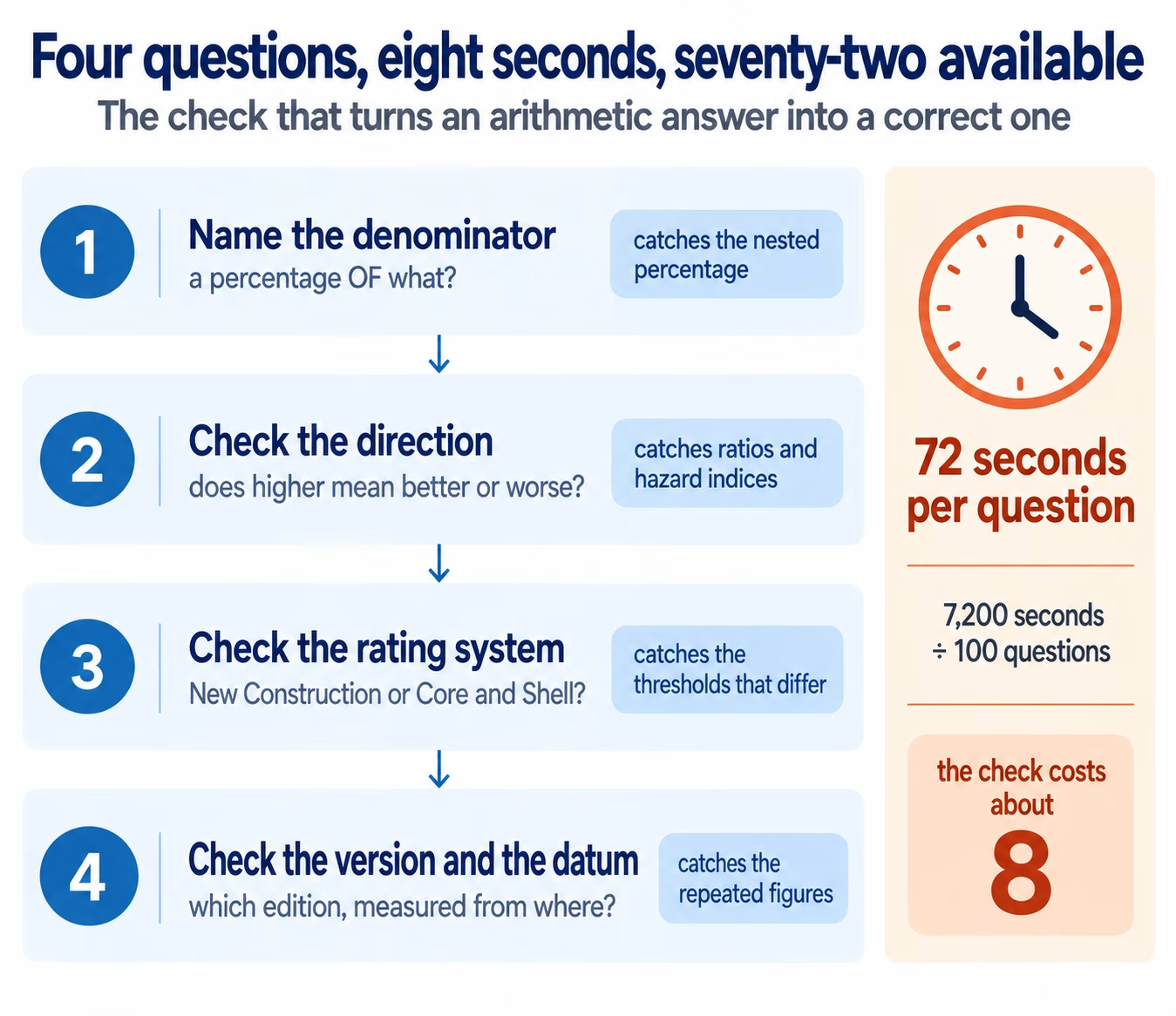
First, the number every piece of timing advice below is measured against. Two hours is 7,200 seconds. The paper is 100 questions. That is 72 seconds each, and it is more than it sounds.
Tips 1 to 4: the check to run on every numeric question
In our teaching, one recurring calculation error is using the right number against the wrong base. These four questions take about eight seconds and they catch that error before you commit to it.
1. Name the denominator
Before touching the arithmetic, say what the percentage is a percentage of. Site area? Outdoor space? Diverted tonnage? Regularly occupied floor area? Six denominators cover almost every figure in the rating system, and they are listed in the cheat sheet.
This one step catches every nested percentage — the cases where a requirement contains two percentages and the second is a percentage of the first result rather than of the original base.
2. Check the direction
Does a higher value mean better or worse? Almost everything in LEED reads upwards, which is exactly why the three things that do not are worth flagging. A ratio to a baseline measures how much of something the building still uses. A hazard index measures harm. Ratios and hazards read downwards.
You do not need to memorise which quantities those are. Ask what the quantity measures and the direction follows.
3. Check the rating system
New Construction or Core and Shell? Several thresholds differ between them, and so do three of the four Appendix I values. If the stem names one or the other, use it. If it names neither, read it again before assuming.
4. Check the version and the datum
Which edition of the standard, and measured from what point? Several figures repeat across credits with different reference points — the clearest is a 25-foot separation that is measured from the building in one place and from entries, air intakes and operable windows in another. Same number, different datum.
Four questions, about eight seconds, against a budget of 72. It is comfortably affordable and it is the difference between an arithmetic answer and a correct one.
5. Answer every question, and use the flags
There is no penalty structure that rewards leaving a question blank, and the delivery software lets you change answers, skip and flag for review. Use the flag rather than stalling. A question you have spent three minutes on has overrun its budget by a hundred and eight seconds — another one and a half questions.
There is also an optional ten-minute tutorial before the exam, which sits outside the two hours. Take it. It costs nothing from your budget and it is where you confirm how flagging and review actually behave on the day rather than discovering it under time pressure.
6. Read the qualifier before the options
A great many LEED requirements are joined by and rather than or. Satisfying one limb is not satisfying the requirement, and the difference between “all”, “at least two of”, “the greater of” and “either” is frequently the whole requirement.
The practical habit: read the stem twice and the options once, rather than the reverse. Most of the information is in the stem.
7. Prepare for the two levels that revision does not fix
The exam is written at three cognitive levels — Recall, Application and Analysis — all three defined in the candidate handbook, with no split published between them. Only the first is a memory problem.
Which means more revision of the same material has sharply diminishing returns after a point, and the useful substitute is worked problems and credit interactions. If you can state what happens to one credit when a decision is made under another, you are preparing for the two levels that matter. See how hard the exam is for what those levels actually ask.
8. Know the four things that may never be counted twice
Double-counting rules are relationships rather than figures, and they are finite — you can learn them all in an evening. Material kept on site is excluded from waste diversion; the project boundary may not be redrawn to ease a calculation. The cheat sheet has the others.
And the one overlap that is allowed: harvested rainwater earns the rainwater reuse point and counts as alternative water. The rule underneath is worth more than the list — a quantity may serve two credits that measure different things about it, and may not serve two that measure the same thing.
9. Weight the last fortnight by scored questions, not by your comfort
100 questions are delivered and 85 of them are scored — the other 15 are unlabelled trial items, which is why the specification, and every plan built on it, works from the 85. Those 85 are spread across eight domains, and they are not equal. Energy and Atmosphere is 18; LEED Process is 7. Revising in syllabus order or in order of what you enjoy puts the same effort into both.
| Domain | Scored questions |
| Energy and Atmosphere | 18 |
| Materials and Resources | 13 |
| Indoor Environmental Quality | 13 |
| Sustainable Sites | 9 |
| Water Efficiency | 9 |
| Integrative Process | 8 |
| Location and Transportation | 8 |
| LEED Process | 7 |
| Total | 85 |
Do not allocate by rating-system points instead. Integrative Process is 8 scored questions and a single New Construction point; Location and Transportation is 8 questions and fifteen points. Study by points and you get both badly wrong. The full picture is in credit categories and exam weights.
10. Debrief a mock three ways, not one
A mock exam score on its own tells you almost nothing you can act on. Cut the result three ways:
1.By domain — where to study.
2.By cognitive level — how to study. A pattern of Recall errors and a pattern of Analysis errors need completely different fixes.
3.By the reason each answer was wrong — whether you did not know it, misread a qualifier, used the wrong denominator, or ran out of time.
The third cut is the one that gets skipped and it is the one that pays. A misread qualifier and a genuine knowledge gap look identical in a domain score and have nothing in common as problems. Stop at the first cut and the conclusion is always “I am weak at Energy”, followed by re-reading the Energy chapter — which may be the wrong fix entirely.
A self-check for the last week
Cover this page and answer aloud. Hesitation tells you where to go back.
- Name the six denominators.
- A 300-room hotel with no occupancy data — how many regular occupants? (1.5 × 300 = 450, then × 60% = 270.)
- A project is 55% residential and 45% office. Which project type requirements apply? (None — neither reaches 60%.)
- A three-bedroom apartment houses how many people for LEED purposes? (Four — bedrooms plus one.)
- Name the three quantities where a lower number is better.
- Which single quantity may legitimately earn credit in two categories, and why?
- Which tonne may never be counted twice, and why?
- Which domain carries the most scored questions, and how many? (Energy and Atmosphere, 18 of 85.)
Thresholds and calculation rules referred to on this page are as taught in our LEED AP BD+C v5 course material and reflect LEED v5 BD+C. Domain weights are from the published exam specification. Confirm the thresholds against the LEED v5 BD+C Reference Guide before relying on them for a live project.
The one thing that is not on this list
A pass rate. USGBC publishes none, for any of its exams, so any percentage attached to this question was produced by whoever published it. That is worth knowing before you calibrate your confidence against a number you found online. What is published is the scale — 125 to 200, with 170 to pass — on USGBC’s support site. See the passing score.
Frequently asked questions
How do I pass the LEED AP BD+C exam?
Do the reading, then add technique. The highest-value technique is a four-step check on every numeric question: name the denominator, check whether higher means better or worse, check whether the stem is New Construction or Core and Shell, and check the version and the datum. It takes about eight seconds against a budget of 72 seconds per question.
How much time do I have per question in the LEED AP exam?
72 seconds. Two hours is 7,200 seconds and the paper is 100 questions. That is more time than it feels like under pressure, which is why a short deliberate check on numeric questions is affordable and why stalling on a single hard question is the expensive mistake rather than the careful one.
What is the most common mistake on LEED calculation questions?
In our teaching it is using the right number against the wrong base. On this exam a wrong answer is rarely a bad sum. Nested percentages are the clearest case: where a requirement contains two percentages, the second is usually a percentage of the first result rather than of the original base, so an arithmetically correct answer can be the answer to a question nobody asked.
Should I answer every question on the LEED AP exam?
Yes. Nothing rewards leaving an answer blank, and the delivery software lets you change answers, skip and flag questions for review. Use the flag rather than stalling. There is also an optional ten-minute tutorial before the exam which sits outside the two hours, and it is where to confirm how flagging behaves rather than finding out under time pressure.
How should I use a LEED AP mock exam result?
Cut it three ways. By domain to find where to study, by cognitive level to find how to study, and by the reason each answer was wrong. The third cut gets skipped and it is the one that pays: a misread qualifier and a genuine knowledge gap look identical in a domain score and need completely different fixes.
Which LEED AP BD+C domain should I revise most?
Energy and Atmosphere, at 18 of the 85 scored questions. The eight domains are not equal, and revising in syllabus order gives the same effort to Energy and Atmosphere at 18 and LEED Process at 7. Do not allocate by rating-system points instead: Integrative Process is 8 scored questions and a single New Construction point, while Location and Transportation is 8 questions and fifteen points.
What is the pass rate for the LEED AP BD+C exam?
There is not one. USGBC does not publish pass rates for any of its exams, so any figure attached to this question was produced by whoever published it rather than by the organisation that runs the exam. The scale is published: 125 to 200, with 170 required to pass, on USGBC’s support site.
Is it enough to memorise the LEED numbers?
No, and the reason is structural. The exam is written at three cognitive levels, Recall, Application and Analysis, all defined in the candidate handbook. Memorising thresholds prepares you thoroughly for the first and not at all for the other two, which is why more revision of the same material stops helping at a certain point and worked problems start.
If you want the protocol drilled rather than described
3FOLD TRAINING has prepared professionals for certification exams since 2008, across more than 100 countries. Our LEED AP BD+C training works the four-step check through timed problems and includes a full mock with the three-way debrief above. Every tip on this page works whether or not you buy anything, and no course is required to sit or pass the exam, ours included. Ask through the course enquiry form.




Leave a reply