You need a scaled score of 170 to pass the LEED AP BD+C exam. The scale runs from 125 to 200, which means 170 is not 85% and cannot be converted into one. There is no published number of questions you must answer correctly, and there is a good reason for that — anyone who gives you one is guessing.
The number
The LEED AP with Specialty Candidate Handbook states that “the only way to earn a LEED professional credential is to earn a score of at least 170 or higher on the required exam”.
GBCI’s own exam results guidance puts it more broadly: “A score of 170 or higher is required to pass all GBCI professional exams”, on a scale running between 125 and 200.
So the same threshold applies whether you are sitting Green Associate, a LEED AP specialty, or another GBCI credential. It is a fixed point in a system, not a number chosen for this exam.
Why 170 is not 85%
This misunderstanding is easy to arrive at, and it comes from a natural but wrong assumption: that a score out of 200 works like a percentage doubled.
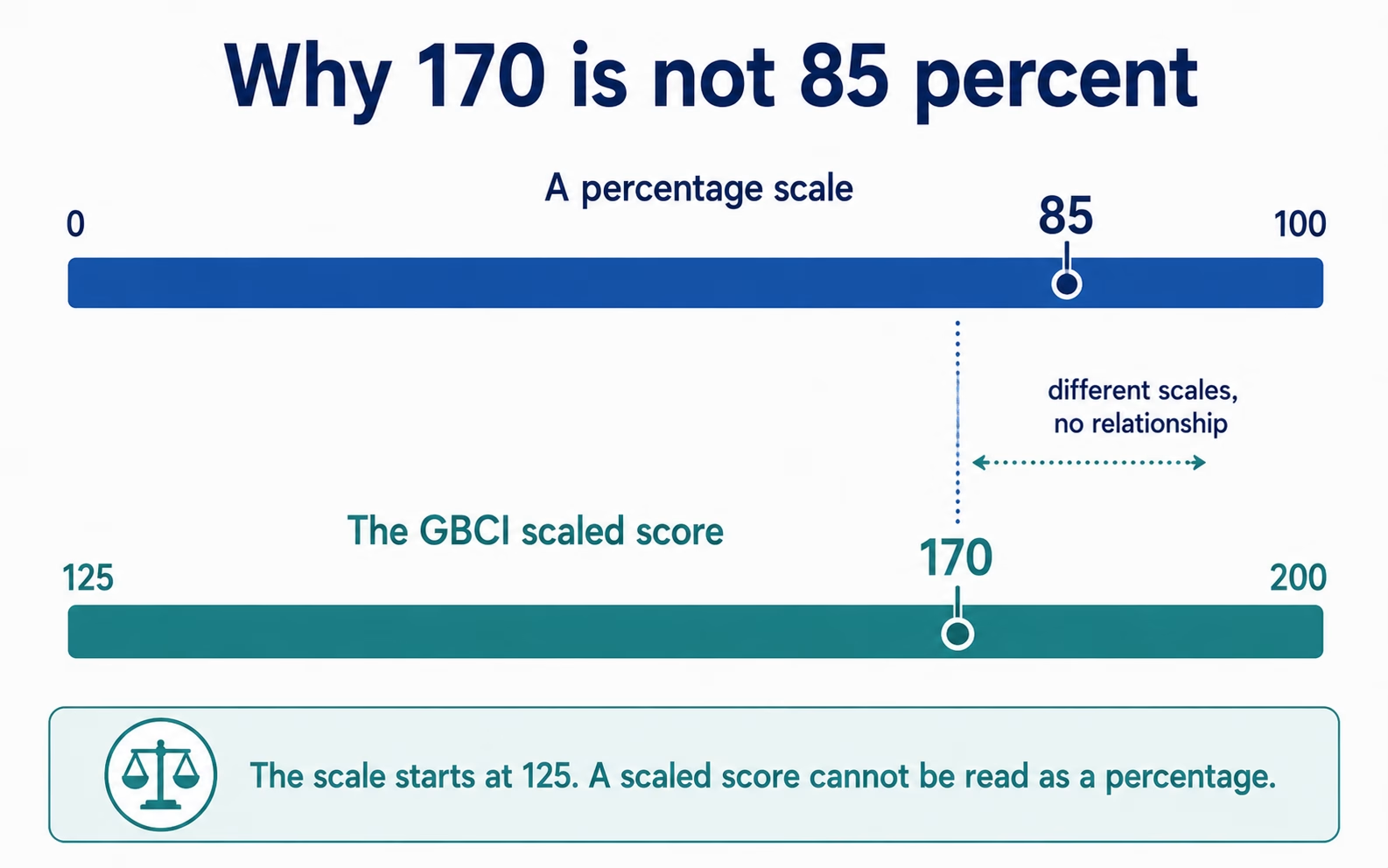
The scale does not start at zero. It starts at 125.
The reported scale runs from 125 to 200 — a span of 75 points, not 200. There is no zero on it, so 170 sits nowhere near 85% of anything.
Try the conversion and you can see it break. Is 170 out of 200 equal to 85%? Only if the scale runs 0 to 200. It does not. Is it 60% of the range from 125 to 200? That arithmetic works, but it tells you nothing either, because a scaled score is a converted value rather than a proportion of the questions you answered. GBCI describes the conversion as a mapping of your raw score onto a standardised scale, not as a percentage.
What scaling actually does
GBCI describes the mechanism plainly: your raw score — the total number of correct questions — is mapped onto a standardised scale, with the minimum competency threshold always mapped to a scaled score of 170.
Read that carefully, because the phrase always mapped is doing the work. 170 is a definition, not a count. It is the label attached to “the standard required”, wherever that standard falls in raw marks on the particular form of the exam you happened to sit.
Scaling of this kind is how standardised exams keep a threshold meaning the same thing across different versions of a paper, rather than tying it to a fixed number of correct answers. GBCI’s own description is the authority here, and it is worth reading in its own words rather than through anyone’s summary, this one included.
What matters for you is the consequence, and it is why the next question has no published answer.
How many questions do I need to get right?
There is no published answer, and there cannot be a fixed one.
Two independent reasons:
1.The threshold is defined on the scaled score, not on a raw count. GBCI maps the minimum competency threshold to 170. It does not publish a raw equivalent, and a raw count is not what the standard is set against.
2.Fifteen questions do not count. The exam is 100 questions and 85 are scored. The other 15 are unscored trial items placed at random, and you are not told which. So even a raw count of your correct answers would not tell you your raw score — you would not know how many of your correct answers were among the scored 85.
You will find pages stating that you need a specific number out of 100, or a specific percentage. No such figure is published by USGBC or GBCI, so wherever those numbers come from, it is not the source that sets the standard.
So what should you aim for?
A useful question with a useful answer, unlike the previous one.
Aim to know the material, not to clear a threshold. Preparation aimed at a minimum tends to arrive at the minimum, and the minimum is precisely where scaling makes the outcome least predictable.
In practice that means:
1.Be comfortable across all eight domains, not six. There is no domain small enough to write off — LEED Process is the smallest at 7 scored questions, and that is still 7 marks you would be conceding before you start.
2.Put the time where the weighting is. Energy and Atmosphere at 18, Materials and Resources at 13, Indoor Environmental Quality at 13 — 44 of the 85 between them. See the exam format.
3.Use practice results as a direction, not a prediction. A practice score is not a scaled score and cannot be converted into one. What it tells you reliably is which domains are weak. That is what it is for.
When and how you find out
Your score appears on screen at the end of the exam session, so you will know as soon as you finish.
A score report follows by email to your registered address within 24 hours.
If you pass, GBCI’s guidance is that credential accounts update within 72 hours, and directory profiles reflect the new status where visibility is enabled.
What you will not receive
Worth setting expectations on, because candidates plan around this and should not.
GBCI states that it “does not release exam content or answers or allow candidates to review proprietary content under any circumstances.” You will not see which questions you got wrong, and you cannot request a review of the paper.
That is normal for a professionally administered exam — released content is compromised content, and the value of the credential depends on the questions staying confidential.
The practical implication matters if you are planning a retake: do not build a revision plan around reviewing the paper, because you will not be able to. Timed practice by domain will tell you where you are weak, and it will tell you before the exam rather than after. That approach is set out in failed the LEED AP exam.
The one-line summary
170 on a 125-to-200 scale, which is not a percentage, cannot be converted to one, and does not correspond to a published number of correct answers. Know the material across all eight domains and the threshold takes care of itself.
Frequently asked questions
What is the passing score for the LEED AP BD+C exam?
A scaled score of 170. GBCI’s guidance is that a score of 170 or higher is required to pass all GBCI professional exams, on a scale running between 125 and 200.
Is 170 the same as 85 percent?
No. The scale starts at 125 rather than zero, so a scaled score cannot be read as a percentage at all. 170 out of 200 would only be 85 percent if the scale ran from zero, and it does not.
How many questions do I need to answer correctly to pass?
There is no published number. The threshold is defined on the scaled score, where the minimum competency threshold is mapped to 170, rather than on a count of correct answers. In any case 15 of the 100 questions are unscored and are not identified to you.
What does a scaled score mean?
GBCI describes it as your raw score, meaning the total number of correct questions, mapped onto a standardised scale, with the minimum competency threshold always mapped to a scaled score of 170. It is not a percentage.
When do I get my LEED AP result?
Your score is displayed on screen at the end of the exam session, and a score report is emailed to your registered address within 24 hours.
How long until my credential shows on my account?
GBCI’s guidance is that credential accounts update within 72 hours of passing, with directory profiles reflecting the new status where visibility is enabled.
Can I see which questions I got wrong?
No. GBCI states that it does not release exam content or answers or allow candidates to review proprietary content under any circumstances.
Is the passing score different for LEED Green Associate and LEED AP?
No. A score of 170 or higher is required to pass all GBCI professional exams.
Preparing for the standard, not the threshold
3FOLD TRAINING has prepared professionals for certification exams since 2008, across more than 100 countries. Our LEED AP BD+C training works across all eight domains in the weighting the specification sets. No course is required to sit or pass the exam, ours included. Ask through the course enquiry form.



Leave a reply