

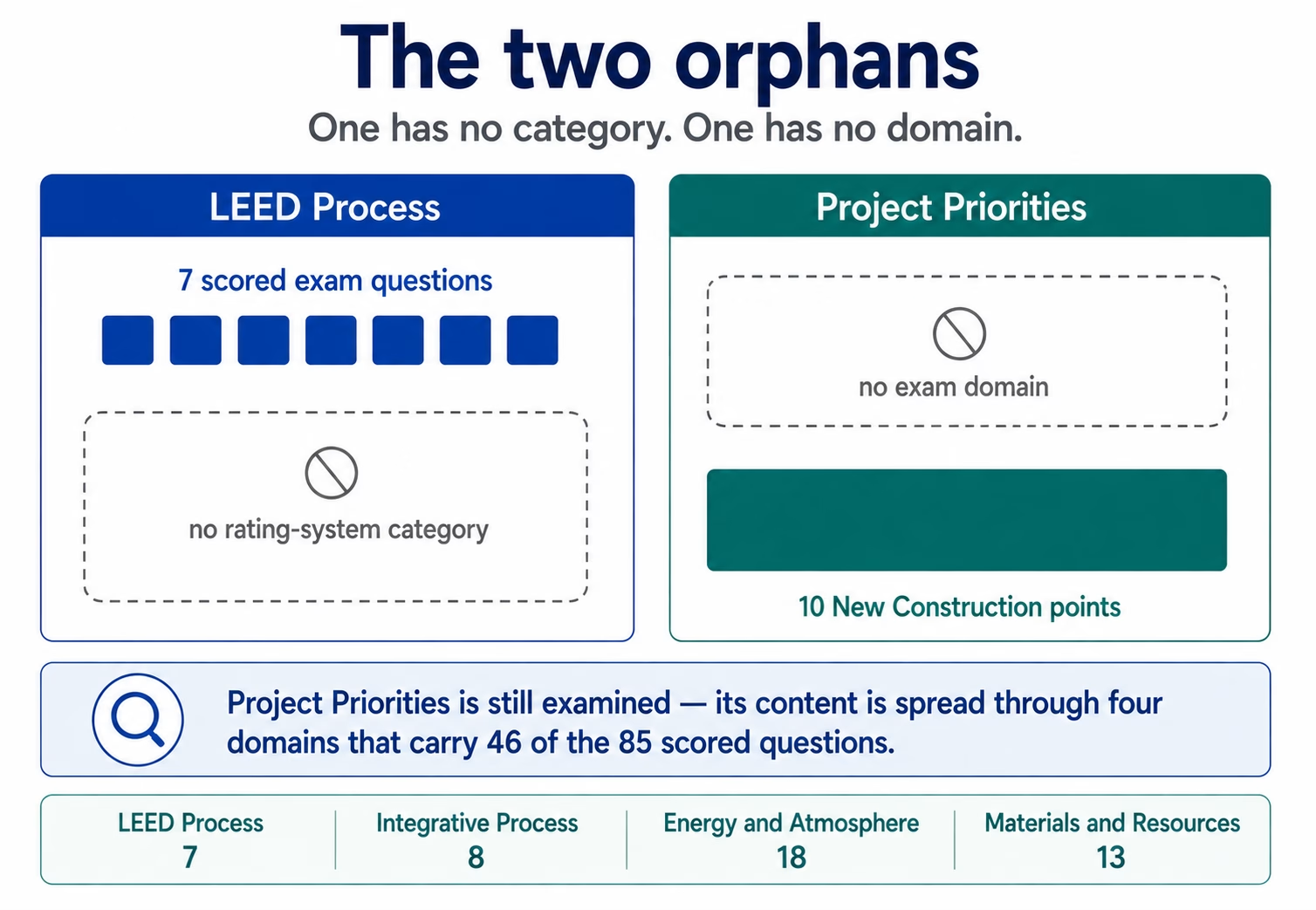
LEED Process is 7 of the 85 scored questions and has no rating-system category at all. Project Priorities is 10 rating-system points and has no exam domain. They are mirror images of each other, and putting them on one page is deliberate: between them they prove that the exam specification and the scorecard are two different documents that happen to share most of their vocabulary.
The two orphans
| LEED Process | Project Priorities | |
| Scored exam questions | 7 | None — not a domain |
| New Construction points | None — not a category | 10 |
| What it is | How LEED itself works | Points for priorities a project chooses |
Point allocations as taught in our LEED AP BD+C v5 course material. Confirm against the LEED v5 BD+C Rating System before relying on them for a live project.
Ten points is not a rounding error. It is more than the whole Water Efficiency category, and within a few points of Indoor Environmental Quality. A project team that treats Project Priorities as an afterthought has written off a larger block of points than several of the categories it spent months optimising.
Why Project Priorities is examined anyway
It has no domain of its own, and it is still examinable — because its content is distributed through the domains that do exist: LEED Process, Integrative Process, Energy and Atmosphere and Materials and Resources.
Those four carry 46 of the 85 scored questions between them.
Which produces a specific and avoidable failure. A candidate revising domain by domain never meets this material as a block, and so never learns it as a system. It arrives in pieces, attached to other subjects, and never gets its own hour. If you are working through the eight domains in order, this is the material most likely to fall between them.
LEED Process: seven sub-topics for seven questions
One question per line, near enough. There is nowhere to hide.
| Minimum Program Requirements | And the requirements for Platinum |
| Avenues to achieve LEED goals | Credit interpretation rulings and requests, project priorities, LEED equivalencies |
| Synergies and trade-offs | Between rating systems, between credits, and between strategies |
| Boundaries | Project boundary, LEED project boundary and property boundary |
| How LEED evolves | Addenda, continuous improvement, development cycles |
| Selecting the rating system | Including the 40/60 rule |
| LEED occupancy | See the warning below — the terminology has moved |
The three Minimum Program Requirements
There are exactly three, they carry no points, and they are not credits — they are the conditions that make a project eligible to pursue LEED at all.
1.A permanent location on existing land. No project designed to move at any point in its lifetime may certify.
2.Reasonable LEED boundaries. The boundary must include the contiguous land supporting typical operations, and may not be drawn to exclude parts of the site in order to make compliance easier.
3.Project size requirements. A minimum gross floor area, which differs between rating systems.
The consequence is the examinable part: certification may be revoked from a project on discovery of non-compliance with a Minimum Program Requirement — before or after the award. Unlike a missed credit, an MPR failure is not something a project simply scores lower for.
Three boundaries, three jobs
Candidates lose marks here by assuming there is one boundary. There are three, and they are used for different things.
| Property boundary | The legal limits of the land the owner holds. Set by title, not by LEED, and often much larger than the project |
| LEED project boundary | The land and building being certified. Governed by the second MPR. This is the boundary most credit calculations use — default to it unless a credit says otherwise |
| Project boundary, or site work | The extent of construction and site disturbance. Used for construction-phase requirements such as pollution prevention |
Two different 60% tests
Two rules in this domain use the same number for different things.
One 60% test is about how much of the building is complete. It governs which rating system applies, through the treatment of incomplete space — a New Construction project may have no more than a set proportion of its floor area incomplete, and a Core and Shell project must have at least that proportion incomplete.
The other 60% test is about what the building is used for. Where a single use type accounts for 60% or more of the gross floor area, that project type’s additional requirements apply — schools, healthcare, warehouses, residential.
Worked through:
| Project mix | Consequence |
| 75% residential, 25% retail | Residential requirements apply |
| 55% residential, 45% office | Neither reaches 60% — no project type requirement is triggered |
| 60% healthcare, 40% office | Healthcare requirements apply |
A scenario that tests both at once is the one to be ready for, and the way through it is to ask which 60% each part of the question is about: how much is finished, or what it is for.
Two exclusions worth memorising
Neither BD+C rating system applies to residential buildings under four storeys, single-family or multi-family.
The entire gross floor area of a project certifies under a single rating system, and is subject to all that system’s prerequisites and attempted credits — regardless of mixed construction or mixed space use. A project cannot certify half of itself under one system and half under another.
⚠ The occupancy terms have changed and the specification has not caught up
This is worth knowing precisely because it is confusing.
The published exam specification’s occupancy line still uses LEED v4 vocabulary — full-time equivalents and transients. LEED v5 counts regular building occupants and visitors.
| Regular building occupants | Routine users, full-time and part-time |
| Visitors | Intermittent users |
Learn the v5 terms. A candidate who learned the specification’s own wording would be learning terminology the rating system has moved past.
Project Priorities: two credits, ten points
| Credit | Points | What it rewards |
| Project Priorities | up to 9 | Several pathways, freely combined, with a ceiling of 9 and no sub-caps |
| LEED AP | 1 | A principal participant holding an active LEED AP BD+C credential |
| Total | 10 | The same for New Construction and Core and Shell |
Point allocations as taught in our LEED AP BD+C v5 course material. Confirm against the LEED v5 BD+C Rating System before relying on them for a live project.
“No sub-caps” is the fact to carry. A project may take its nine points through any combination of the available pathways, without a limit on how many come from any one of them. Caps and ceilings appear all over the rest of the rating system, so this is worth noting precisely because it is an exception.
And note the second credit. A point for having a LEED AP BD+C on the project team is, among other things, a direct answer to anyone asking what the credential is worth on a live project. It is covered in is LEED AP BD+C worth it.
Where candidates lose marks
1.Skipping Project Priorities because it is not a domain. The failure this page exists to prevent.
2.Using the wrong boundary. Default to the LEED project boundary unless a credit says otherwise.
3.Mixing the two 60% tests. Completion versus use type.
4.Using v4 occupancy vocabulary. Including because the specification does.
5.Treating an MPR failure as a lost credit. It is a revocation risk, not a scoring one.
A revision checklist
1.Name the three Minimum Program Requirements and the consequence of failing one.
2.Name the three boundaries and say which one most credit calculations use.
3.Explain both 60% tests and what each governs.
4.State the two hard exclusions from the BD+C rating systems.
5.Give the LEED v5 occupancy terms, and say what they replaced.
6.State the two Project Priorities credits, their points, and the no-sub-caps rule.
7.Name the four domains through which Project Priorities content is examined.
8.Name all seven LEED Process sub-topics.
Then practise it
Work through LEED Process practice questions against the clock. Because Project Priorities has no question block of its own, its questions will arrive wearing another domain’s clothes — which is exactly why it needs studying as a block first.
The full cross-category picture is in LEED AP BD+C credit categories.
Frequently asked questions
How many questions on LEED Process are in the LEED AP BD+C exam?
7 of the 85 scored questions, across seven sub-topics, so roughly one question per line. LEED Process has no corresponding rating-system category, because it covers how LEED itself works rather than something a project earns points for.
How many points is Project Priorities in LEED v5 BD+C?
10 points, the same for New Construction and Core and Shell, as taught in our LEED AP BD+C v5 course material. That is more than the whole Water Efficiency category. Confirm against the LEED v5 BD+C Rating System before relying on it for a live project.
Is Project Priorities examined if it is not a knowledge domain?
Yes. Its content is distributed through LEED Process, Integrative Process, Energy and Atmosphere and Materials and Resources, which carry 46 of the 85 scored questions between them. A candidate revising domain by domain never meets it as a block.
What are the Minimum Program Requirements in LEED v5?
Three: the project must be in a permanent location on existing land, it must use reasonable LEED boundaries that are not drawn to make compliance easier, and it must meet a minimum gross floor area. They carry no points, and certification may be revoked on discovery of non-compliance, before or after the award.
What is the difference between the project boundary and the LEED project boundary?
The property boundary is the legal limit of the owner’s land, set by title. The LEED project boundary is the land and building being certified, and it is what most credit calculations use. The project boundary, or site work, is the extent of construction and site disturbance, used for construction-phase requirements.
What is the LEED 40/60 rule?
It concerns incomplete space and governs which rating system applies: a New Construction project may have no more than a set proportion of its gross floor area incomplete, and a Core and Shell project must have at least that proportion incomplete. It is a different test from the 60 percent that triggers project type requirements.
When do LEED project type requirements apply?
When a single use type accounts for 60 percent or more of the gross floor area. A project that is 75 percent residential follows the residential requirements; one that is 55 percent residential and 45 percent office triggers none, because neither reaches 60 percent.
What are the LEED v5 occupancy terms?
Regular building occupants, meaning routine users whether full-time or part-time, and visitors, meaning intermittent users. These replace the LEED v4 vocabulary of full-time equivalents and transients, which the published exam specification still uses in its occupancy line.
The material that falls between the domains
3FOLD TRAINING has prepared professionals for certification exams since 2008, across more than 100 countries. Our LEED AP BD+C training gives Project Priorities a session of its own precisely because the exam specification does not, which is the argument this page makes. No course is required to sit or pass the exam, ours included. Ask through the course enquiry form.




Leave a reply