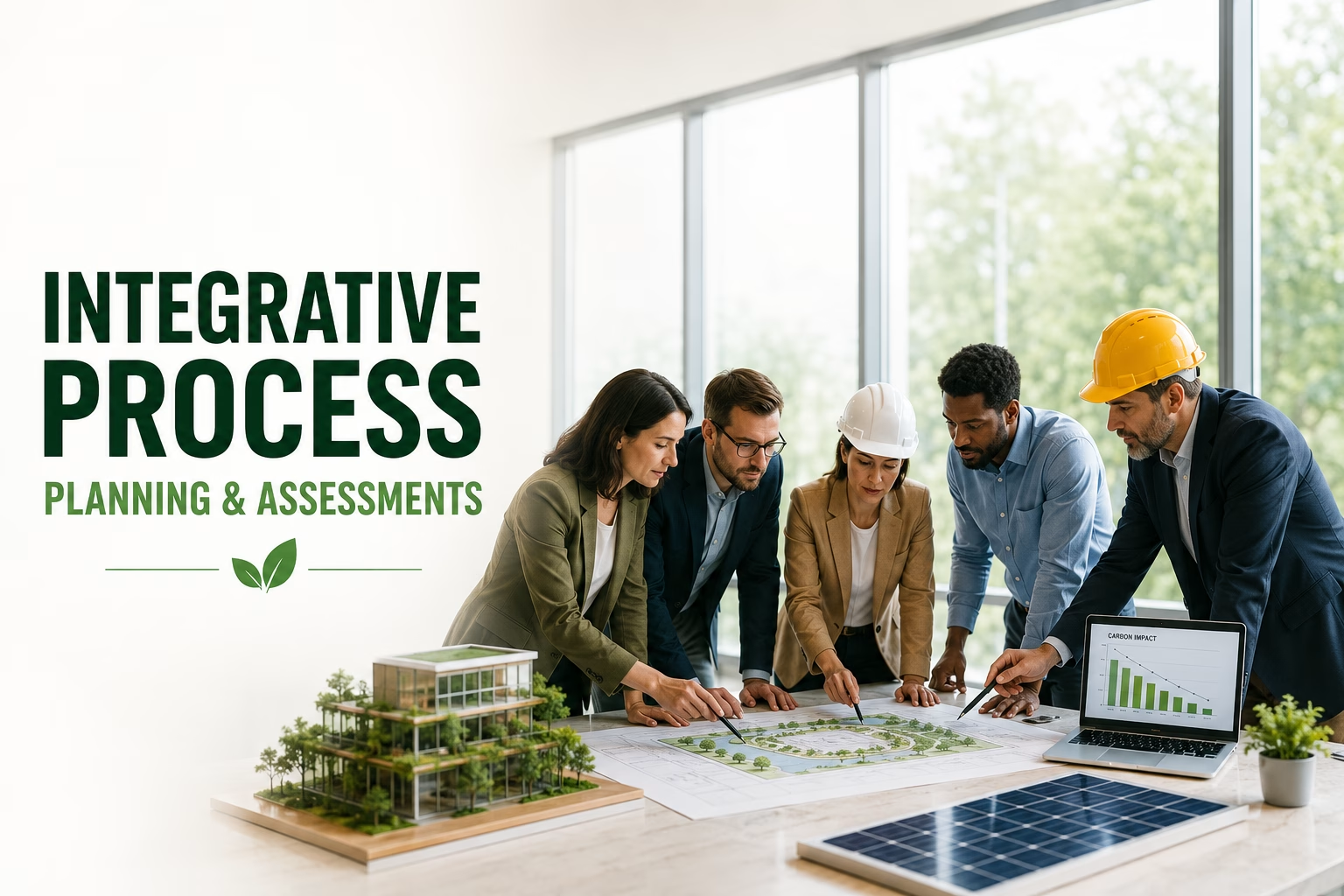
Integrative Process, Planning and Assessments is 6 of the 85 scored questions on the LEED Green Associate exam. It is the smallest domain and the one most worth understanding beyond its mark value, because it is the idea the rest of the rating system is built on. Candidates who grasp it answer scenario questions in every other domain more accurately, because they start looking for the connections the questions are testing.
What the integrative process actually is
Conventional design is sequential. The architect designs the building, then hands it to the engineer, who sizes systems to fit what has already been decided. Each discipline optimises its own part, and nobody optimises the whole.
In practice, an integrative process emphasizes:
- Systems thinking — considering relationships between building and site systems rather than evaluating each system in isolation.
- Interdisciplinary collaboration — involving relevant disciplines and stakeholders early so their expertise can inform project decisions.
- Early and coordinated decision-making — using analysis and collaboration to identify opportunities and trade-offs before major decisions are fixed.
In LEED v5, the Integrative Design Process credit specifically includes an Integrated Team, Design Charrette and LEED Goal Setting.
In practice it starts with a goal-setting workshop or a charrette — an intensive collaborative working session bringing the whole team together at the beginning of a project.
The example that makes it concrete
Improve a building’s envelope — better insulation, better glazing, controlled solar gain — and the heating and cooling loads fall. Because they fall, the mechanical plant can be smaller. Smaller plant costs less, so some or all of the extra spent on the envelope comes back. The building ends up cheaper to run, more comfortable, and no more expensive to build.
That trade is only available if the envelope and the systems are considered together, before the plant is sized. In a sequential process the engineer receives a fixed design and sizes equipment for it, and the saving never appears. This single example explains why LEED cares about process at all, and it is worth being able to reproduce.
Why it has to happen early
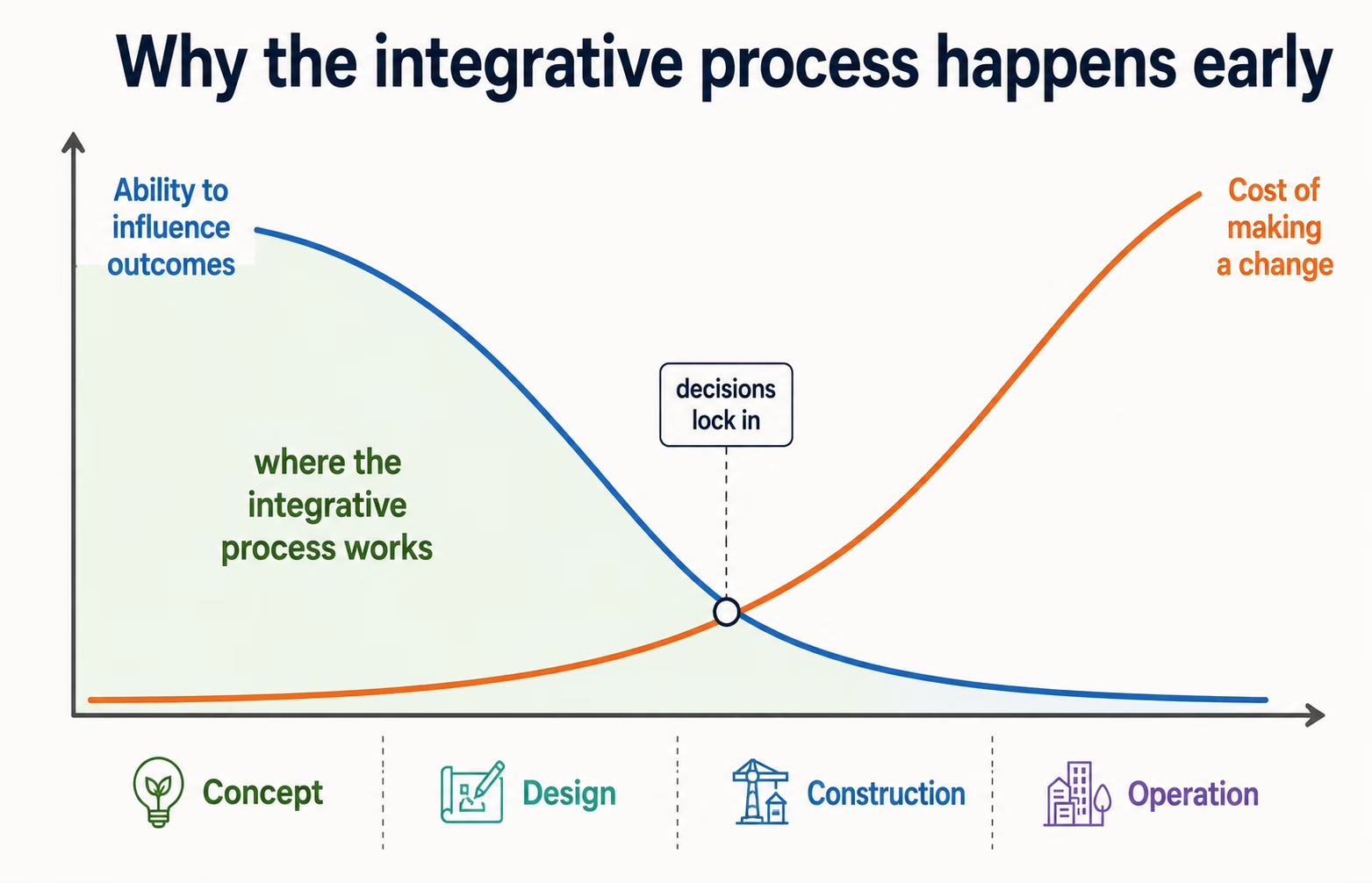
Two curves run in opposite directions across a project. Your ability to influence the outcome is highest at concept stage and falls away as decisions accumulate. The cost of making a change is lowest at concept stage and rises steeply once drawings, contracts and construction follow.
Everything valuable happens where those curves are furthest apart — at the beginning. Changes are far cheaper in early design than during construction, synergies deliver more performance for the same or lower cost, and the decisions made in the first weeks shape performance for the building’s whole life.
Two life-cycle ideas that get confused
| Term | What it means |
| Life-cycle approach | Looking at all stages of a project, product or system — from raw material extraction through to end of life |
| Life-cycle costing | An integrative method that weighs purchase cost and long-term operating cost together |
The distinction the exam tests: the life-cycle approach is about environmental impact across time; life-cycle costing is about money across time. Life-cycle costing is what reveals that a small extra investment now pays back over the building’s life — the argument that wins the integrative process its budget.
Who is in the room
The integrative project team is broader than a conventional design team, and it is assembled earlier.
| Member | What they bring |
| Owner and architect | The vision, the goals and the budget |
| Engineers | Mechanical, electrical, plumbing, structural and energy expertise |
| Landscape architect | Site, ecology, water and the outdoor experience |
| Commissioning provider | Facilitates communication and verifies that systems perform as intended |
| Facility manager | The operational reality — what will actually be maintained |
| Community and stakeholders | The voices of the people the project affects |
Two of those are worth noticing. The facility manager is present at design stage, which is unusual and deliberate — the person who will run the building for thirty years has views about what is maintainable. And the community is a team member rather than a consultee, which is one of the clearest signals of what changed in LEED v5.
Equity and wellbeing
LEED v5 treats social equity as a core sustainability outcome rather than a bonus, and this domain is where that lands. Expect these terms.
Environmental justice is the principle that all people deserve equal protection from environmental and health hazards. Fenceline communities are the people living immediately next to polluting facilities, who bear disproportionate impacts from them. Social determinants of health are the non-medical factors — housing, access, environment — that shape health outcomes, and which buildings influence more than most people assume.
The people side extends to those who build and run the project: safe, fair and healthy conditions for the construction workforce, responsible labour practices across the materials supply chain, and healthy conditions for the occupants and operators who inherit the finished building.
Resilience and carbon, assessed early
Hazards are the events or conditions that pose risks to a project — heat, flooding, wildfire, storms, drought. A climate-risk and hazard assessment is a forward-looking analysis identifying and prioritising the highest-priority hazards for that specific site. Resilience is the capacity to prevent, withstand, respond to and recover from them.
The reason this sits in the integrative process domain rather than among the site credits is timing: the assessment has to happen early, while the project can still respond to what it finds. A flood risk identified after the ground floor level is fixed is information arriving too late to use.
The two carbons
| Type | Where it comes from |
| Operational carbon | Day-to-day energy used to run the building |
| Embodied carbon | Manufacturing, transporting and installing materials, plus construction activity |
Both are assessed early for the same reason: estimating carbon while the design can still change is where the leverage is. Embodied carbon in particular is largely fixed once the structure is built — you cannot retrofit your way out of the concrete you have already poured. This connects directly to Materials and Resources, where the same distinction reappears.
Key terms to memorise
| Term | Definition the exam expects |
| Integrative process | Early, collaborative, iterative design of the building as one system rather than as separate parts |
| Systems thinking | Understanding individual elements and their relationship to the whole |
| Iterative decision-making | Examining and revisiting solutions repeatedly as information improves |
| Charrette | An intensive collaborative working session at the start of a project |
| Life-cycle approach | Considering all stages from raw materials to end of life |
| Life-cycle costing | Weighing purchase and long-term operating costs together |
| Commissioning provider | Facilitates communication and verifies systems perform as intended |
| Environmental justice | All people deserve equal protection from environmental and health hazards |
| Fenceline communities | People living next to polluting facilities who bear disproportionate harm |
| Social determinants of health | Non-medical factors such as housing, access and environment that shape health |
| Hazard | An event or condition posing risk — heat, flood, wildfire, storm, drought |
| Climate-risk and hazard assessment | Forward-looking analysis identifying and prioritising a site’s highest-priority hazards |
| Resilience | Capacity to prevent, withstand, respond to and recover from hazards |
| Operational carbon | Emissions from the energy used to run the building day to day |
| Embodied carbon | Emissions from making, transporting and installing materials, and from construction |
Synergies to recognise
Finding synergies is the entire purpose of the integrative process, so this section is the domain rather than an addition to it.
- Envelope and HVAC. A better envelope shrinks the mechanical plant, cutting capital cost, energy and carbon while improving comfort. The canonical example.
- Site and water. Green infrastructure manages rainfall, cools the site and adds habitat from one intervention — see Sustainable Sites.
- Health and energy. Daylight and good ventilation support wellbeing and can reduce energy use, provided glare and heat gain are controlled.
- Location and everything. The siting decision reaches into carbon, health, equity and ecology at once — see Location and Transportation.
- Early carbon assessment and materials. Knowing the embodied carbon of a structural option while the structure is still a choice.
Where candidates lose marks
- Treating the integrative process as a meeting. It is a way of making decisions across the whole project, not an event held once.
- Swapping life-cycle approach and life-cycle costing. Approach is about impact; costing is about money.
- Forgetting who belongs on the team. Facility manager and community are the two candidates omit.
- Underestimating the equity content. Environmental justice, fenceline communities and social determinants of health are examinable under LEED v5.
- Confusing operational with embodied carbon. Operational is running the building; embodied is building it.
- Missing why assessments are early. A hazard or carbon assessment produced late is a report, not a design input.
- Answering “later, once we have more information”. Iterative does not mean postponed. It means start early and revisit.
Revision checklist
You are ready on this domain when you can, without looking:
1.Define the integrative process and name its three habits.
2.Explain the envelope-and-HVAC example from start to finish.
3.Say what a charrette is and when it happens.
4.Explain why influence falls and cost of change rises across a project.
5.Distinguish the life-cycle approach from life-cycle costing.
6.Name six members of an integrative project team and what each brings.
7.Say what a commissioning provider does.
8.Define environmental justice, fenceline communities and social determinants of health.
9.Explain what a climate-risk and hazard assessment is for and why it is early.
10.Give the four-part definition of resilience.
11.Distinguish operational from embodied carbon and say which is harder to change later.
12.Give three examples of cross-category synergies.
Test yourself
Reading is not revision. Work through our Integrative Process practice questions, then sit the 50-question mock exam under time.
Frequently asked questions
How many Integrative Process questions are on the LEED Green Associate exam?
Integrative Strategies represents 8 questions in the LEED Green Associate exam’s knowledge-domain specification. The exam itself has 100 multiple-choice questions.
What is a charrette?
An intensive collaborative working session held at the start of a project, bringing the whole team together to set goals and find synergies before decisions lock in.
What is the difference between operational and embodied carbon?
Operational carbon comes from the energy used to run the building day to day. Embodied carbon comes from manufacturing, transporting and installing materials, and from construction activity.
Why does LEED insist the integrative process happens early?
Because a project’s ability to influence outcomes is highest at the start while the cost of making changes is lowest. Once decisions lock in, the synergies that make a building perform better for the same money are no longer available.
Learning this properly
3FOLD TRAINING teaches integrative design, life-cycle thinking, equity and early carbon assessment as a full module in LEED Green Associate training, written to LEED v5. Ask us through the course enquiry form.


Leave a reply