
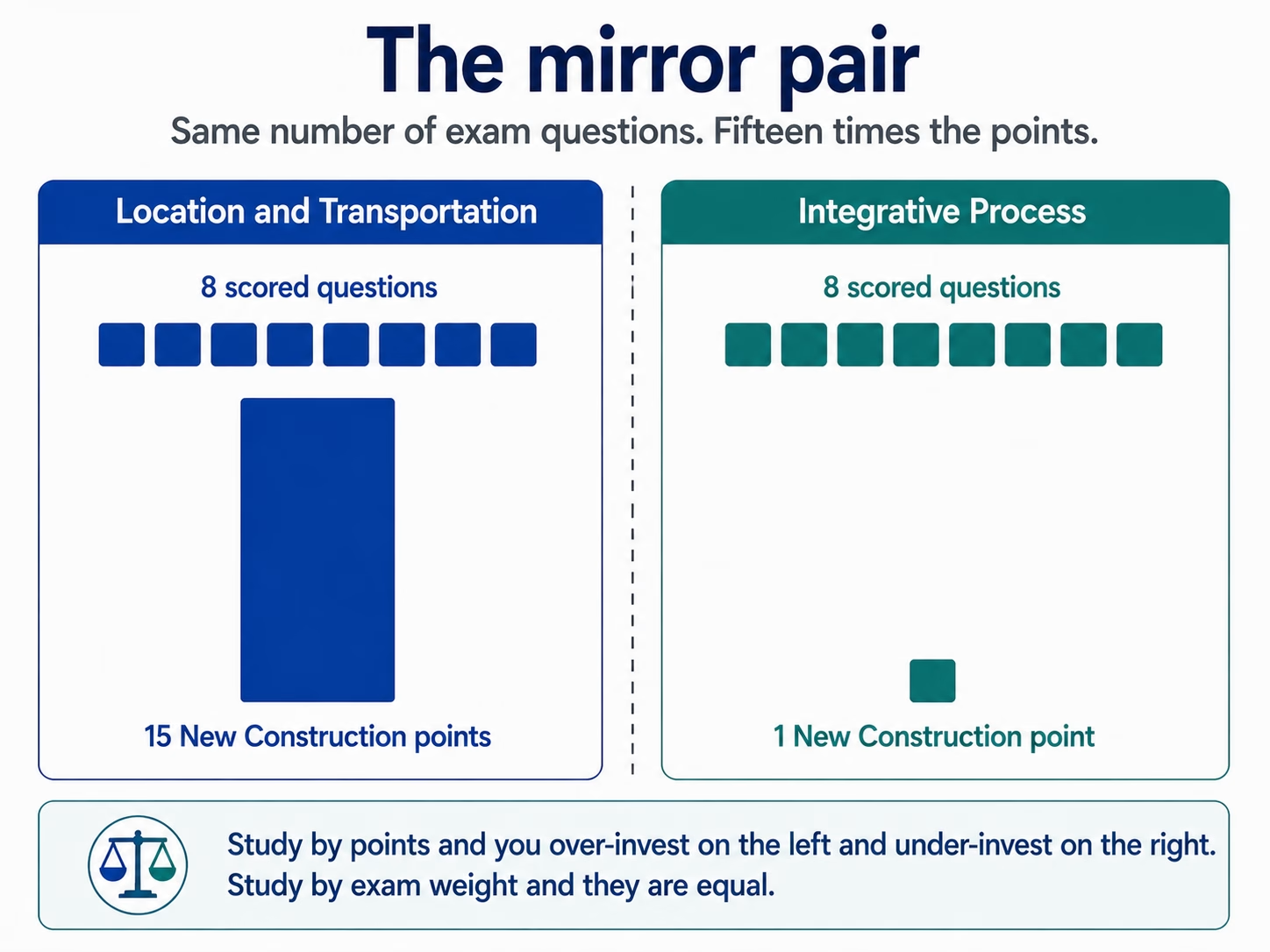
Location and Transportation is 8 of the 85 scored questions and 15 points — the same for New Construction and Core and Shell. It is the exact mirror of Integrative Process, which is also 8 questions and worth one point. Same weight on the exam, fifteen times the weight on the scorecard, and between them they show why studying by points goes wrong in both directions.
The shape of the domain
| 8 of the 85 scored questions | Across six sub-topics |
| 15 points | Identical for New Construction and Core and Shell |
| No prerequisites | The only credit category besides Project Priorities with none |
| Five credits | One of which is 6 points on its own |
No prerequisites is worth pausing on. Location and Transportation and Project Priorities are the only two categories with none: everything in them is optional and everything in them pays. Every other category carries at least one compulsory item that earns nothing, so a project cannot simply decline to engage with it.
The mirror of Integrative Process
Set the two side by side and the distortion is obvious:
| Location and Transportation | Integrative Process | |
| Scored questions | 8 | 8 |
| New Construction points | 15 | 1 |
| Prerequisites | None | Four |
A candidate allocating study time by rating-system points would give this category fifteen times the attention of Integrative Process. The exam asks the same number of questions about each.
The reason is not that Location and Transportation matters less. It is that its points are earned by where a project chose to build, which is often settled before the design team arrives. Integrative Process points are earned by how a team works, which is a competence — and the handbook is explicit that the AP exam tests practitioner competency and project proficiency.
The other side of the pair is at Integrative Process, Planning and Assessments, and the full picture at LEED AP BD+C credit categories.
Six sub-topics
| Development constraints and opportunities | Prime farmland, floodplains, species and habitat, water bodies, wetlands, historic districts, priority designations, brownfields, steep slopes |
| Community connectivity | Walkability, street design, surrounding density, diverse uses |
| Access to quality transit | Concepts and calculations, multimodal choice |
| Transportation demand management | Parking capacity and management, bicycle storage and showers |
| Electric vehicles | Regional energy sources for electricity generation, EV parking, supply equipment specification |
| Economic and social vitality | Equitable construction, supporting the local economy, affordable housing |
The last one is not what most people expect from a transport category. Equitable construction, supporting the local economy and affordable housing are examined here, alongside walkability and transit — so where a building goes is treated as a social question as well as an environmental one.
The five credits
| Credit | Points | What it rewards |
| Compact and Connected Development | 6 | Density and transit access, through several options that cap at 6 |
| Transportation Demand Management | 4 | An assessment first, then reductions in parking capacity on a ladder |
| Equitable Development | 2 | Several options around local hiring, apprenticeships and community benefit |
| Electric Vehicles | 2 | Charging provision as a proportion of parking, or a minimum number of spaces |
| Sensitive Land Protection | 1 | Avoiding farmland, floodplains, habitat, water bodies, wetlands and steep slopes |
| Total | 15 |
Point allocations as taught in our LEED AP BD+C v5 course material. Confirm against the LEED v5 BD+C Rating System before relying on them for a live project.
Compact and Connected Development is 6 of the 15 on its own, structured as a menu of options with a ceiling. As elsewhere in v5, the options can add up to more than the credit pays, and the credit still pays its ceiling.
Where candidates lose marks
1.Missing that the demand management credit needs an assessment first. The parking reduction is what pays, but the assessment is the gate — unless the project is exempt. A scenario describing a large parking reduction and no assessment is describing a project that has not earned it.
2.Rounding the wrong way on electric vehicles, or double counting. The provision can be expressed as a proportion of spaces or as a minimum number, and the same space cannot be counted twice toward both. Round up, count once.
3.Treating sensitive land as one test. It covers several distinct land types with different buffers and thresholds — water bodies and wetlands have different distances, and steep slopes are graded, with the steeper band requiring more protection.
4.Confusing this category with Sustainable Sites. The boundary is choosing the site versus what happens on it. Wetlands and steep slopes are here; habitat restoration and rainwater are in Sustainable Sites.
5.Over-studying it. Fifteen points makes this look like a major domain. Eight questions is what it is worth on the paper. Give it the time the exam gives it, not the time the scorecard suggests.
A revision checklist for this domain
1.Say why this category has no prerequisites, and name the only other one that does not.
2.State all five credits and their points, and identify the one worth 6.
3.Name the land types the sensitive land credit protects and say which have different thresholds.
4.Explain what must happen before the parking reduction in the demand management credit can pay.
5.State the two ways electric vehicle provision can be expressed, and the two counting rules.
6.Explain what happens when a menu credit’s options sum above its ceiling.
7.Name all six sub-topics, including the social and economic one.
8.For any site-related credit, say whether it lives here or in Sustainable Sites.
Then practise it
Work through Location and Transportation practice questions against the clock. This domain has more arithmetic in it than its question count suggests, so practise the calculations rather than reading them.
Frequently asked questions
How many questions on Location and Transportation are in the LEED AP BD+C exam?
8 of the 85 scored questions, drawn from six sub-topics. That is the same number of questions as Integrative Process, which is worth one point where this category is worth 15.
How many points is Location and Transportation in LEED v5 BD+C?
15 points, identical for New Construction and Core and Shell, as taught in our LEED AP BD+C v5 course material. Confirm against the LEED v5 BD+C Rating System before relying on it for a live project.
Does Location and Transportation have any prerequisites?
No. It is the only credit category besides Project Priorities with none, so everything in it is optional and everything in it earns points. A project can score zero here and still certify.
What is the largest credit in Location and Transportation?
Compact and Connected Development, at 6 of the 15 points as taught in our LEED AP BD+C v5 course material. It is structured as a menu of options that can add up to more than the credit pays, and the credit still pays its ceiling. Confirm point values against the LEED v5 BD+C Rating System.
Why is Location and Transportation worth 15 points but only 8 exam questions?
Because its points are largely earned by where a project chose to build, which is often settled before the design team arrives. Integrative Process is the mirror image: the same 8 questions for a single point, because it tests how a team works rather than where it built.
What does the transportation demand management credit require first?
An assessment, unless the project is exempt. The parking capacity reduction is what earns the points, but a scenario describing a large reduction with no assessment describes a project that has not earned the credit.
What is the difference between Location and Transportation and Sustainable Sites?
Location and Transportation is about choosing the site, including sensitive land such as wetlands, floodplains and steep slopes, and about connectivity and transport. Sustainable Sites is about what happens on the site once chosen, including habitat restoration, rainwater, heat island and lighting.
Weighting your revision correctly
3FOLD TRAINING has prepared professionals for certification exams since 2008, across more than 100 countries. Our LEED AP BD+C training allocates time by exam weight, which for this category means less than its 15 points would suggest, and for Integrative Process a great deal more than its one point would. No course is required to sit or pass the exam, ours included. Ask through the course enquiry form.




Leave a reply