
The reading list looks impossible and it is not. The exam is a test of LEED, not of the standards themselves. What the published specification covers is how LEED works — which means learning which standard governs which credit, and which version applies, rather than the contents of each document. Read for recognition, not recitation, and a catalogue that looked unmanageable becomes a manageable one.
Why the count frightens people, and why it should not
Counted across the nine domains, LEED v5 BD+C names 86 entries — a handful of which appear in more than one category, so the number of distinct documents is slightly lower. Set out by category, the distribution is lopsided in a way that matters:
| Category | Entries | What that number actually means |
| Sustainable Sites | 21 — the most | Misleading. Thirteen of the twenty-one sit inside one credit, Enhanced Resilience, at roughly one standard family per hazard — flood, wind, hail, wildfire, drought, tsunami. A project addresses at least two of the highest-priority hazards identified in the climate resilience assessment. You will never need all of them |
| Indoor Environmental Quality | 17 | Genuinely spread, but anchored by one backbone standard |
| Energy and Atmosphere | 16 | Heavily concentrated in one family — different editions and sections of the same energy standard account for most of the list |
| Materials and Resources | 16 | About a third are ISO conformance standards for life cycle data and product declarations; most of the rest govern emissions testing |
| Location and Transportation | 8 | Half of them govern a single land-eligibility option |
| Water Efficiency | 5 | Two labelling programmes, a baseline methodology, an eligibility gate, a calculator |
| Integrative Process and LEED Process | 3 — the fewest | An emissions scenario source, a disclosure score, and the occupancy density source |
The Sustainable Sites figure is the one to understand rather than fear. It is the largest count and the least of a problem, because the credit’s structure means a project meets one standard family per hazard it addresses — not twenty-one.
Two standards carry the study weight
If you study two things from this page, study these.
| Standard | Uses | Where |
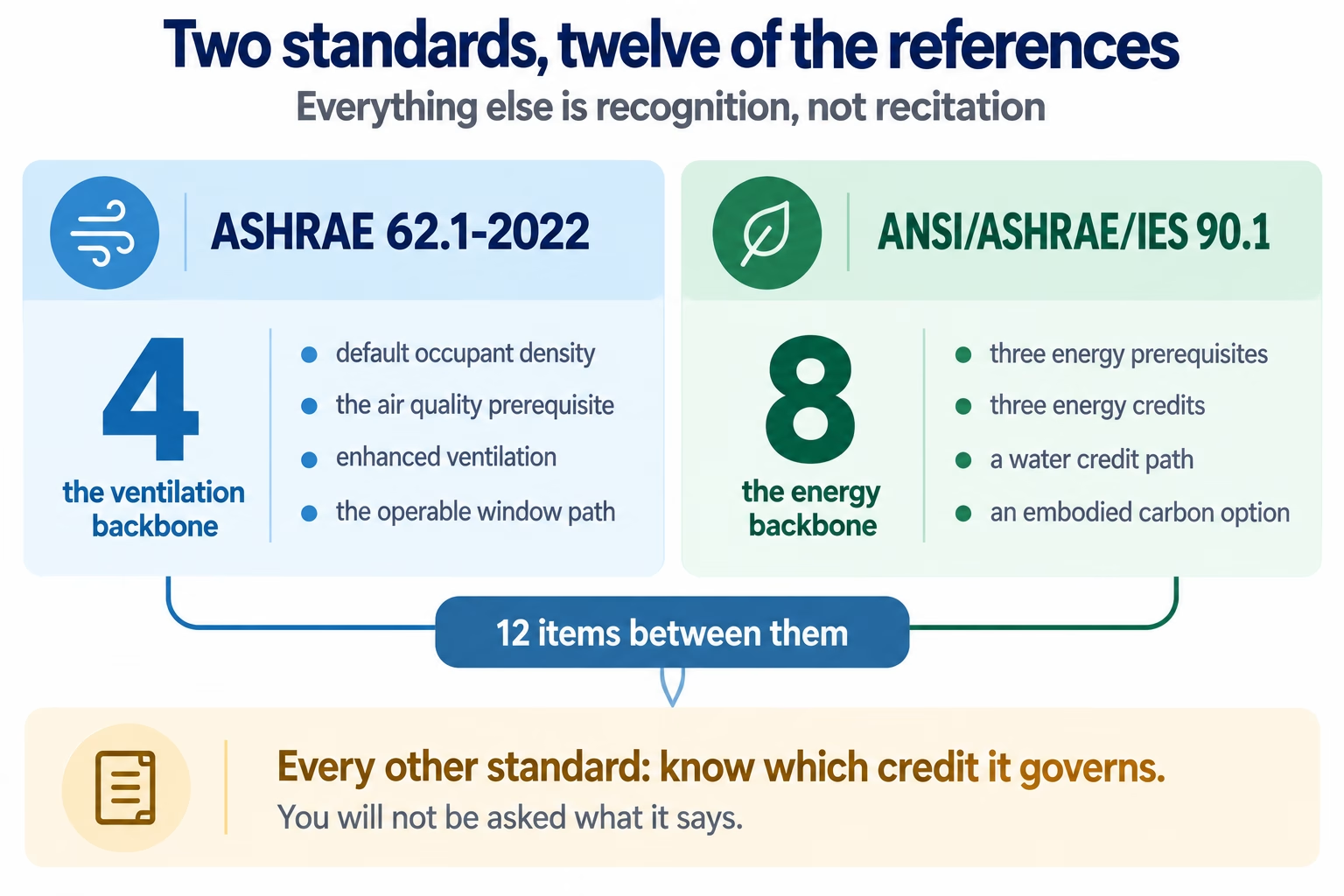
| ASHRAE 62.1-2022 — the ventilation backbone | 4 | Default occupant density · the indoor air quality prerequisite · the enhanced ventilation credit, which exceeds it · the operable window compliance path |
| ANSI/ASHRAE/IES 90.1 — the energy backbone | 8 | Three of the energy prerequisites · three energy credits · a water use reduction path · the operating energy element of the embodied carbon option |
Twelve items between them. These two are worth genuine study time — not memorising their contents, but knowing which prerequisites and credits sit on top of them and roughly what each one governs. Everything else on the list is recognition-level.
The other recurring names
A second tier appears two or three times each. Knowing that a name recurs is itself useful, because it tells you the name is doing structural work rather than sitting in one credit.
| Standard | Appears in |
| ENERGY STAR | Water-using equipment · charging equipment functionality criteria · a disclosure item |
| FEMA | Two hazard families in the resilience credit, and behind one indoor air limit |
| ISO/IEC 17065 | Product declaration verification, and third-party verification of a recycling facility’s rate |
| ASHRAE 241-2023 | A filtration alternative, and the infection risk mode of the enhanced air quality credit |
| SITES | Two hazard families in the resilience credit |
| IPCC | The emissions scenario for the climate resilience assessment, and refrigerant global warming potential values |
The version dates that change the answer
This is the part of the standards material that is genuinely examinable in detail, because a version is a fact with a date attached and dates are answerable.
| Version | What it carries | When it applies |
| Energy standard, 2019 edition with Addendum cr | Addendum cr is mandatory. All other 2019 addenda are optional | Projects registered before 1 January 2028 |
| Energy standard, 2022 edition | The edition LEED v5 requires for later registrations | Mandatory for projects registered on or after 1 January 2028 |
| The 2004 edition | Not a compliance option. It is the stable baseline that the Performance Index represents | Behind every Performance Index figure |
| The energy code equivalences | Stated equivalences between two code editions and the two energy standard editions above | An alternative compliance route under the energy prerequisite |
| The enclosure commissioning standard | All tasks apply except two, which are named in the credit | Enhanced commissioning |
| Refrigerant global warming potentials | The IPCC Fourth Assessment Report or later, on a 100-year basis | The refrigerant prerequisite |
The 1 January 2028 boundary is the most concrete thing in this material — a date is either right or wrong. One edition before it, another on or after it, and one mandatory addendum attached to the earlier edition. If you learn nothing else from the standards, learn that.
What to do with the rest
The remaining names — soil surveys, species listings, walkability scoring, parking generation, lighting zones, laboratory accreditation, emission test methods, blower-door protocols — are recognition-level. The useful preparation is not reading them. It is being able to say, on seeing the name, which credit it belongs to and roughly what it governs.
Three groupings make that easier than learning them one at a time:
- The land-eligibility cluster. Several standards in Location and Transportation exist to define what counts as prime farmland, threatened habitat or an imperilled ecological community — all serving one option in one credit.
- The hazard cluster. Most of the Sustainable Sites count is one standard family per hazard in the resilience credit.
- The conformance cluster. Around a third of Materials and Resources is ISO standards specifying what a life cycle assessment tool, dataset or product declaration must conform to — not what a project must build. Most of the remainder governs how product emissions are tested.
Learn the three clusters and the two backbones and you have accounted for something like four entries in ten, without reading a single standard.
Category counts and version rules on this page are as taught in our LEED AP BD+C v5 course material and reflect LEED v5 BD+C. Confirm against the LEED v5 BD+C Reference Guide and the addenda database before relying on them for a live project.
How this fits the rest of your preparation
Standards are not a domain. They run through all eight, which is why they are easy to leave until last and then panic about. Put them where they belong: alongside the calculations, late, once the credits themselves are learned — the six-week plan puts both in week six. The figures those standards govern are in the cheat sheet, and the energy standard’s own credits are covered in Energy and Atmosphere.
Frequently asked questions
Do I need to read the ASHRAE standards for the LEED AP exam?
Not their contents. The exam is a test of LEED rather than of the standards themselves, so what is worth knowing is which standard governs which credit, and which version applies to a given project. Read the catalogue for recognition rather than recitation, and spend the study time on the two backbone standards instead of on the long tail.
Which standards matter most for LEED AP BD+C?
Two. ASHRAE 62.1-2022 is the ventilation backbone and appears in four places, including as the source for default occupant density. The energy standard, ANSI/ASHRAE/IES 90.1, appears in eight, covering three of the energy prerequisites, three energy credits, a water use reduction path and part of the embodied carbon option. Twelve items between them.
How many referenced standards are there in LEED v5 BD+C?
USGBC does not publish the referenced standards as one official numerical catalogue. The standards are identified throughout the applicable LEED v5 BD+C reference materials and exam references.
Why does Sustainable Sites have so many referenced standards?
Because thirteen of the twenty-one sit inside one credit, Enhanced Resilience, at roughly one standard family per hazard: flood, wind, hail, wildfire, drought, tsunami. A project addresses at least two of the highest-priority hazards identified in its climate resilience assessment, so the count overstates the study burden considerably.
Which version of ASHRAE 90.1 does LEED v5 use?
It depends on the registration date. Projects registered before 1 January 2028 use the 2019 edition with Addendum cr, which is mandatory while the other 2019 addenda are optional. The 2022 edition is mandatory for projects registered on or after that date. Separately, the 2004 edition is not a compliance option at all: it is the stable baseline behind the Performance Index.
What is Addendum cr in LEED?
It is the one addendum to the 2019 edition of the energy standard that LEED v5 makes mandatory. All other 2019 addenda are optional. That asymmetry is the kind of detail that is genuinely answerable, which is why it is worth learning alongside the 1 January 2028 boundary rather than treated as trivia.
Are the referenced standards published as one list?
Not that we have found. They are named credit by credit, which is why candidates arrive at a total by counting and then overestimate the work involved. Our own course material compiles them into a single catalogue, and this page publishes the shape of that catalogue, the two backbone standards and the version rules rather than the full list.
How much study time should reference standards get?
Late and little. They are not a domain of their own, they run through all eight, and the credits have to be learned before the standards attached to them mean anything. In our own six-week plan they sit in the final week alongside the calculations, after every domain has been covered.
Where this comes from
3FOLD TRAINING has prepared professionals for certification exams since 2008, across more than 100 countries. Our LEED AP BD+C training compiles the full catalogue as a single reference, because it does not exist as one anywhere else we have found — but the shape of it, which is what the exam tests, is on this page. No course is required to sit or pass the exam, ours included. Questions through the course enquiry form.



Leave a reply