
It is a real exam with a real standard, and it is passable in weeks rather than months by someone with no green building background. The difficulty is breadth, not depth: eight knowledge domains, a lot of precise vocabulary, and 100 questions in 2 hours. Almost nobody fails because the concepts were too advanced. They fail because they underestimated the coverage, or revised from material written for an older version of LEED.
First, about that pass rate you read
You have probably seen a figure — 70 per cent, 80 per cent, something confident. USGBC and GBCI do not publish a pass rate for this exam, or for any of their exams. There is no official number, which means every figure in circulation is either invented or extrapolated from one training provider’s own students.
A provider’s internal pass rate tells you about their students, not about the exam. People who buy a course and finish it are not a random sample of candidates.
So ignore the number, and ask a more useful question: what actually makes this exam hard, and which of those things applies to me?
What actually makes it hard
1. Breadth, not depth
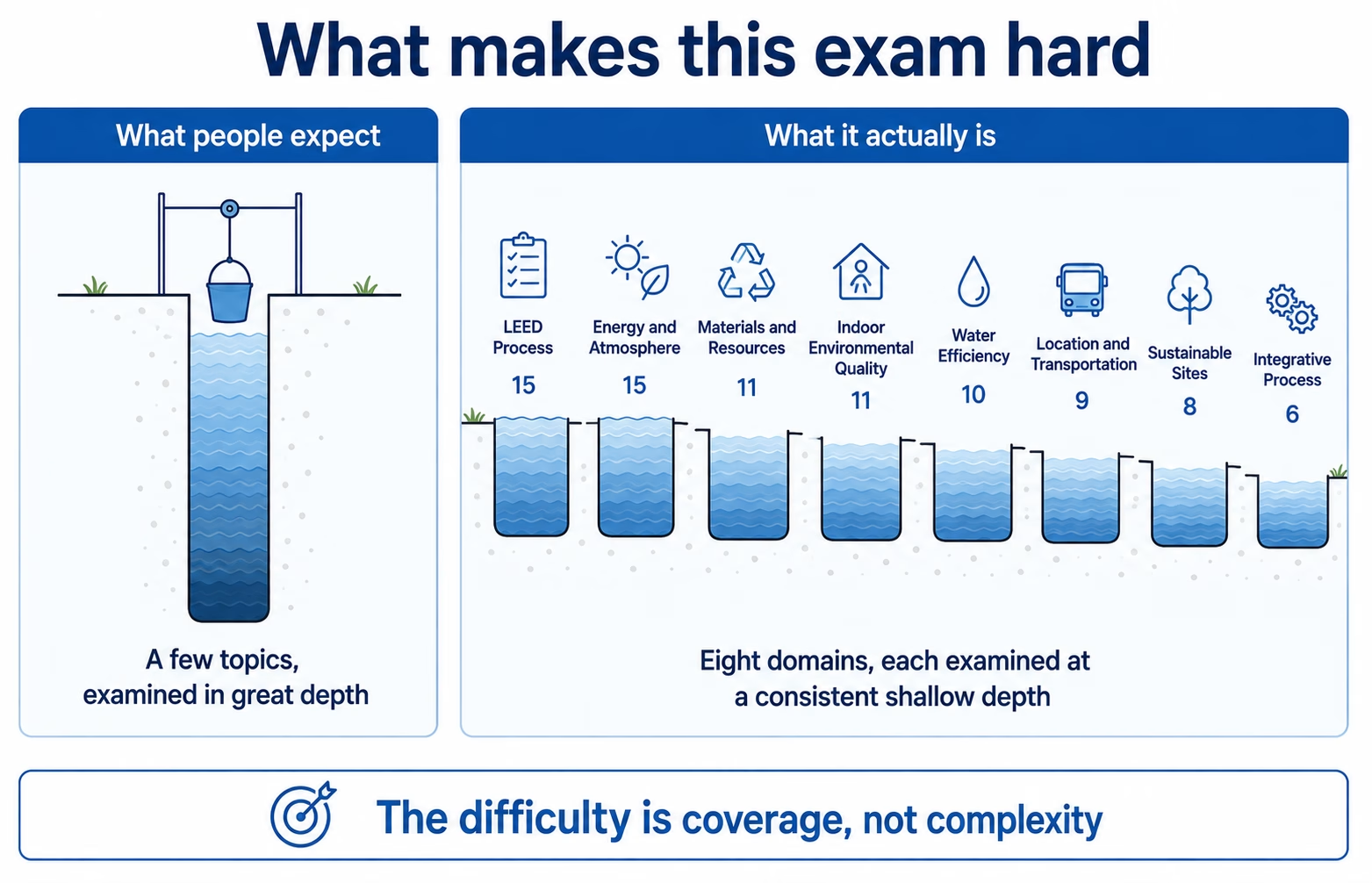
The exam covers eight knowledge domains — the process, energy, materials, indoor environment, water, location, site and integrative design. USGBC’s specification spreads 85 scored questions across all eight, so you cannot afford a domain you skipped.
Why 85 and not 100. You answer 100 questions, but the specification covers only the scored ones. The other 15 are trial items GBCI is piloting for future exams, mixed in at random and not identified to you. Revise as though every question counts, because you cannot tell which do.
Nothing in it is intellectually difficult at Green Associate level. There is no calculation to master and no engineering to understand. But there is a great deal of it, and it is all examinable. This is why people with strong technical backgrounds sometimes struggle: they go deep where the exam wants wide.
2. Precision of vocabulary
A large share of the questions turn on distinctions between terms that sound alike. Native against adapted plants. Embodied against operational carbon. Flush rate against flow rate. Certification against accreditation. ASHRAE 62.1 against ASHRAE 55.
Half-knowing a term produces a confidently wrong answer, which is worse than knowing you do not know. The good news is that this is the most fixable kind of difficulty — it responds directly to drilling. Our acronyms and terminology glossary sets out the confusable pairs side by side for exactly this reason.
3. Pace
100 questions in 2 hours is 1 minute 12 seconds per question. That is comfortable for anyone who knows the material and brutal for anyone who has to reason each one out from first principles.
Pace is the difficulty candidates discover too late, because reading a study guide never simulates it. It is also the easiest to fix: sit full-length timed papers until the clock stops being a factor.
4. Material written for the wrong version
This is the one currently doing the most damage, and it is not the candidate’s fault. LEED v5 changed what the exam weights and, in places, what the correct answer is. Embodied carbon carries far more weight than before. Equity and resilience are examinable content rather than context. And the question format changed — every question now has exactly one correct answer, so any practice material still offering “choose the best three” items was written for an exam that no longer exists.
A candidate who studies hard from a v4 guide will walk in confident and be wrong about specific things. See LEED GA v5 exam changes.
What makes it easier than people fear
- There are no prerequisites. No degree, no experience, no prior credential. Anyone can sit it.
- Every question has one right answer. Elimination works cleanly — you never have to judge whether a fourth option is also acceptable.
- You can skip, flag and change answers freely until you submit. Nothing locks.
- There is no negative marking. A guess costs nothing.
- Both unit systems appear. Every LEED exam presents imperial and metric together, imperial first with metric in brackets, so candidates who think in metric are not disadvantaged.
- The syllabus is finite and published. USGBC tells you the eight domains and how many scored questions each contributes. Very few professional exams are this transparent about where the marks are.
- You can rehearse the logistics. Prometric offers a Test Drive — a 30-minute dry run of the whole check-in and test delivery process. Almost nobody mentions it, and it removes most of the unfamiliarity that makes exam day stressful, particularly if you are sitting remotely.
How hard will it be for you?
The honest answer depends almost entirely on your starting point.
| Your background | What you will find |
| You work on LEED-registered projects | Much of it is familiar. Your risk is assuming familiarity is enough — the exam wants precise definitions, not practical instinct |
| Architecture, engineering or construction, but no LEED exposure | The concepts land easily. The vocabulary and the rating-system structure are new and need deliberate learning |
| Sustainability or ESG, outside buildings | The principles are familiar, the building-specific content is not. Energy, materials and water need real work |
| A different field entirely | Everything is new, and it is still very achievable. This credential is designed as an entry point, not a gate |
| Student, no professional background | Entirely doable, and there is a reduced exam fee for students. Time is the input you have most of |
Why people actually fail
In our experience preparing candidates, failures cluster into four causes, and none of them is intelligence.
1.Out-of-date material. The single biggest cause right now.
2.Reading without rehearsing. Reading a guide produces familiarity, which feels like knowledge and is not. The exam asks you to choose between plausible options at speed. Only timed practice builds that.
3.Skipping the small domains. Integrative Process is 6 questions and Sustainable Sites is 8. Together that is more marks than most people can afford to concede.
4.Booking too early. Registering to create motivation, then arriving under-prepared. It works for some people and is expensive for the rest, because every attempt costs the full fee.
The only honest readiness test
Do not judge readiness by how much you have read or how many hours you have logged. Judge it by this: can you score consistently well on a timed paper, across all eight domains, on questions you have not seen before?
If yes, book. If you are strong in six domains and weak in two, the average is hiding a problem the real exam will find. Our free 50-question mock exam will tell you which you are, and it takes under an hour.
Frequently asked questions
What is the pass rate for the LEED Green Associate exam?
USGBC and GBCI do not publish a pass rate for the LEED Green Associate exam or for any of their professional exams. Any figure you find online is either invented or drawn from one training provider’s own students, which is not a representative sample.
Is the LEED Green Associate exam hard?
It is a genuine exam with a real standard, but the difficulty is breadth rather than depth. It covers eight knowledge domains at a consistent level and rewards precise vocabulary and steady pace rather than advanced technical knowledge.
Can I pass without a construction or design background?
Yes. There are no prerequisites and the credential is designed as an entry point to green building. Candidates from outside the industry pass regularly; they simply start with more vocabulary to learn.
What is the most common reason candidates fail?
Studying from material written for an older version of LEED, and reading without ever sitting a full-length timed practice paper.
Making it easier
3FOLD TRAINING has prepared professionals for certification exams since 2008, across more than 100 countries. Our LEED Green Associate training covers all eight domains and is written to LEED v5. Not sure whether you need a course? Tell us your background through the course enquiry form and we will tell you honestly.




Leave a reply