
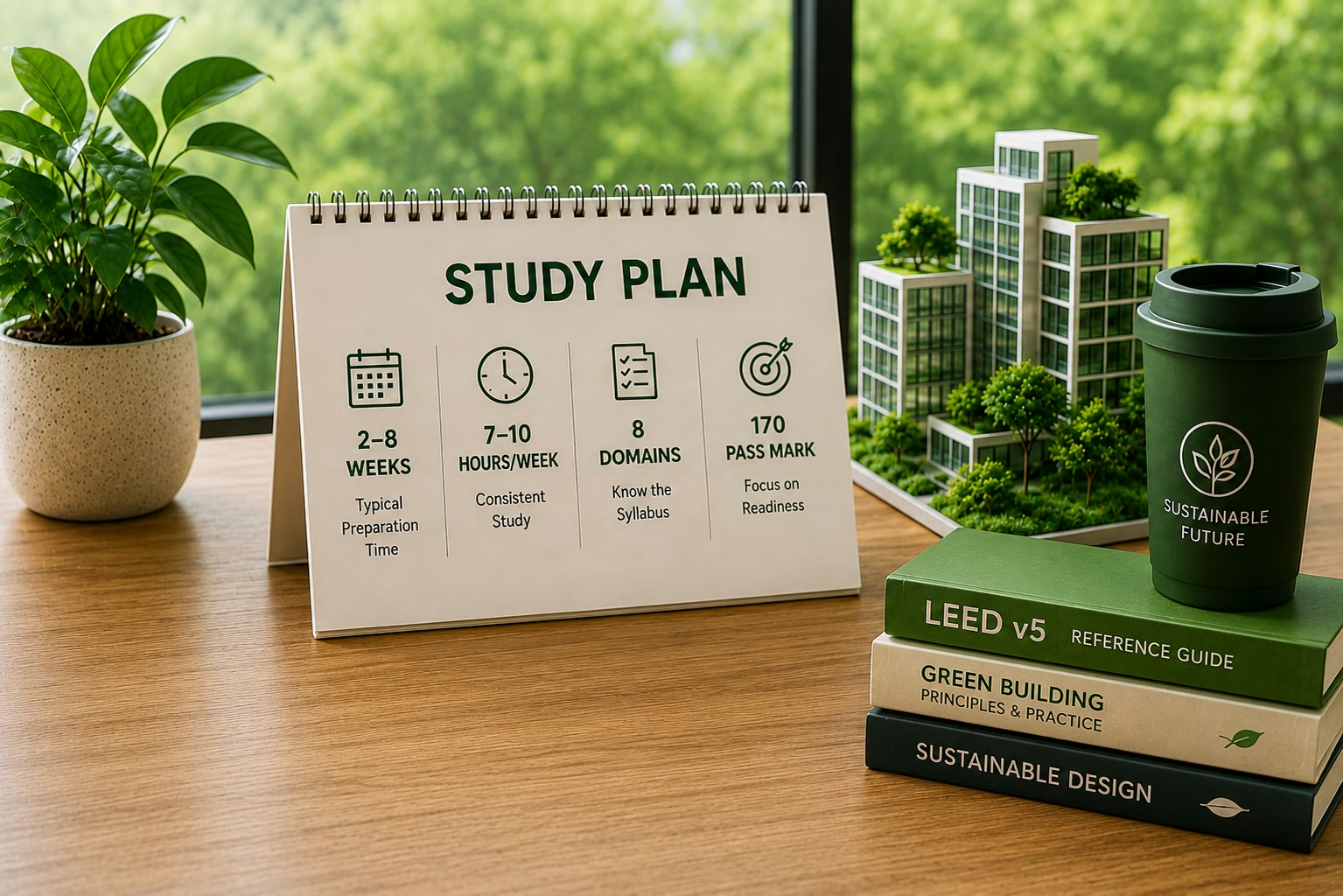
Most candidates need somewhere between two and eight weeks of consistent evening study, and where you fall in that range depends almost entirely on your starting point rather than on any number of hours. USGBC publishes no recommendation at all — so treat every confident figure you find, including ours, as an estimate rather than a target.
Why there is no official answer
USGBC and GBCI publish the syllabus, the domain weightings, the exam format and the passing score. They do not publish a recommended study time, and they do not publish a pass rate. There is no official “40 hours” or “six weeks” to be found, because the honest answer depends on a candidate’s background and nobody can measure that for you.
What follows is our estimate from preparing candidates, offered as a range rather than a promise.
An honest range, by starting point
| Where you are starting | Realistic preparation | What takes the time |
| You work on LEED-registered projects | 2–3 weeks | Converting practical knowledge into exam-precise definitions, and closing the domains your projects never touched |
| Architecture, engineering or construction, no LEED exposure | 3–5 weeks | Rating-system structure and vocabulary. The building concepts are already familiar |
| Sustainability or ESG, outside buildings | 4–6 weeks | The building-specific domains — energy, materials, water, indoor environment |
| A different field entirely | 6–8 weeks | Everything, but at a shallow depth. It is volume rather than difficulty |
| Student with time available | 3–4 weeks | Less competing for your attention, so consistency is easier |
These assume an hour on most weekdays plus a longer weekend session — roughly seven to ten hours a week.
What actually drives the number
Four things move this more than anything else, and three of them are within your control.
Consistency beats total hours
Thirty-five hours spread across four weeks produces better recall than the same thirty-five hours crammed into two weekends. This is not motivational advice; it is how memory works. Spaced repetition moves material into long-term memory; cramming does not.
The practical version: an hour most days beats a heroic Sunday.
Whether your material is current
Studying from material written for LEED v4 does not just waste time — it costs you time twice, because you have to unlearn things. Check before you start that whatever you are using says v5. See LEED GA v5 exam changes.
Whether you test yourself or just read
Reading a guide cover to cover builds recognition — the feeling that a term is familiar. The exam asks for recall under time pressure, which is a different and harder thing. Testing yourself immediately after each section is what builds it, and it is why every session in our study plan ends with questions rather than reading.
Whether you take a course
Structured training compresses the timeline, mainly by removing the two biggest time sinks: working out what matters, and discovering late that your source was wrong. It is not required — plenty of people pass alone — but it changes what the weeks are spent on.
How to spend the time
Whatever your total, the shape should be roughly the same.
| First half | Learn the domains, weighted by how many questions each carries. Test yourself after each one rather than at the end |
| Third quarter | Drill the weak domains the testing exposed. Memorise the vocabulary and the numbers |
| Final quarter | Full-length timed papers, repeatedly, until pace stops being a variable |
The domains are not equal, and your hours should not be either. LEED Process and Energy and Atmosphere are 15 scored questions each; Integrative Process is 6. The four-week study plan allocates the time for you.
Can you do it in a week?
Some people do, and they are almost always candidates who already work on LEED projects and are essentially confirming what they know.
If you are starting from scratch, a week is not enough, and the failure mode is expensive: every attempt costs the full registration fee, so a rushed attempt that fails costs you the fee plus the weeks you would have spent anyway. Preparing properly is the cheaper route, not the slower one.
How to know you are ready
Not by hours logged. By this:
1.You score consistently well on timed papers you have not seen before.
2.You are strong across all eight domains, not six.
3.You can define the confusable pairs without hesitating — native against adapted, embodied against operational, flush against flow.
4.You finish inside the time with some to spare.
5.When all four are true, book. Until then, more time is cheaper than a retake. Start with our free 50-question mock exam.
Frequently asked questions
How many hours should I study for the LEED Green Associate exam?
USGBC publishes no recommendation. In our experience most candidates need between two and eight weeks at roughly seven to ten hours a week, depending on their starting point.
Can I pass the LEED Green Associate exam in a week?
Only if you already work on LEED projects and are confirming knowledge you have. Starting from scratch, a week is not realistic, and a failed attempt costs the full registration fee.
Is it better to study a little every day or in long sessions?
A little most days. Spaced repetition moves material into long-term memory far more effectively than cramming, so an hour on most days beats one long weekend session.
How do I know when I am ready to book?
When you score consistently well on timed papers you have not seen before, across all eight knowledge domains, and finish with time to spare.
Compressing the timeline
Structured training shortens preparation mainly by removing the guesswork about what matters. 3FOLD TRAINING covers all eight domains to LEED v5 in LEED Green Associate training — ask through the course enquiry form. If you would rather do it alone, the four-week study plan is free and lays out the weeks in order.



Leave a reply