
Four weeks, roughly seven to ten hours each, weighted the way the exam is weighted. Three weeks of content, one week of rehearsal. Every session ends with questions rather than reading, because retrieval is what makes knowledge available under time pressure.
Adjust the length to your starting point — see how long it takes — but keep the shape. The shape is what matters.
The principle: weight your weeks like the exam weights its questions
USGBC’s specification spreads 85 scored questions across the eight domains, and they are not equal. Studying them equally is the most common planning mistake.
| Domain | Scored questions | Covered in |
| LEED Process | 15 | Week 1 |
| Energy and Atmosphere | 15 | Week 1 |
| Materials and Resources | 11 | Week 2 |
| Indoor Environmental Quality | 11 | Week 2 |
| Water Efficiency | 10 | Week 2 |
| Location and Transportation | 9 | Week 3 |
| Sustainable Sites | 8 | Week 3 |
| Integrative Process, Planning and Assessments | 6 | Week 3 |
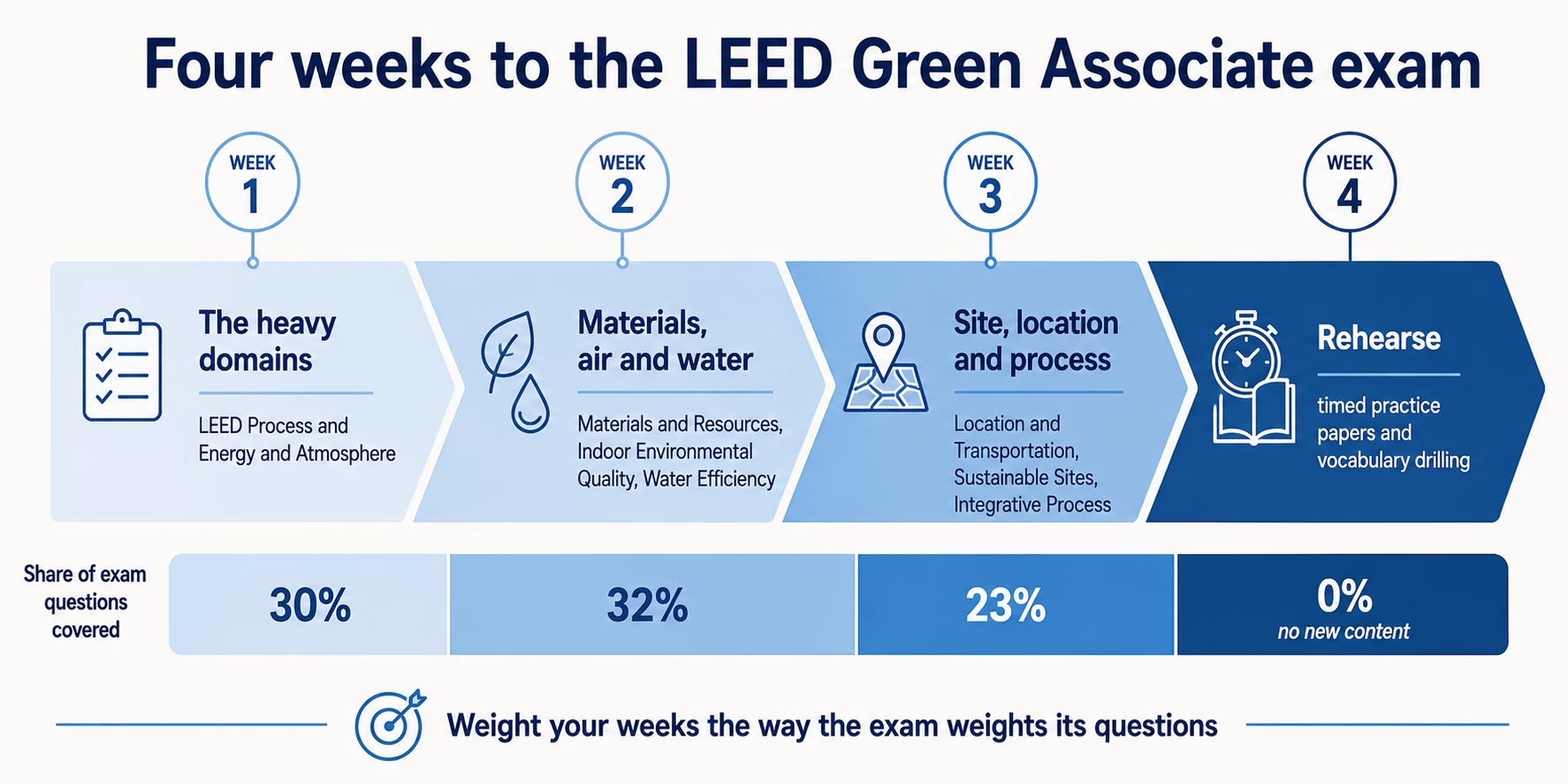
Week 1 covers 30 of the scored questions, week 2 covers 32, week 3 covers 23. Week 4 adds no new content at all — and that is deliberate.
Week 1 — the heavy domains
Covers 30 of the 85 scored questions. Start here while your energy is highest.
| Sessions 1–2 | Read LEED Process. This is the frame everything else hangs on — what LEED is, who does what, how a project certifies, what the levels mean. Finish with the LEED Process practice questions |
| Sessions 3–4 | Read Energy and Atmosphere. The largest technical domain and the one v5 changed most. Finish with the Energy and Atmosphere practice questions |
| Weekend session | Re-test both domains. Anything you got wrong, go back to the teaching page rather than re-reading the explanation |
End of week 1 check: can you explain the difference between certification and accreditation, and between operational and embodied carbon, without looking?
Week 2 — materials, air and water
Covers 32 of the 85 scored questions. The biggest week by content.
| Sessions 1–2 | Materials and Resources, then its practice questions. Embodied carbon, life-cycle assessment, EPDs and HPDs, the waste hierarchy |
| Sessions 3–4 | Indoor Environmental Quality, then its practice questions. Air, light, sound, thermal comfort, inclusive design |
| Session 5 | Water Efficiency, then its practice questions. The smallest reading load of the three and almost pure vocabulary — good value for the time |
| Weekend session | Re-test all three. Start the numbers cheat sheet as daily five-minute drilling from here on |
End of week 2 check: EPD against HPD, graywater against blackwater, flush rate against flow rate, ASHRAE 62.1 against ASHRAE 55. All four, instantly.
Week 3 — site, location and process
Covers 23 of the 85 scored questions. A lighter week by content, which leaves room to repair whatever weeks 1 and 2 exposed.
| Session 1 | Location and Transportation and its practice questions |
| Session 2 | Sustainable Sites and its practice questions |
| Session 3 | Integrative Process and its practice questions. Only 6 questions, but understanding it improves your answers everywhere else |
| Sessions 4–5 | Repair work. Return to your two weakest domains and rebuild them from the teaching pages |
| Weekend session | Your first timed paper: the 50-question mock exam, done strictly against the clock in one hour — half the exam length at exam pace. Expect it to be uncomfortable. That is the point of doing it a week early |
End of week 3 check: you have covered all eight domains and know from a timed paper, not a feeling, which two are weakest.
Week 4 — rehearsal, no new content
The temptation this week is to keep learning. Resist it. Week 4 exists to convert knowledge into performance, and adding new material undermines that.
| Session 1 | Work through ten tricky questions explained. These are the confusable pairs that cost marks |
| Session 2 | Drill the glossary and the cheat sheet. Both directions: term to definition, definition to term |
| Session 3 | Sit a timed paper again — the mock, or the domain sets run back to back against the clock. Compare against week 3 by domain, not by total |
| Session 4 | Whatever the comparison exposed. Nothing else |
| Session 5 | Light revision only. Read the exam day page so the logistics hold no surprises. If you have not sat a Prometric exam before, book their 30-minute Test Drive — a dry run of check-in and test delivery |
| Day before | Do not study. Check your ID matches your registration exactly, confirm the appointment, sleep |
Five rules that make the plan work
1.Every session ends with questions. Reading builds recognition; testing builds recall. Only one of those is available to you at 1 minute 12 seconds per question.
2.Go back to the teaching page, not the answer. Re-reading an explanation teaches you that answer. Rebuilding the concept teaches you the next question too.
3.Five minutes of vocabulary daily, from week 2. It costs almost nothing and it is where a surprising share of the marks sit.
4.Do not book until week 3’s timed paper. Book on evidence, not on optimism.
5.Check everything you study says v5. Material written for LEED v4 will teach you things that are no longer true.
If four weeks is not your shape
| Two weeks | Only if you already work on LEED projects. Compress weeks 1 to 3 into eight sessions and keep week 4 intact. Never cut the rehearsal week |
| Six to eight weeks | Stretch weeks 1 to 3 and add a second repair week before rehearsal. Better for candidates new to the industry, or anyone studying around a full-time job |
| Stop-start schedule | Keep the daily vocabulary drilling going even in weeks you cannot do a full session. It preserves momentum at almost no cost |
Frequently asked questions
Is four weeks enough to prepare for the LEED Green Associate exam?
For most candidates studying seven to ten hours a week, yes. Candidates new to the building industry often need six to eight weeks, and candidates already working on LEED projects may need two to three.
What order should I study the domains in?
Start with LEED Process, because it is the frame everything else fits into, then Energy and Atmosphere. Work down in order of how many questions each domain carries, and leave the smallest until week three.
Should I keep learning new material in the final week?
No. The final week should be timed practice papers, vocabulary drilling and repairing weak domains. Adding new content late undermines the rehearsal the week exists for.
When should I book the exam?
After your first timed paper, once you know from evidence rather than instinct that you are close.
Following the plan with support
This plan is free and works on its own. What structured training adds is someone who has taught the material a thousand times deciding what matters, and a syllabus you can trust is current. 3FOLD TRAINING covers all eight domains to LEED v5 in LEED Green Associate training — ask through the course enquiry form.




Leave a reply