
There is no official answer, because USGBC publishes no study-time figure for any of its exams. What there is instead is a variable that predicts it better than any other: how much LEED project work you have actually done. A candidate who has run a certification and a candidate who has only read about one are preparing for different exams, and no single number covers both.
Why nobody can give you a number
Two reasons, and the second is the more important one.
1.It is not published. USGBC and GBCI publish the exam specification, the format, the scale and the pass mark. They do not publish recommended study hours. Anyone quoting an official figure is quoting something that does not exist.
2.The spread between candidates is genuinely wide. Not because people differ in ability, but because they arrive with different amounts of the thing the exam is testing. The handbook says “practitioner competency and project proficiency is tested objectively within the exam” — so a candidate who has watched a scorecard being assembled is being asked about things they have seen, and one who has not is learning judgement and facts at the same time.
A single number would have to be wrong for most people to be right for anyone.
The variable that decides it
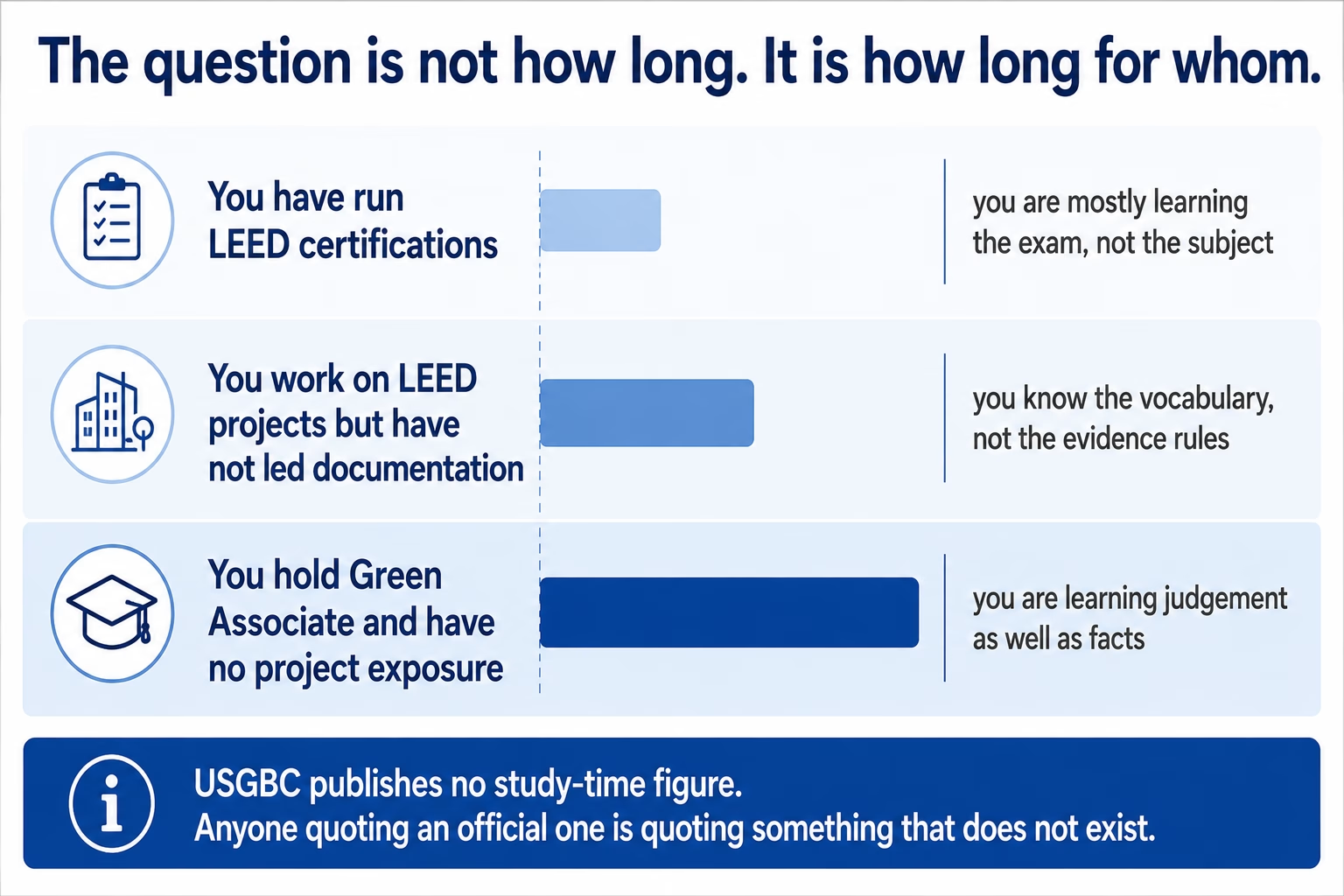
Ask which of these describes you. It will tell you more than any published range.
| Where you are starting from | What you are actually learning |
| You have led LEED certifications | Mostly the exam, not the subject. Where the thresholds sit, what the specification weights, how the questions are phrased |
| You work on LEED projects but have not led the documentation | The evidence rules. You know the vocabulary and the intent; what you have not done is prove a credit |
| You hold Green Associate with no project exposure | Judgement as well as facts. Two of the three cognitive levels the exam uses are not memory, and those are the ones project work would ordinarily teach |
That third row is a real route and people take it successfully. It is also the one that takes longest, and being honest about that at the start is more useful than a reassuring number. How to close the gap deliberately is in passing LEED AP BD+C without LEED project experience.
What we tell our own candidates
Here is our experience rather than a published fact, and it is offered as a working assumption to be adjusted.
For a Green Associate holder with some project exposure, six weeks of consistent evening and weekend study is a realistic target. That is the shape our six-week study plan is built to.
Adjust it up if you have no project exposure, if your Green Associate was several years ago, or if you are studying against a busy delivery period. Adjust it down if you run certifications for a living and are mainly learning the paper.
What matters much more than the total is the distribution. In our experience six weeks of consistent short sessions beats the same total time compressed into the fortnight before the exam, because two of the three cognitive levels are built by working through problems repeatedly rather than by reading intensively once.
Where the time should go
This part is not a matter of opinion. The exam specification allocates 85 scored questions across eight domains, and time should follow it:
| Domain | Scored questions | Share of your time |
| Energy and Atmosphere | 18 | About a fifth |
| Materials and Resources | 13 | About a seventh |
| Indoor Environmental Quality | 13 | About a seventh |
| Sustainable Sites | 9 | About a tenth |
| Water Efficiency | 9 | About a tenth |
| Integrative Process | 8 | Just under a tenth |
| Location and Transportation | 8 | Just under a tenth |
| LEED Process | 7 | About a twelfth |
The top three carry 44 of the 85 between them, so time spent there is worth roughly twice time spent on the bottom three. The breakdown by domain is in LEED AP BD+C credit categories.
Do not allocate by rating-system points. Integrative Process is 8 scored questions and one point for a New Construction project; Location and Transportation is 8 questions and 15 points. Study by points and you will get both badly wrong.
Those point values are as taught in our LEED AP BD+C v5 course material; confirm against the LEED v5 BD+C Rating System before relying on them for a live project. The scored-question counts are from the published exam specification.
Three things that waste the time you do spend
Re-reading what you already know. A reliable way to feel prepared without becoming prepared. If a domain is comfortable, test it and move on.
Studying the wrong version. BD+C is transitioning to LEED v5, and material written for an earlier version will teach you things confidently and wrongly. Confirm which version applies to your appointment before you buy anything — LEED AP BD+C v5 exam changes.
Preparing only for Recall. Flashcards address one of the three cognitive levels. They are useful and they are not sufficient. See how hard is the LEED AP BD+C exam.
Working backwards from a date
If you already have an appointment, plan backwards rather than forwards.
1.Reserve the last week for a timed mock and the review that follows it. Not for new material.
2.Reserve the week before that for the domains your practice scores say are weakest.
3.Divide what remains by domain weight, biggest first.
4.Put Energy and Atmosphere early enough to come back to it. It is the largest domain, and in our experience the one that most often needs a second pass.
And one practical constraint worth knowing before you book: rescheduling closes at midnight on the third day before the appointment, so choose a date you are confident about. See how to register for the LEED AP BD+C exam.
Frequently asked questions
How long does it take to study for the LEED AP BD+C exam?
There is no published figure. USGBC does not publish recommended study hours for any of its exams, so anyone quoting an official number is quoting something that does not exist. In our experience, six weeks of consistent evening and weekend study is a realistic target for a Green Associate holder with some project exposure, and longer without it.
Why is there no official study time for the LEED AP exam?
Because USGBC publishes the specification, format, scale and pass mark but not study hours, and because the spread between candidates is genuinely wide. The handbook says practitioner competency and project proficiency is tested objectively, so a candidate who has run a certification is being asked about things they have watched happen.
How much longer does it take without project experience?
Longer, and we do not publish a multiplier because we have no data that would support one. The difference is that two of the exam’s three cognitive levels, Application and Analysis, are not memory, and project work is what ordinarily teaches them.
Is it better to study intensively or spread out?
Spread out, in our experience. Consistent short sessions across several weeks beat the same total hours compressed into a fortnight, because Application and Analysis questions are answered better after working through problems repeatedly than after reading intensively once.
How should I divide my study time between domains?
By the exam specification. Energy and Atmosphere is 18 of the 85 scored questions, Materials and Resources and Indoor Environmental Quality 13 each, Sustainable Sites and Water Efficiency 9 each, Integrative Process and Location and Transportation 8 each, and LEED Process 7. The top three carry 44 of the 85 between them.
Should I allocate study time by the rating system points?
No. Integrative Process is 8 scored questions and one point for a New Construction project, while Location and Transportation is 8 questions and 15 points. Allocating by points gets both badly wrong.
What wastes study time for this exam?
Re-reading material you already know, studying from resources written for an earlier LEED version, and preparing only for recall. Flashcards address one of the three cognitive levels and are not sufficient on their own.
Planning against a date
3FOLD TRAINING has prepared professionals for certification exams since 2008, across more than 100 countries. If you have an appointment booked and want a second opinion on whether the time you have is enough, ask through the course enquiry form — we will tell you straight. Our LEED AP BD+C training is one route and no course is required to sit or pass the exam, ours included.




Leave a reply