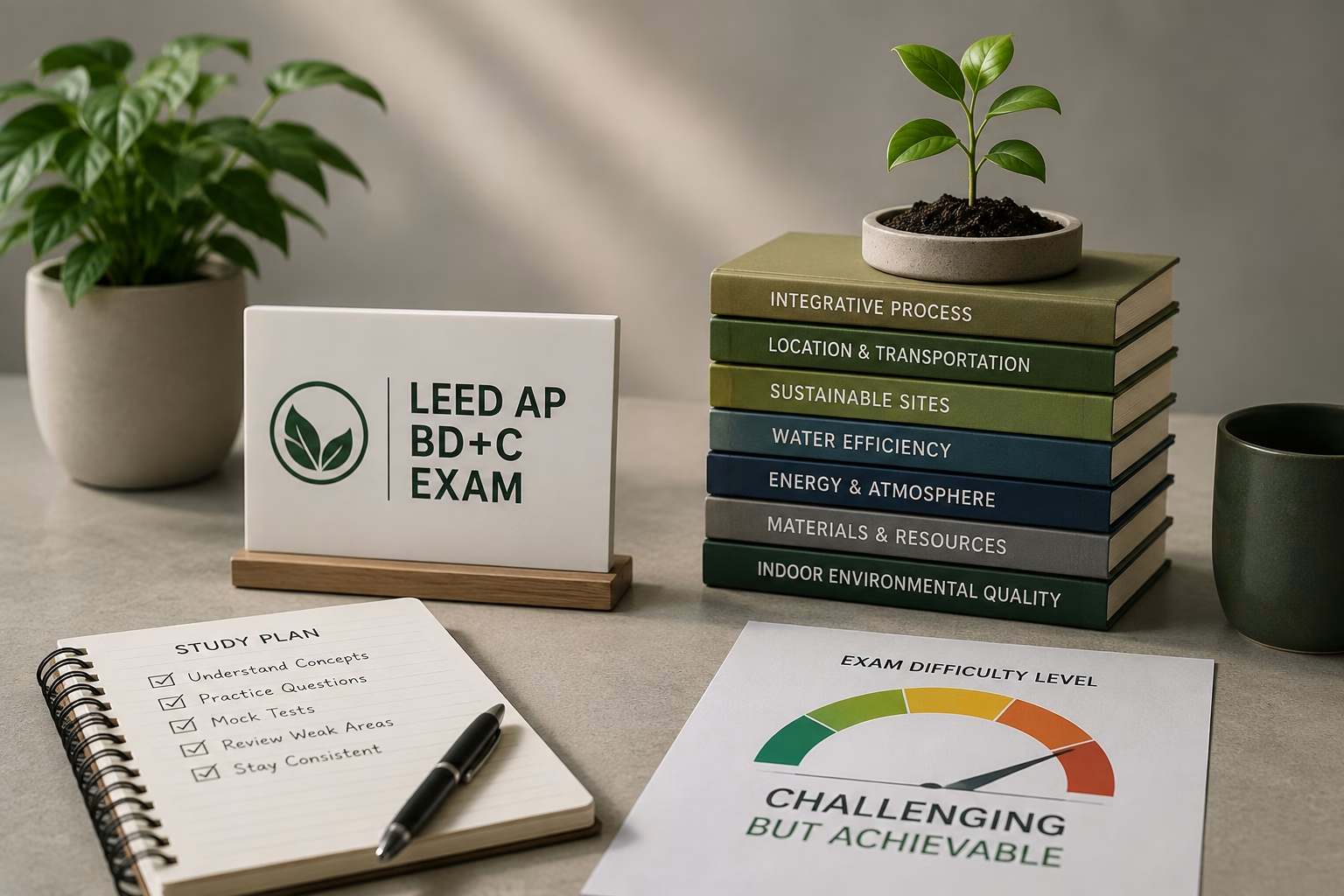
Harder than LEED Green Associate, and harder in a specific way rather than simply bigger. The AP exam covers the same nine knowledge domains and the same 100 questions in two hours. What changes is that it is written at three cognitive levels — Recall, Application and Analysis — and only the first of those is fixed by more revision. Nobody publishes a pass rate for it, and we are not going to invent one.
First, what nobody can tell you
USGBC does not publish pass rates for any of its exams. So any figure you find attached to this question was produced by whoever published it, not by the organisation that runs the exam.
That is worth knowing on its own, but there is something more useful: there are four things nobody publishes, and knowing the list lets you spot an invented figure on sight.
| Not published | What that means |
| The split across the three cognitive levels | The levels are defined. No count or percentage is given for any of them |
| Which questions are unscored | The specification allocates 85 scored questions across the eight domains, so 15 of the 100 are unscored trial items. They are never labelled and you are never told which is which |
| Sample BD+C questions | The handbook prints samples only for older exams, and notes those items were discarded during development |
| A pass rate | None, for any GBCI exam |
Be careful with any study source that quotes a cognitive-level percentage, or claims to know which items on your paper are unscored. Neither is published, so a page giving you one is telling you about itself rather than about the exam. The number of unscored items is simple arithmetic — 100 questions, 85 scored, so 15 are trial items — but nobody is told which fifteen, and you answer all 100 the same way.
(The scaled score range is published — 125 to 200, with 170 to pass — on USGBC’s support site at support.usgbc.org, though not in the candidate handbook. See the LEED AP BD+C passing score.)
Three cognitive levels
This is the real answer to “how hard is it”, and it is more useful than an adjective.
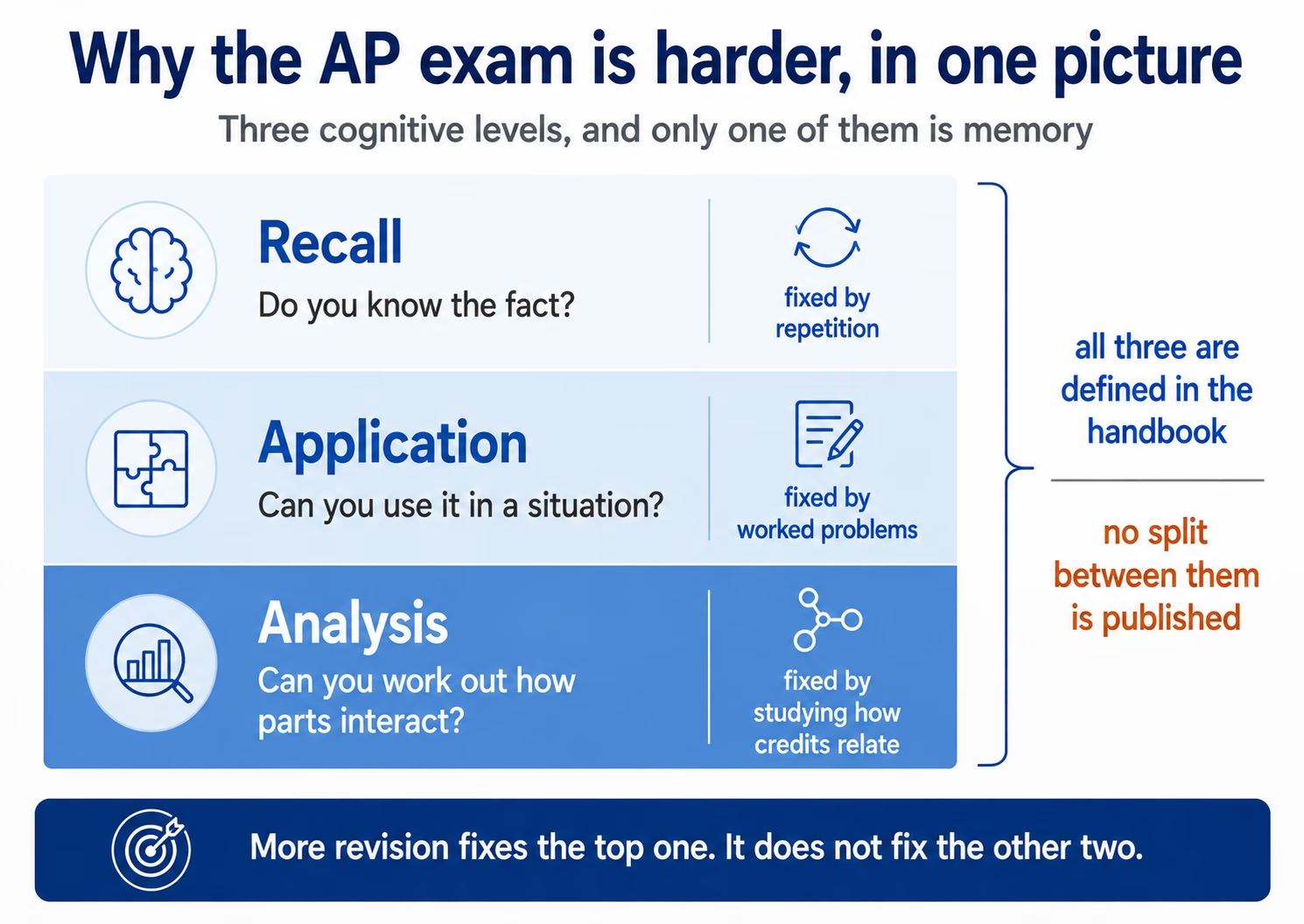
The handbook defines three levels at which questions are written:
| Recall | Do you know the fact? | Fixed by repetition |
| Application | Can you use it in a situation? | Fixed by worked problems |
| Analysis | Can you work out how parts interact? | Fixed by studying how credits relate to each other |
Only the first is a memory problem. A candidate who prepares by memorising thresholds is preparing thoroughly for one of the three levels and not at all for the other two — which is why “I knew the material and still failed” is a coherent thing to say about this exam and not about a purely factual one.
No split between the three is published, so nobody can tell you how many questions sit at each level. What you can do is prepare for all three, which is a different activity from preparing harder for one.
Harder than Green Associate, and where
The two exams share their format exactly: 100 questions, two hours, one correct answer each, 85 scored, scaled 125 to 200 with 170 to pass. Nothing about the shape of the paper gets harder.
Three things do change.
- The weighting moves. Energy and Atmosphere rises from 15 scored questions to 18 and becomes the outright largest domain — on Green Associate it was tied with LEED Process at 15. LEED Process falls from 15 to 7. The technical delivery domains — energy, materials, indoor environment — carry 44 of the 85 between them. Full comparison in from LEED GA to LEED AP.
- The questions move up the cognitive levels. Green Associate leans on knowing what things are. AP asks what you would do, and what happens to one credit when another changes.
- Practitioner experience is assumed. The handbook says prior LEED project experience is “strongly recommended” and that “practitioner competency and project proficiency is tested objectively within the exam”. It is not required — see the experience question — but the questions are written as though you have some.
What makes it hard
Not the volume. Four things, in roughly this order.
Credit interactions. The AP exam is full of situations where one decision changes what another credit can pay. The compliance path chosen for a prerequisite capping what its credit can earn is the clearest example. These are Analysis-level questions and they cannot be revised for by list.
Options that cap. Several v5 credits offer routes that add up to more than the credit pays. Knowing the routes is Recall; knowing that the ceiling still applies is not.
Conjunctive requirements. A great many requirements are joined by and rather than or, and satisfying one limb is not satisfying the requirement.
The Core and Shell column. Several credits pay differently for Core and Shell, and two categories are worth more for it. A scenario that names Core and Shell has changed the arithmetic.
What makes it easier than it looks
Three things in the other direction, and they are worth knowing before you decide this is beyond you.
The syllabus is the same eight domains you already met. There is no new subject at AP level, only greater depth in some of them.
The smallest domain is the most fixable one we see. LEED Process is 7 scored questions on boundaries, occupancy, rating system selection and certification levels — bounded, factual, and largely Recall. Protect the big three, and do not leave the small ones half-learned — they are quick to bring up to full marks, and just as quick to lose.
You can navigate freely. The exam lets you change answers, skip questions and flag questions for later review. All three are useful, and a candidate who works straight through without using them is making the paper harder than it is.
The honest summary
It is a demanding professional exam that rewards understanding over memory, and it is passed regularly by people who prepare for the right thing.
In our experience the candidates who find it hardest are rarely short of knowledge. They prepared by memorising, met Application and Analysis questions, and answered a question about a project decision with a definition. That is a preparation problem rather than an aptitude one, and it is fixable — which is what the six-week study plan is built around.
How long it takes is in how long to study for the LEED AP BD+C exam, and what to study from is in LEED AP BD+C study materials.
Frequently asked questions
How hard is the LEED AP BD+C exam?
It is harder than LEED Green Associate in a specific way rather than simply bigger. The format is identical, but the questions are written at three cognitive levels, Recall, Application and Analysis, and only the first is fixed by more revision.
What is the pass rate for the LEED AP BD+C exam?
USGBC does not publish pass rates for any of its exams, so no official figure exists. Any number attached to this question was produced by whoever published it.
What are the three cognitive levels on the LEED AP exam?
Recall, which asks whether you know a fact; Application, which asks whether you can use it in a situation; and Analysis, which asks whether you can work out how parts interact. All three are defined in the candidate handbook, and no split between them is published.
Is LEED AP BD+C harder than LEED Green Associate?
Yes, though not because the paper is bigger: both are 100 questions in two hours with 85 scored. What changes is that the weighting moves toward the technical delivery domains, the questions move up the cognitive levels, and practitioner experience is assumed even though it is not required.
Why do people fail the LEED AP exam when they know the material?
Because knowing the material addresses Recall, and the exam also asks Application and Analysis questions about project decisions and credit interactions. A definition-shaped answer to a decision-shaped question is how a well-read candidate loses marks.
Can I skip questions or change answers in the LEED AP exam?
Yes. The delivery software allows you to change answers, skip questions and flag questions for later review. There is also an optional ten-minute tutorial before the exam, which sits outside the two hours, and it is the place to confirm how all of that works.
Which is the easiest LEED AP BD+C domain?
LEED Process is the smallest at 7 of the 85 scored questions, and it is bounded and largely factual: boundaries, occupancy, rating system selection and certification levels. In our experience it is the quickest domain to bring up to full marks.
Are there official sample questions for the LEED AP BD+C exam?
The handbook prints samples only for older exams and notes that those items were discarded during development, so there are no official sample questions for this exam. Be cautious with any source quoting a cognitive-level percentage or claiming to know which items are unscored, since neither is published.
Preparing for all three levels
3FOLD TRAINING has prepared professionals for certification exams since 2008, across more than 100 countries. Our LEED AP BD+C training works through credit interactions and project decisions, which is the part revision alone does not reach. No course is required to sit or pass the exam, ours included. Ask through the course enquiry form.


Leave a reply