

LEED AP Jobs: Which Roles Require the Credential
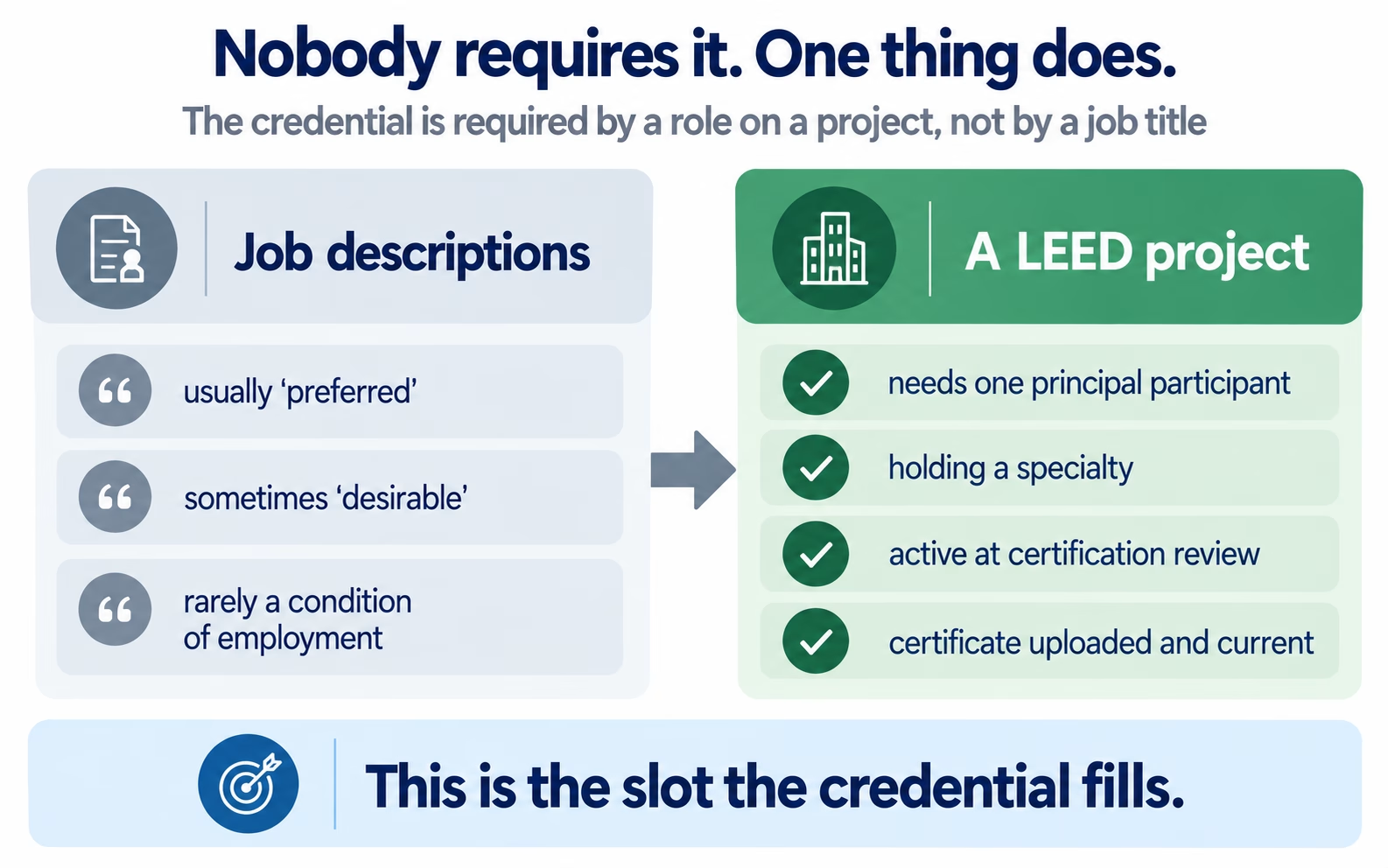
LEED AP is rarely a condition of employment. In many vacancies it appears as “preferred” or “desirable”. But LEED v5 BD+C creates one specific, practical reason for a project team to need an appropriately credentialed LEED AP.
But one requirement is genuinely tied to the credential, and it is not an employer: under the LEED v5 BD+C LEED AP credit, a project can earn one point when at least one principal participant of the project team is a LEED AP with a specialty appropriate for the project.
That is the slot this credential fills, and it explains the hiring behaviour better than any vacancy list.
Important: We are not a job board. This page is about what the credential opens, not about where to apply.
The one thing that genuinely requires it
LEED v5 BD+C awards a project a point where at least one principal participant of the project team is a LEED AP with a specialty appropriate for the project. For New Construction and Core and Shell, the appropriate specialty is LEED AP BD+C.
One project point creates a specific team requirement
The value is not that every employee needs LEED AP BD+C. The value is that a project pursuing the point needs an appropriately credentialed principal participant.
Four conditions come with it, and each one has a hiring consequence:
| Condition | Why a firm cares |
|---|---|
| A principal participant, not an occasional reviewer | The person has to be genuinely on the team. A firm cannot borrow a name. |
| A specialty. LEED APs without one do not qualify, and nor does Green Associate | The pool of people who can fill the slot is smaller than the pool of people with LEED credentials. |
| A qualifying LEED AP | The project must have at least one principal participant who is a LEED AP with a specialty appropriate for the project. |
| LEED AP credential information entered in LEED Online | The LEED AP certificate is uploaded to the Credentials section in LEED Online so the system can identify the credential. |
Project-use note: The point value and the credit's requirements are as taught in our LEED AP BD+C v5 course material and reflect LEED v5 BD+C. Confirm against the LEED v5 BD+C Rating System before relying on them for a live project.
That is the demand. For a project pursuing the LEED AP point, the project team needs at least one principal participant who is a LEED AP with a specialty appropriate for the project. It is a modest, specific, real reason to hire or promote someone who holds it.
Where the credential actually shows up
Described by role type rather than by employer, because role types are stable and employers are not.
| Role type | How the credential is usually treated |
|---|---|
| Sustainability consultant / LEED consultant | On projects pursuing the LEED AP point, a sustainability consultant may be able to serve as the qualifying principal participant if they are part of the project team and hold the appropriate LEED AP specialty. |
| Project architect and design manager on certifying projects | A project architect or design manager may serve as the principal participant when they are part of the project team and hold the appropriate LEED AP specialty. |
| MEP and energy engineers | Listed as “preferred” where it appears at all. MEP and energy engineers may encounter the credential as a preferred qualification, particularly when their work involves LEED project coordination or analyses required for LEED credits. |
| Contractor and developer sustainability roles | Varies widely. Where the client's brief specifies LEED, the credential becomes a bid asset rather than a job requirement. |
| Facility and operations roles | Demand exists, and often for a different specialty. If you run existing buildings, read LEED AP for facility and sustainability managers before choosing BD+C. |
What the credential does to a CV
It works as a filter, not as a differentiator. Two effects, both worth understanding:
Where a role mentions LEED at all, not holding the credential is an easy reason to be filtered out early. Holding it is not, on its own, a reason to be chosen.
The more specific effect, and the one people miss. When a firm assembles a team for a LEED bid, it has to be able to name who the AP is. Being that person is a different proposition from being generally qualified.
The display rules, which are easy to get wrong
Worth reading carefully. They are visible on every profile, and in our experience they are the thing candidates most often have to be corrected on after passing.
| Rule | Detail |
|---|---|
| Write the credential, not a description of it | On written confirmation you may use LEED AP BD+C after your name. Never “LEED Accredited Professional”. |
| Never “LEED Certified” | Certification applies to buildings and projects. A person is never LEED Certified. |
| Green Associate is superseded | When you earn a specialty credential, your Green Associate credential expires and is replaced. Stop using it and take it off the CV — listing both signals that you have not read the rules. |
| Your certificate is a PDF | Your certificate is available as a PDF from the Credentials Dashboard, and you can print a copy if you want a hard copy. |
| The certificate has a job to do | For LEED Online, the LEED AP uploads a copy of the certificate to the Credentials section so the system can identify the credential for the project. It sits on your profile, so keeping it current falls to you in practice. |
Keeping it current is part of the value you provide.
If you are looking for the job rather than the credential
Three things that help more than the credential does on its own:
Be able to name projects you worked on and what you did on them. The credential says you know the system; the projects say you have used it.
Learn one thing properly. Energy modelling, life cycle assessment or commissioning are paid differently from documentation coordination, and they are learnable independently of the exam.
Understand the point you represent. Being able to explain the credit's four conditions in an interview demonstrates something a credential alone does not.
And the honest caveat
The credential opens doors in green building. It does not create a market where there is not one. If LEED is rare in your city and your sector, the credential will do less for you than a locally recognised route would — that is a real answer and it is more use than an encouraging one. Where LEED is common, the point makes the case for itself.
Whether that adds up for you specifically is the subject of is LEED AP BD+C worth it , and the pay question is in what the salary numbers really mean .
Frequently Asked Questions
What jobs require LEED AP?
For a LEED v5 BD+C project pursuing the LEED AP point, at least one principal participant of the project team must be a LEED AP with a specialty appropriate for the project.
Is LEED AP required to work on a LEED project?
Not for every member of the team, but a project claiming the LEED AP point needs at least one principal participant with a specialty appropriate to the project, which for New Construction and Core and Shell is LEED AP BD+C. These requirements are as taught in our own v5 course material; confirm against the LEED v5 BD+C Rating System before relying on them for a live project.
Does LEED AP help you get hired?
It tends to work as a filter rather than a differentiator. Where a role mentions LEED, not holding the credential is an easy reason to be filtered out early, and holding it is not on its own a reason to be chosen. The more specific effect is that it makes you nameable: when a firm assembles a team for a LEED bid, it has to be able to say who the accredited professional is.
How should I write LEED AP on my CV or LinkedIn?
On written confirmation you may use LEED AP BD+C after your name. Never write LEED Accredited Professional, and never LEED Certified, which applies to buildings and projects rather than to people. Your certificate can be downloaded as a PDF from the Credential Dashboard and printed if you want a hard copy.
Should I list both LEED Green Associate and LEED AP?
No. The specialty credential supersedes LEED Green Associate: your Green Associate credential expires and is replaced when you earn a specialty. Listing both suggests you have not read the rules. LEED AP BD+C is what goes on the CV and Green Associate comes off.
Why does my GBCI profile matter to my employer?
Because the LEED AP credential must be correctly documented for the project. In LEED Online, a LEED AP uploads a copy of the credential certificate to the Credentials section so the system can identify the person as a LEED AP for the project. This information only needs to be added once, not for every project.
Which kinds of role hold LEED AP BD+C?
In our experience: sustainability and LEED consultants, project architects and design managers on certifying projects, and MEP and energy engineers. Contractor and developer sustainability roles vary by market. Facility and operations professionals also hold LEED credentials, but often a different specialty, so check which specialty fits your work before registering.
Is LEED AP worth it if there is little LEED work where I am?
Probably not on its own. The credential opens doors in green building but it does not create a market where there is not one, and where LEED is rare a locally recognised route may do more for you. Where LEED is common, the fact that a project can claim a point for having you on it makes a concrete case.
If you want a straight answer about your own role
3FOLD TRAINING has prepared professionals for certification exams since 2008, across more than 100 countries. Describe what you do and where you work through the course enquiry form and we will tell you whether the credential is likely to do anything for you — including when it is not, and when a different specialty fits better.
Our LEED AP BD+C training is one route, and no course is required to sit or pass the exam, ours included.
Does LEED AP BD+C fit your role?
Tell us what you do and where you work. We will help you understand whether BD+C — or another LEED specialty — fits your career direction.



Leave a reply